JP On Gaming

Showing posts with label GMing. Show all posts

Saturday, March 25, 2023

[Old Pro Tricks] NPC-on-NPC Dialogue

I responded to a post on Murfreesboro D&D Facebook Group earlier when another member, Stephanie-M said that she tried GMing and it wasn't for her.

What prompted this post was her comment about NPCs talking between them and have extended conversations...

So my first (and quick) response was: "Don't have complete conversations between NPCs." There is no point in having any of the details of such conversation. Yes, it showcases how you can have a chat with yourself but it rarely brings much to the story as players' eyes glaze over. Then they ask you "so what did he say that was important."

I've been guilty of this. A lot. I don't ever recall doing this for the purpose of showing off my prose skills (I still think they suck), no. Thinking back on some such discussions, I usually wanted the PCs to understand some element of the NPC's personality or motivations.

But all I succeeded was to glaze eyes over.

And burn through GM voices during weekends.

So how can a GM accomplish this without boring everyone else? Here are a few tricks and ideas I've used I believe make the encounters more dynamic.

First off, a few predicates.

- The players are the main characters of the campaign. They are to be involved in the most significant parts of the action. The focus is on them.

- Not every word spoken by the NPC deserved to be immortalized on stone tablets. Do not be attached to EVERYTHING they say. A few sentences at most...

- The intent is usually sufficient.

- Know what the scene should convey. What do you want the players to learn?

How to do it?

Instead of talking about a hypothetical, let's say you want the PCs to learn that the king's advisor is really a crooked guy. The players returned from their quest and are telling the king about the dragon they killed.

- Describe the situation, the king sits on his throne as the players describe what they saw. Every revelation, they give, the advisor whispers into the king's ear.

- PCs wanting to listen in may make checks to overhear words like "tavern," "mercenaries," or "exaggeration."

- They may try to read the King and discover that the longer the story goes, the less does he pay attention.

- The advisor only interacts with the players to highlight the most comical or fantastic part of the story.

- So there is no need for the advisor and the king to have a prolongued exchange.

- If the PCs are not there, have someone TELL them what the NPCs said and interact with THEM about the conversation.

So...

The best trick I can give you is: Try it.

Try it. Fail. Try again. Fail better.

Wednesday, January 4, 2023

GM Gifts 2023

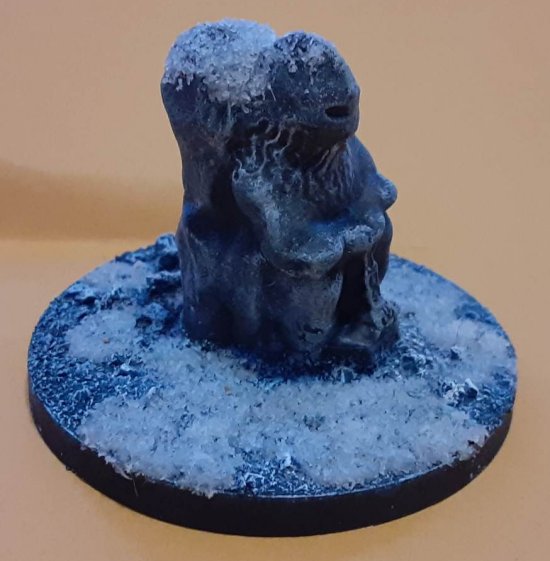
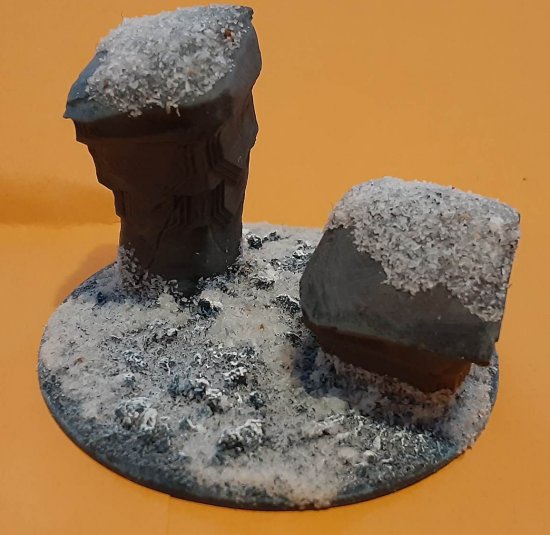
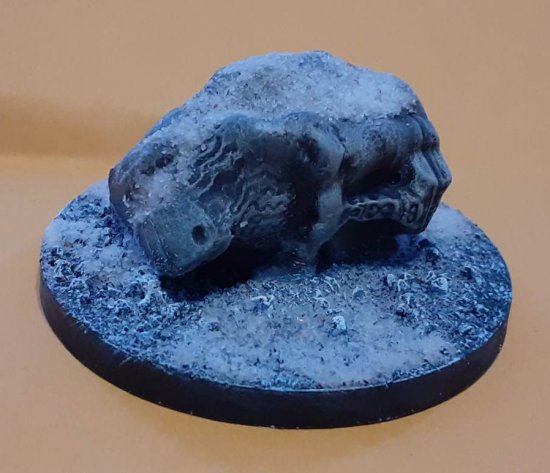
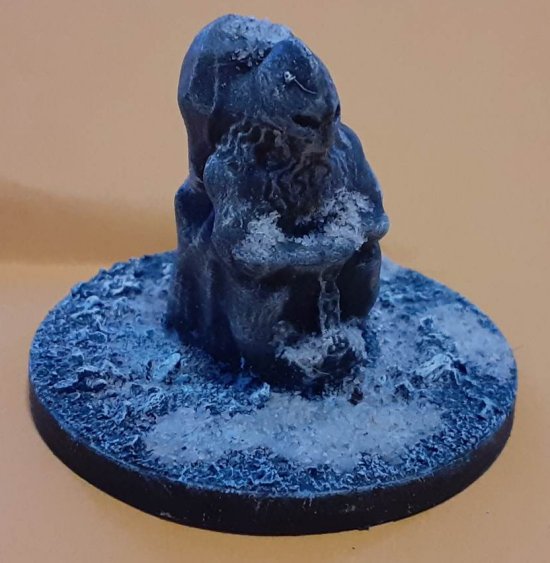
So... with my 3d printer, I printed a lot of things. Some of them are random pieces of terrain. I practiced with some terrain elements.

You will ask me But JP... Why do you call this a GM gift? The idea is simple. If you take one of the GM gifts, you must use it at some point during the year in a game/ encounter AND tell me how you used it.

I think I may keep a few of these and hand them out throughout the year. Get a stream of surprises as I try to make this challenge ever more complicated... This one should be the easiest of them all.

Thursday, July 21, 2022

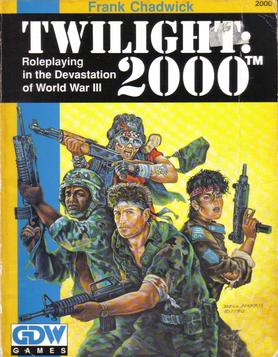
[Campaign Fails] One fist killed Twilight: 2000

A big thanks to Ryan-A for bringing this back to my memory. It has been a while since I thought about that game or that story.

It was the 1980s, I must've been around 14 or 15 years old when someone brought the original Twilight: 2000 RPG by GDW to school. It was an odd game.

For those who do not know, it is 2000AD, and the East-West war shook Europe (and the rest of the world, but we played in Poland). Tactical nukes where sent by both sides. The bombs leveled a lot of cities and turned others into radioactive wastelands. The old orders and regimes collapsed, and a new post-apoc order rose. Mercenaries from a collection of countries banded together to prey upon the land and well... do what mercs do.

My buddies Marc-P and Patrick-D were very much gung-ho players who really appreciated using heavy weapons on things, firing m-60s and grenades at anything that moved.

Useful.

However, that was around the time when I began to think there was more to RPGs than shooting stuff and killing monsters. That story mattered and that we could do cool stuff. My friends weren't "quite there yet," and I could not quite explain how and what I wanted to do with the game - not that I think they would've been on board.

So the party had 4 people: Marc was an American heavy weapon specialist, Patrick had a French Canadian demolition expert, there was another guy (I can't remember who) but he has a Canadian rifleman. And I was a Russian Medic/ Intelligence officer (I took it because we needed a lot of languages).

The Plot

So I can't remember who the GM was, I thought it was Philippe-B. Our mission was simple: We were holed up in Poland without gas or money for our vehicles. Then this warlord came to us with an offer. He wanted us to extract this guy in that village. The NPC had information he wanted. We would get a premium if we could get that information.

We manage to scope out the town, get some great intel, and discover that something isn't quite right. The bad guys were not acting as expected: they had all shiny new American gear, spoke English, and had like a bunch of missiles and stuff. I told the guy about it, but all they were excited about was the new Rolls Royce car and the large gas tank.

I could see them salivating as they imagined the explosion they could do. I think I was also excited about it, as a great way to cover us as we fled...

Well I don't really remember the details of the operation but things turned south:
We got the target out (he did not want to come with us).
The guys opened up on the gas tank early
There was another firefight at the entrance as we stole the car.

The Game (and I) Die

In the end, we were in the car flying over bad Eastern Europe road in a car riddled with bullet holes. The target was bleeding. I was screaming for the driver to slow down so I could save him but they didn't care. Bringing the target would get us paid. I wanted to know about that strange outfit.

I pulled my pistol at the driver and ordered him to slow down.

Then Marc who was riding shotgun declares he will punch me in the face.

Okay that's fair. We roll dice. He hits.

His base damage double the amount of hit point I had on my head.

So my head exploded.

Followed massive arguments (mostly on my part) about how that made no sense. In the end, I was dead.

That was the last time I played TW2000. Yeah, I took my ball and went home. I was pretty unhappy.

Fallout

The game ended then and there. It started something of a feud between the guys and I, which we resolved only much later.

To make things worse, I spoke with the GM later and he was super happy that someone "got" the many hints he had in there about something more happening. He was excited for us to do more than blow things up randomly. He never told me what he wanted to do or what his plan was.

It is something that haunts me to this day... Decades later.

It may be just as well because I can dream of what could've been. From that day, I planned to reveal only what is happening when players discover it. Everything else is...

Well it didn't happen, just as I said in the previous post: What Would've Happen To [NPC]? from mid-May 2022.

Wednesday, May 18, 2022

[Old Pro Tips] Creating Effective Scenes

:I've been writing a LOT these days. And I mean A LOT for Gencon (see the blurbs for everything in this post). I have been thinking of other GMs who ran games that really hit home. I focused on scene-setting. What worked best? What didn't work?

What didn't work

Among a number of elements, one that doesn't work involves over-described room. Rooms with so many elements that get lost with the number of things present. Here are two examples that jumped to my mind (one was Pathfinder Society and the other from a GM I don't want to name here).

- An inn where you know the size, composition, type of the cups of beer, add the number, size, color, and history of the boar heads trophies on the walls, the exact position of the tables, the graffiti on them... Then the scene focuses on talking to the strange guy in the corner.

- A forest where you are told the type of trees in great details, the size of the fallen trunks and branches, the color of the leaves (it was set during summer), and the sound of the birds singing and squawking nearby. And then, what we had to do was sneak through the forest.

Tere

What does work

Reversing the scene, I kept thinking back to Mario (who ran WHFRP in 2009-10) and the other is from a more recent GM. These scenes were notable by focusing on the essential and unique elements of each location. The simplicity of their dressing made it so they allowed for us players to come up with solutions. Then if we, the players, wanted to do something with the environment, we can ask and go from there. Need vines? Now they are there! Need Spanish Moss? Sure! What about a very knobby tree? Oh yeah!

- A bandit camp centered around a fire pit with a series of tents in a rough circle around it.

- A thick jungle where a creek flows into a pond covered with waterlillies.

What I really like is that each of us were able to use the basic description and add elements to it based on our common imagination, with each player adding something. By the time we attacked the bandits in the camp, there were deer skins getting tanned for cover, buckets of water (and chamber pots), the two sentries huddled around the fire, and a pair of horses were tied nearby. I really love that scene because each of us, player and GM, built into something concrete we used in our plan.

We didn't care the bandit's spears were made of maple, oak, or pine wood. So it was never defined.

Finally

Everyone can picture a tundra. A sandy desert. A pinewood forest. A pool beneath a waterfall. A fortified city gate. See what I did there? You pictured each of those scenes and I use no more than 5 words to describe each of them.

KISS. Keep It Simple Stupid. Focus on elements that matter to the players or major elements. Unless you plan to have a confrontation or a trap-like with a scaffold, don't mention it unless/until it becomes relevant to the players. Work with them.

Yeah. KISS. And grow the story and scene together.

Monday, October 12, 2020

Adventure Creation 101 Friday Oct 16th

This Friday evening, I will be running a short seminar with the kids of my Friday group. However, if a few starter GMs want to join, I would be fine with a few join in.

The event will run from 18:30-21h CDT on Friday night using Skype.

We will go over the basics of writing/ preparing your own adventures. From the original idea to the production. We will cover encounter creation, overall adventure creation, polishing, and running.

The theme will be Halloween monsters. I asked everyone to think of a monster typically associated with Halloween. This can be skeletons, ghouls, vampires, witches, whatever, anything you want.

Next preparatory step: think of a short way to use the monster in an adventure in a few sentences.

The vampire lives in a dark castle and feeds on maiden from the village

Bring a few pieces of scrap paper, a pen/pencil/sharpie and your ideas.

If you are interested, contact me directly through email, Facebook, one of the many ways in the internet.

Sunday, October 4, 2020

"Stealth Missions" are not all about Stealth!

I was lurking on Reddit about how to run "Stealth" adventure. He was thinking ofrunning a game in the style of Assassin's Creed: mostly moving around, avoiding detection, and fighting the least amount possible.

I thought this was worth cross-posting here. This is the answer I wrote:


The thing about "stealth missions" and how to run them successfully and in an interesting way, is to NOT be "just about Stealth". True, the goal is to not be detected but unlike in computer games where you just have to move from mob to mob and hide, TTRPG require "more".

This include:

- Using Deception to disguise yourself as guards or servants
- Find out what a password is
- Prevent the enemy from raising the alarm
- Climb around obstacles/well-guarded areas
- Parcour

Notice that I avoided to give specific checks because the players may have a variety of spells/ feats/ abilities to mitigate the challenge. Spells like alter self, disguise self, invisibility, spider climb, or even sleep may be used. And those are just BEFORE the action.

There is something to be said for Before the action: obtain duplicate of keys, passwords, outfits, and plans.

Tuesday, November 5, 2019

[Old Pro Tip] Setting up a gaming group

I have been reading across the internet "I'm a GM and I can't get a campaign going."

I was lucky to be able to travel and form RPG groups in no less than four countries (Canada, France, Ireland, and the USA). When I reached all countries but my native Canada, I was able to get a gaming group going within a month. Here are some of the lessons I learned.

- Run Short Events I cannot stress this enough. Once we leave school/college, time comes at a premium. Spouses, jobs, children, video games, professional sports, or porn: RPGs require time and you are competing with people's own time. Many WANT to play but are not ready to put the time to actually play. Running short events is a great way to do this, by focusing on a 4h "one-shot", you bring the best of the story to the table, dropping the extra fluff. It allows you to showcase your GMing style by showing off your strengths. People are more willing to devote 2-4 hours than their every Saturdays to playing a game.

It took me YEARS to run a dungeoncrawl I'm comfortable with running and doing a good job of it. I'm typically not one who enjoys running them. But that's a rant for another day.

- Run in public This is one I learned over the many years of trying to organize games. I have been lucky enough to work with a number of great stores over the years: Le Griffon Feerique, Gamers Haven, Petrie's Family Games, and now Grand Adventure Comics. (Yes I forget a few)

This helps both sides of the equation. As a GM, I don't bring in a bunch of strangers into my house, where other family members keep interrupting. Similarly, I may not be interested in going to people's homes (I have pet allergies). There are some people you do not want in your home, to say nothing of the weirdos.

Yes, you cannot use your 100,000$ super-surround sound, 3D-projector, full wall of miniatures, and other convenience. There are on-lookers breaking the immersion, you have to keep it PG-13, you cannot act out every scene, and you may have a closing time impacting your game time.

So I ask you: what is your end game? Run a campaign. Or run a campaign at home, on your own time?

- Keep it simple This is a big issue I see a lot. Many GMs plan massive arcs that take the PCs from levels 1 to 135,000 and will run for three decades. I say do the opposite. Focus on short games, ones you can resolve in one to four sessions. Again, this allows you to focus on your best elements. By doing this, you can vet your players: who is good, who is offensive, who knows his stuff, who is a noob, and allows you to remedy situations: remove a player, train the crew, adjust your own style to the group, or change based on what they want to see.

Simple allows for expansion, saving you prep-time.

I would like to call this running the game as Columbo. Columbo was a series of made-for-TV movies starring Peter Falk as the detective. The movies were tied together only by the titular detective (hey! don't blame me, I am not a fan of the series). Perhaps this lends itself better to running a series of "I'm hiring you bum adventurers for this mission, " instead of a plot where the PCs are the chosen ones.

- Participate in Organized Play Organized Play campaigns: Adventure League, [Path/Star]finder Societies, Shadowrun Missions, Living Arcanis, or even my own Legacies, are always looking for GMs. This is a good way to meet people. Not only do they reach more people than you do by yourself but it allows you to showcase your skills. Having run a few games, you will be able to invite people you like to your own campaign.

- Fail All of the above lead to this one. You WILL fail. That's fine, just get back up and try again. You may luck out or you may fall flat on your face. Like everything in life, you get back up and try again.

LIFE!

Sunday, March 4, 2018

[Old-Pro Tips] Explain it all vs Say nothing

I have been and played with many GMs. Some good, some bad, some okay, but they all fit into one of these two categories: The Explain-it-All and the Say-Nothing. These types are not static as GMs go from one extreme to the other...

I found it really hard to find a middle ground between these two extremes. Let's examine both before we try to rationalize.

Explain it All

Someone who is Explain-It-All, cannot stop himself from telling you all the wonderful thing an adventure contains. All the intricacies the players missed, read into, skimmed, ignored, or decided against. When the adventure is over and you step away from the game table, you know everything there is about it.

People who do that are often excited and enamored with the adventure that they want to showcase it all, make sure the players understand its awesomeness.

Say Nothing

The Say-Nothing is the GM who at the end of the adventure closes the book, smiles and says "see you next time". He is a bank vault about what you missed or ignored in his work.

What you experienced is all there is.

The Say-Nothing GM can also be very excited about the adventure, but his excitement lies in the surprise of the follow-up. That time when he slaps you with "that NPC you completely forgot about who now seeks revenge..."

Who am I?

Adventure writers and GMs are an odd bunch. Differently odd. Opposite odd in many ways. Adventure writers have to be Explain It All while GMs should be Say Nothing. Why? Because their goals are different.

The writer HAS to put everything in his product so the GM can make correct rulings and understand what is going on and focusing only on the absolute essentials. That is one of the reason that playing with the author is so great: because you learn all the secrets behind the adventure, some of the secret bolts the "random" GM has little way of knowing.

As a GM (of other people's stuff), I lean towards the Say-Nothing type, letting the game be the source of record. However as an author, I want to get people excited about all the possible secret links they did not experience in the adventure.

Which is best?

That is the big question. I do not think there is anything wrong with either of these styles or approach. What type of game I play - and run - impacts my personal taste both as a player and as a GM.

As I play a lot of organized play games, I like knowing what elements our table missed as the GM is rarely in charge of what comes next and important plot elements may be needed to understand what is happening next. So, Explain-it-All. Now I no longer run organized play from others, so this one for me is only on the player side.

In the few home games I play, I prefer the Say-Nothing approach so the GM can pick and choose threads he will expand upon going forward.

Monday, December 18, 2017

[Old Pro Tricks] 10 points to a paranoid sandbox campaign

I have been talking and participating in a number of threads of rpg.stackexchange.com recently, challenging myself to post valuable insight from the many, many years of DMing, writing and playing RPGs. Every so often, I write something there I think has a lot of value that should be re-posted here.

The other user asked a long-winded question about what he called a "Unstructured narrative", basically he wanted to create a sandbox "but not quite". His question was how to create such a setting and how to have his players suffer form paranoia and avoid choice paralysis. I was quite taken by the question because it is one I struggled with - and failed quite a lot - during my long career. He asked for methods to accomplish that.

Let's see...
Pathfinder RPG Check
Making my players paranoid of what was coming up next. Check
Providing them with a sandbox where they can drown to my heart's content. Check
Keep the PCs in one place for longer than possible. Check

So I had to reply.

The biggest problem you may have is that players simply do not know what to do and don't know where to start.

Things I would do before setting them completely loose.

   1- Present the NPC and feature interaction with them. Not just *"Hi! I'm Bob, I'm your cousin blacksmith, do you want a sword?"* But something more meaningful.

   2- Make sure the NPCs bring in some of the questions you want the PCs to ask themselves. Ideally, following the rule of three. They will figure it out and take it beyond what you thought.

   3- Your NPCs should also share some possible avenues of resolving conflict, "You should take care of those Hatfields... they are jerks". Again the rule of three is a good way to start.

   4- Avoid the whole thing depending on a Sense Motive check (made or failed). A single check should not unveil everything.

   5- Provide the PCs with visuals (or at least a list) of the major suspects. Since they come from town, they should not spend their time exploring and wondering who is who. They WOULD know that Tim sleeps with his neighbors' wife. They WOULD know that Mrs Buttons is the gossip queen. They WOULD know that Father Smitty sleeps in the church on warm afternoons. Etc. All these things are good to provide right off the bat.

   6- The NPCs should FEEL like they are doing something. For example, the guards does not sit at the gate all day waiting to charge gate tax. They get called upon for things of various importance: Mrs Buttons' cat in the tree, looking at a murder, fighting off marauding orcs/goblins, breaking up a brawl. This gives the PCs an added reason to talk to the NPCs: What happened today and what did you do about it?

   7- The death of such a campaign is when the players don't know what to do because they do not have enough things to do. Ideally, overwhelming them with hooks, stories, avenues of investigation. Why? Because if they can't handle everything, guess what the mayor/lord has to deal with? His hands are tied too.

   8- Make sure EVERY PC has some personal story/ plot to deal with. Even the orphan who knows nothing about his past should have something. This may not be immediately obvious, but perhaps the spinster Miss Kara looks longingly at the PC... Every character should have a thread or two that is related to HIM/HER.

   9- Split the party... Yes, I said it. There should be time when the party will split. If they do that and you run the two groups separately, that will create some paranoia. When you do that, this leads me to the big one:

   10- Make sure everyone has equal time with you. Not everyone is as interested in a total sandbox.

What you ask for is VERY possible and doable. In the early parts of the campaign, provide the PCs with a little guidance: offer a few possible missions and ideas, see if they want to take them.

Monday, May 23, 2016

[GM Aid] Working on a Wilderness book

Inspiration is a fickle and fun thing. Back in the days when I was writing for NeoExodus, I was thinking about creating a dynamic system to build locations for the campaign. Something where I could define and build up a region, and provide it to the players. So I put down a number of ideas: interesting locations, settlements, and terrain features. There were quite a few things in there.

The idea quickly evolved into a way to create a map on the fly. Those of you who purchased our no-longer available book on the city of Gytha will immediately recognize that the swamp itself was left nebulous, and ready to explore. It was my idea, really.

Imagine an empty hexmap. Why? Because Hexmaps always seem more appropriate for wilderness areas. Why? Because I'm an old guy and back in my days, we drew our wilderness maps on hexmaps. Now stop arguing, and just focus on the story.

Dang kids. Won't listen. Won't do what they're told.

Picture an empty hexmap. Pick a spot in the center of the map. What is there?

I know the map is empty! Hence why I'm asking what your players find there... That's right. You are drawing a blank. Gostor: Wilderness will let you know with a few quick dice roll what is there. Then as they explore the area around and beyond, you can do the same and just expand as they travel.

What I lacked was a format to make it all come together. So the book stayed in my "Work in Progress" folder. And I saw it every time I open this directory (read: multiple times per day).

Then a few days ago, I was reading the 5e Dungeon Master's Guide. and I happened to fall upon the section about wilderness adventuring. I returned to the document with a few ideas on how to sort out the chaotic mess I had.

With a format defined, I reworked, and cleaned up the content to make it into a clean and simple set of entries, much like the rest of the Gostor products. As the product began taking shape, I could immediately see synergies with other Gostor products.
- Gostor: Bandits Because any trip in the wild may lead to conflict!
- Gostor: Ruins Because ruins are a natural site for adventure!
- Gostor: While on the road Because sometimes you just want to provide a quick overview of the trip. Gostor: Wilderness is the "opposite" approach.

So I am now in the final stages of touching up this book and plan on releasing later this week.

JP

Monday, November 17, 2014

[Old Pro Tips] 5 quick villains for any GM

Villains are important in any campaign. I believe, the villain create the hero. To any new GM, here are five villains you need to be able to generate on the fly. They are generally not the the ones who the PCs confront directly - not initially at least.

Emperor Palpatine (From the Star Wars movies) This villain is the one who has reached the pinnacle of power and now seeks to keep it. To many ambitious villain, the Emperor is a complete success story. He would rather seduce you to join him, but you refuse, he is quite ready to destroy you. Overconfidence and paranoia are the two common flaws this villain commonly has.

Jason Vorhees (Friday the 13th movie franchise)This villain is simply a psychopathic madman with a singleminded focus and no intention to share or work with others. He proceeds on his path destroying anyone he encounters. This type of villain usually makes a lot of enemies, creating a case for the "enemy of my enemy".

Magneto (Marvel comics super villain) This is the villain with a clear idea and a definite, easy to state goal. As such, he can be almost predictable in his action, but therein also lies his power. Although his ultimate means may be villainous, many heroes might share some -or all- of his ultimate goal.

Igor (Classic Horror movies) Named for the usually deformed villain's henchmen of classic horror films, this villain is one who passes himself off as a or as a weakling to deflect all danger away from him. As such, he lets others take credit for his work as he secretly amasses the power he needs. Chancellor Palpatine (from Episode 1 and 2) fits this bill. The Igor is not in a hurry, and is willing to make temporary alliances as long as he benefits in the long run.

Hannibal Lecter (From the Hannibal, Red Dragon, Silence of the Lambs movies) This is a villain who is completely rotten and insane, almost as though one chose that path of evil, and is perfectly happy with how he is. The Hannibal Lecter can be flattered into helping or pushed off the rail to become a Jason Vorhees.

JP

Thursday, November 6, 2014

[Old Pro Tricks] 5 ways to keeping players engaged

Someone in the Moonlite Comic RPG group on Facebook asked the seemingly simple question "How do you keep your players on-track".

First let's get our topic defined. I mean keeping the players involved and interested in their game.

1- Vary the pace: Not everything can be a nail-biting encounter. There are some parts that should develop slowly: the PCs travel cross-country. The mix of slow and fast encounters allows some players to disengage for a short period and be less engaged

2- Focus on the important: Not every NPC requires a long, extended conversation. Make what is important, important. Make what is not, not. Yes, throwing a curveball once in a while keeps them guessing.

3- Make sure your style of game is what your players like: running political adventures for those who want hack-n-slash, and vice-versa.

4- Make it personal: Not necessarily possible in organized play, but give the characters an impetuous for adventuring. Instead of a nameless princess being captured, have it be a PC's sister or their mother. Adventuring just for loot is fun for a while, but quickly gets old.

5- Some players will never get it: Some players never get into it as much as you want. Make sure they have the opportunity to become engage, but don't force it upon them.

Those would be the five point list!

JP

Friday, April 19, 2013

Your fun is not my problem. Wait, it is!

This week I have been reading a number of posts (such as this one and that one) where a GM/Player state that they do not feel responsible for the fun of others at the table.

That gnawed at me. There was both truth and problem in that... And I thought about it.

True, I cannot be held responsible for a player's fun. Each person brings to the table something, and what one may love, another may not. Real-world issues sometimes bleed into the game. There is no way for me to know. I can help, but in the end each player is responsible for his own enjoyment of the game.

So after that, I thought of a number of scenarios when I did not enjoy myself. And I came up with the caveat of the original assessment.

While I cannot be held responsible for your fun/enjoyment, I can must be held responsible for preventing your from enjoying the game.

What I mean here is that through action, inaction, nagging, or out-of-game, I can make it so the enjoyment of others is significantly lessened. And that, I can be responsible. I joked that which I cannot be responsible for you breathing, by putting my fingers around your throat, I can make it really hard for you. Yes that's was a little assassin humor! Unlike many players, I like to create characters with a blaring flaw or a built-in problem: whether its lack of melee abilities or a very low attribute. Something. Also my character should be good at what I want to do: melee, spell casting, healing, or ranged attacks. That's the character's role and goal. From that base he can and will florish in the game.

Back in college, I used to do improv-theater, and one of the common penalties was "character refusal". Character refusal was a way of blocking others rather than roll with the punches. It usually had the unfortunate side-effect of stopping or blocking creativity. It wasn't simply saying "No". As you entered play, someone told you "Hey John the Fisherman!" And you replied "I'm not John and I'm not a fisherman" was surefire penalty. However, replying "I'm Bill, John's twin and I'm looking for John" would not. In an RPG, players have their characters pre-established, but players - and I've guilty of this myself - sometimes block each other's actions. Shall I point out the two trapspotting rogue parties? Who disables the traps? "I have +10, you're +9 you help me..."

Yep.

I'm sure of it. While I cannot make it so someone enjoys the game, I can make it so someone does NOT enjoy the game. Not an easy thing.

JP

Friday, April 27, 2012

Organized Play People: Talking to the Admins about GMs

When I started this whole thinking process few weeks ago, I had an idea and I wanted to see whether my master plan could be applied to all products. However, as the conversation evolved and more input was added to it, what I came to realize was that with the variety of organized play campaigns out there, nearly every play style was catered to and the variety of systems and campaign goals was pretty wide.

Now, different campaigns mean different strokes for different folks, and the can only benefit the community in the end. By making a comparative presentation, it is my hope that you, my readers, can find and promote locally the OP campaign that you prefer. We talked about Organized Play in a manner that was system-less, focusing on game play and what GMs were allowed, not allowed and methods of empowering them to allow them to shine.

This conversation took place between the following people appearing in alphabetical order. Many of whom you will recognize from previous chats on this blog, and a few new faces. They are all known faces and names in the field of Organized Play campaigns.

Teos Abadia (Ashes of Athas) Interview

Jay Babcock (Living Divine) Interview Part 2

Kitty Curtis (Legends of Arcanis) Interview Part 2

Cory Mills (Legend of the Five Rings) Interview Part 2

Steven "Bull" Ratkovich (Shadowrun Missions)

Pieter Sleijpen (Living Forgotten Realms) Interview (with Dave Kay, former campaign admin)

James Stepanek (Serial Pulp) Interview

When I started this whole thinking process about two weeks ago, I had an idea and I wanted to see whether my masterplan could be applied to all products. However, As the conversation evolved and more input was added to it, what I came to realize was that with the variety of organized play campaigns out there, nearly every play style was catered to and the variety of systems and campaign goals was pretty wide.

Now, different campaigns mean different strokes for different folks, and the can only benefit the community in the end. By making a comparative presentation, it is my hope that you, my readers, can find and promote locally the OP campaign that you prefer. We talked about Organized Play in a manner that was system-less, focusing on game play and what GMs were allowed, not allowed and methods of empowering them to allow them to shine.

This conversation took place between the following people appearing in alphabetical order. Many of whom you will recognize from previous chats on this blog, and a few new faces. They are all known faces and names in the field of Organized Play campaigns.

Overall

Although in different ways, everyone agreed that the goal of this is to provide a fun experience for everyone involved. The how varies, but that is the obvious end goal. Talking with these guys really bring out their passion and really makes for a dynamic conversation to say the least.

Everyone strives to make their campaign unique and successful. This is where I see a lot of variety and really opens makes it so that we - the players - get to pick and choose campaigns we like best.

One thing that came up multiple times was the "GM who ignores whatever is written" and run his own version, completely ignoring the adventure. This subject was heavily debated without a solution that really satisfied everyone. Although this happens in every campaign, I believe that this is the minority, that most GMs do a good job or running and keeps changes to a minimum and keep closely to the written script.

The Two Parts

Two elements really popped that I think we should separate that in their own word, every campaign administrator separated.

First, the Fluff, or the story itself has almost everyone agreeing that all major story points should be kept unchanged, or altered as little as possible. These points, in campaigns that focus heavily on a bigger story (I'm thinking of Living Divine and Arcanis), can really hurt the campaign (and the player's involvement) if the PCs fail to learn or experience a critical event.

Second, the Crunch, the crunch or system-specific numbers (things like hit points, armor, number of monsters) see more versatility and GM freedom. Some campaigns prefer to keep it simple: run as is; others give GMs near total freedom while a third group provide the GM with guidelines on how to adjust (either in the adventure or in their campaign documentation).

But don't take my word for it. Here is what THEY had to say about it.

Steven "Bull" Ratkovich

The general position is: "In the Gamemaster we trust". We have to put our faith in our GMs to do what is best for the adventure and for the players sitting down at the table. And if that means changing things up to handle whatever the players bring to teh table, so be it. At the end of the day we want to provide a challenge to the players, but we also want them to have fun. And if it's not fun, then we (both the Gamemaster and the Missions development team) have failed.

Our guidelines are simple.

1. GMs should hit all the major plot points in the adventure, even if they go "off book" a bit. Seasonal Missions are designed to be complete adventures by themselves, but they serve as part of a larger storyarc as well. So we encourage GMs to play out all the major events, so that players don't miss out on anything.

2. Players get a Debriefing Log at the end of each adventure that the Gamemaster should sign. on this Log the GM should note anything major that happens "off book", so that later GMs can see it and incorporate it (or at least know that the GM really DID let them steal an attack helicopter).

Teos Abadia

We ask DMs to stick to the adventure's plot and to not rewrite the adventure (don't put in new encounters, don't change the monsters, etc.) but you can play with how many monsters you use, etc. In AOA the text of the adventures really allows for whatever is fun - that's the real goal. If it isn't pleasing your table, don't do it. We expect home play DMs, for example, to often hack up the adventure and do different things, and that's ok. We see pretty wide improvisation at cons, which is cool. Because in AOA rewards are specifically tied to the adventures and chapters (you level every chapter, you only earn what is specifically granted) anything else they do is just for fun.

With Ashes of Athas we took DME a bit further (than LFR) by more formally writing it into the player and DM guidance documents, plus making it clear in each encounter that the DM can make alterations for fun. We do this by first stating the intended challenge level of the encounter, then suggesting various things DMs can do, including several suggestions to scale the difficulty. It becomes really clear that it is up to the DM to create fun play. We're very happy with how it has gone and continually increase this aspect. We have recently had adventures where there is mapless combat and the DM is encouraged to play around with the particulars, for example. So yes, our DME policy has absolutely been something that influences our design and that of our authors.

Kitty Curtis

Arcanis has judge empowerment and common sense. Stat-wise, do whatever is going to be the most fun for the players. If the players are going to completely wipe out an encounter which is clearly supposed to be a challenge, and the group really enjoys combat, the judge should ramp it up. If it was supposed to be a routine encounter, but due to mustering they are having a hard time with it, the judge should bring it down. This is stated explicitly in the core rulebook, the Bestiary, and our Campaign Guide.

Plot is where we are sticklers, especially in our core story line. The core story line has a *lot* of foreshadowing, but some of it is pretty subtle, so a judge who hasn't read the entire story arc isn't necessarily able to tell what can be swapped out.

Jay Babcock

Living Divine is particularly niche, and all of our content is heavily vetted to make it uniform with where we want to be. When a player sits down at one of our tables, they have a reasonable expectation of what they are getting. I find it makes our crowd of 'customers' smaller, but happier overall.

A judge at any given table doesn't know all of our intentions, our symbolism, the history and content of every scenario. It's just not possible. If they start improvising a whole new scenario, they're likely to break some of that. To this end, our Gamemaster Guide lays out what we expect: If it's in the scenario, play it as is. However, there are section of the scenario that are left intentionally skeletal (for instance, you're at point A... get to point B, then point C). Those are for you to improvise. Just don't mention mimes and clowns, or energy drinks, as their appearance is tied tightly into our symbolism.

One of the big things with LD is color. Color *never* appears in an LD scenario, unless it is meaningful, and only in the context of living immortals. If the text mentions two NPCs having a staredown, one dressed in all white and the other in all black, there is special significance there. Now, traditionally, that would be a good guy and a bad guy squaring off... but, in our world, white signifies control, and black the unknown... so, that's more likely the current ruler being challenged by an unfamiliar opponent.

Now, if a judge starts adlibbing, and adds in all sorts of color references, that breaks down. It implies meaning that isn't supposed to be there.

Combats: the biggest problem is again, a lack of knowledge about our intent. A judge may see a combat against a squad of stormtroopers as life-threatening, and may softball it, so the PCs don't risk death. But what if the point of that combat was to convince them to run when they later run into a larger group of them?

Pieter Sleijpen

For me, the biggest argument not to meddle too much with actual fights is that sometimes players like to brag a bit/feel rewarded for their choices (especially when they are niche choices) and modifying fights on the fly to get the proper challenge does invalidate the choice of players somewhat. Hence I pay close attention to why something is making something particular easy or hard and how much influence players have over those factors. It is one thing to keep things as is when the players lack burst attacks with a home group that always play together, but another when you are running that same adventure during a convention for a last minute table where two people joined so that 3 people with a ticket can actually play. Making such judgment calls at a convention is hard though, and in that regards, I seldom make them since chances are that indeed the designers/developers did a good job at their intended challenge level ;) Still, each time I hear a DM tell he dazed the same PC over and over because he kept rolling that 5 or 6 on the recharge dice and that PC was known to be the most effective to the monsters I cringe.

Now that I gave my personal opinion. The official opinion for LFR is not too different, but there are rules in regards to what can and cannot be changed (you can find those on-line btw). You can add/remove existing monsters, you can definitely play around with tactics. You cannot redesign monsters, or add new monsters (whether as an addition or replacement).

It should be noted that even though GMs abusing DME are relatively rare, it is apparently common and extreme enough for two major organized campaigns (LFR and Pathfinder) to change their rules and take a stricter stance. In LFR the reason was definitely that a few people did some very extreme things at large public conventions that forced us to change the rules.

Cory Mills

I know that basically every GM runs their adventures/modules/encounters/everything differently from every other GM, and while the official modules for the campaign are written fairly specifically in terms of mechanics and interaction, I honestly think that it only matters in the context of the campaign as a whole. Essentially, if a GM completely changes an NPC in a module to fit their table better (or because they have a creative idea, or they don’t get the intention of the NPC, or for whatever reason), it only really matters in as much as that NPC may appear in future modules. It is highly recommended that the GMs make clear to the players after the module any changes that they made, so that the players understand what the rest of the campaign is dealing with, but I don’t think it’s possible to police every single table. And, as much as I would love to, I cannot run every single table personally, so it is absolutely imperative that I trust the GMs to run the mods for their groups.

Ultimately, if the players have fun, the game is a success.

James Stepanek

Serial Pulp, being rather small has some luxuries that other campaigns don’t have. Our pool of GMs is selected by me, and I know them well. They are all very good, and are capable of dealing with things on the fly. Also the fact that it is a focused RP campaign, with a general sentiment that killing PCs is highly discouraged sets a different tone. All of this means I trust my GMs to ramp things up if necessary but still keep it in line. The modules are generally written with this assumption in mind. Combats are generally written in such a way as to be adapted to party size and composition. Encounters do not have hard scripting.

Given how people build characters (often almost completely combat ineffective), it’s necessary to grant that kind of flexibility to the GMs to adapt on the spot. Were the campaign to be a lot larger, and with a pool of GMs that I would not all know, I can’t imagine it would work. In some ways it’s pretty hard on GMs, but we’re lucky enough to have the people to pull it off. I think part of that luxury comes from how Doyce set the tone when he started the campaign, and as long as someone is familiar with the campaign, they will likely be capable of running it and keeping that tone (given as certain level of GM quality).

A conclusion?

When I started this I thought that we could wrap something up, all agree on something, but the more the conversation went on, the less I believed this could happen. That what works for one campaign may not work for all of them. There is not even big vs small cohesion, D&D vs. Non-D&D settings.

And thinking back on it, that's a good thing!

It means that when you play one campaign, you submit in to a certain paradigm that may or may not apply in another. It gives options. It gives variety. It makes it so new ideas always come into the pool. Organized play campaigns are not one-size-fits all, they are tailored to the personality, likes and goals of their administrators - and their players. While you may or not like something about one campaign, you may find something else to your taste. For example I've been bitching about Arcanis' D12 initiative on which I am starting to come around (but don't tell the PCI people). Similarly I'd like to see Pathfinder Society have a more involved storyline, like Arcanis. But at the same time, it makes me miss those elements and bring me back to them when I play other things.

And that really gives our hobby - and its organized play culture in particular - a unique vitality, a dynamism that is unique in its uniqueness.

Thanks to everyone who participated in the discussion, let's keep the lines of communication open. I found the discussion extremely interesting.

I am very grateful that everyone in these campaign works so hard to bring ME a lot of options to play and participate.

You really didn't think I was that altruistic, did you?

JP

Wednesday, February 29, 2012

Pathfinder Society at Genghis, Part 3: The GM scores

For more info on Genghis Con, read Part 1, Part 2

Something that I find interesting every con is to look at the evolution of GMs, and I'll admit, check out my own numbers and see how the players enjoyed the game. Although, I do have a few issues with the DGA's rating sheet, I haven't come up with a good alternative.

For those who don't know the scoring, it scores Preparation (0-2), Positive Energy (0-2), Fairness (0-1), Focus (0-2, split between GM focus and player focus) and fun (0-3). Comments are also encouraged with the goal of improving the GM. I always read them carefully to get some insight into players' minds. I like to think that I improved as a GM with the help of those comments.

While some consider scores of 9s and 10s to be "easy to get", I strongly disagree. Those top two scores are given to GMs who really pushed the envelope and put up a great and exciting game. Getting a table of "Perfect Tens" is an achievements in itself, something worthy of praise.

Looking at the recorded info I have, I KNOW that some of the tables were not compiled (I am missing one myself, that's how I know.) But out of 25 recorded PFS GMs, only *ONE* did not reach a 9+ average.

Looking at the list below, we can see a number of names return to the top of the leader board, namely Jeff "Mr Perfect" Kokx, and my new Venture-Lieutenant: Bryan Critchfield. This is an accomplishment and something to be proud of. I don't want to identify everyone who had went up or down by a few points (Scott, you're slacking, you had 9.633 and now you are in a free fall)!

Thanks guys for the great efforts you did and for coming out stronger than before. Pat yourself on the back and know that you now need to keep up the bar you raised yourself.

GM NameAverage
Burke, Josh
Kokx, Jeff
Clark, Sean
Critchfield, Bryan
Hardy, Bruce
Sturkie, Jessica
Sturkie, Sam
Wiseman, Orion
10.000
Reynolds, Jason9.833
Lutz, Michelle9.800
Johnson, Derek9.750
Spears, JC9.639
Nelson, D'Anne9.622
Peters, Jeff9.617
Crosson, Scott
Woods, Bill
9.600
Latta, Troy
Seifert, Andrew
9.500
Wong, Daniel9.333
Willey, Nic9.223
Morrow, Everett9.156
Garrett, Clarence9.133
Williams, Kerney9.125
Picone, Joe9.089

JP

Wednesday, September 7, 2011

Tacticon: The Scoring Sheet

I want to thank Scott Dunphy for sending the original Word documents of the sheet to allow us to play with if we wanted.

I never thought that my post from yesterday would trigger a flurry of off-blog emails and IMs dealing with the potential changes in the DGA GM scoring system. Some good discussions with a number of ideas being exchanged on how to improve the scoring sheet and player to GM to coordinator feedback. Thus far, there has not been any final decision, just a few ideas.

So I throw the idea out there to you, the readers. What type of feedback do you find the most useful as a GM? What irks you the most as a player? What do you consider the most important that a GM do when he runs a game? The floor is open.

Let me know what you want as a GM and what you would like to tell me, the coordinator as a player.

JP

Friday, August 12, 2011

Organizing at your local game store

This morning, I was asked how to start a Pathfinder group in a new store. The store, I was told, is a 4e-only shop with owners that do not seem to know that there are other games out there. They referred to Pathfinder as a specialty game, which brought a chuckle to my lips.

I have always been a strong supporter of public games. Playing in public brings immediate recognition to what you are doing.

Let me use war games as an analogy. Why does everyone know that Games Workshop is controlling the market? It’s certainly not because of their customer-friendly marketing or wallet-approved pricing.

No.

It’s because you can see 40k/Fantasy Battles players at almost any shop.

Seeing people play makes it easier to rationalize the expense to collect/ research/ buy/ paint/ play the game. Since others are doing it, it must not be too bad. Plus you get to spend time with fellow geeks and nerds.

Same is true for tabletop RPGs.

If they see it, they will come.

Yep.

Now many of you are already groaning and arguing with me mentally.

Get together three or four players, so you have the core of a table to play, and recruit people on-site. The reason for this is to ensure that you don’t stand alone in a corner looking for people. I’ve done it before and didn’t like it (though I usually managed to get a game going). Putting up your game material (screen, books, map grid and minis) and having people sitting at your table is a big draw.

Work with your game store. Unless they are complete idiots, they will be happy to work with you in getting an event together. After all public events mean people walking in; which has a good chance of translating into sales. Local stores are generally the best PR you can get as they meet people you don’t know.

Be willing to take a minute or two to talk to walkers-by your goal being to build and set up a group, walk-ins may have missed the start of the game, but taking a minute to talk to them will frequently get them excited about the game and makes them feel like you want them. Nothing worse than a dismissive GM.

It’s a public event I know I have to say it… I know your basement is better: you can play with the light, have mood music, have a collection of minis that could fill most people’s apartment. But this is a public event. You will not be alone. There will be noise. There will be distractions. It won’t be perfect, but it will help you get set up.

Lay it on thick Really. Go all out with your GMing. Don’t hold back. It will make a much bigger impression on people if you really RP well and run the event big. Have fun with it, make a splash.

Be consistent At least for the first few events, make sure YOU show up. Be on-time, ready to go and don’t cancel every week because there is a Twilight Zone marathon on TV or you haven’t seen the SyFy disaster movie playing in 1h. Be there and run the event. There will be times when attendance will be low such as when great movies are out, when it’s nice outside, when school is in/out, when people have vacation. People have a lot reason why they can and can’t attend. That’s part of the cycle. It will pick up. If you do it as a one-off and stop, you will fail.

So there you have it. My own guide to starting your own Pathfinder Society group – though it could be applied to any organized play campaign.

Remember it’s up to YOU to set this up, not someone else.

JP

Thursday, July 28, 2011

Preparing to run PFS

Many newcomers to organized play campaigns envision the preparation of an adventure as that of the old GMs of old, who prepared everything, had map completely drawn, had the perfect minis for everything (which they painted, back in the day), and a super-awesome storyline to go with it.

One of my teachers back in College kept shocking us because he would walk into a class flipping a small chalk in his hand and nothing else. He "taught" computer architecture and informational theory (the quotation marks are to present the implication of teaching... the books were much more useful than listening to his "planned lesson"). For some reason we all had the impression that a teacher had to have a briefcase, a big stack of papers, and a coffee cup. He had nothing of that. He was a lousy teacher, very, very lousy. I checked his RateMyProfessor.com rating and he is indeed rated extremely low (1.3 out of 5 is his best score), can’t say I disagree.

Why talk about such a bad teacher in an article about how to prepare to be a good GM? (I consider myself to be a good GM). The man knew his stuff, he couldn’t communicate it to save his life, but he knew his information theory.

0 - You WILL be wrong

Like any married guy will tell you, you will be wrong. It’s okay. Don’t dwell on it. It’s okay to make mistakes, if pointed to a mistake you made, retract, and keep the game going. I have a saying that “nobody cares if nobody dies”. That’s mostly true. If a call you made was wrong and the player shows you, be graceful.

It’s OKAY to be wrong.

It’s NOT OKAY to be defensive or unmovable about it.

It’s NOT OKAY to constantly talk about that judgment call.

1 - Know YOUR stuff

I’m sure I don’t have to tell you, but start by reading the adventure background and summary. Pathfinder Society and most other OPs do a good job with those. After reading those two sections you know 1- how things got to that point 2- what the PCs are expected to do.

In preparing to run an organized play event, you need to know your stuff. I mean know YOUR stuff. That means understanding what the PCs will be trying to do and rolling with the punches. As a GM, you don’t need to know all of the intricacies of classes you never looked at unless you have to run one.

For example, I still have a rudimentary understanding of the following classes (mostly because I never cared to play one yet): Alchemist, Druid, Magus, and Summoner. I know enough to run them as a GM, but could not come up with one on the fly. If a player shows up with such a character, I can run them through an adventure without difficulty, but the many options... Can’t say I read too much about them. I can always ask the player to show me a rule.

Make sure you know the options your villains have and those are all you need to know. Keep the tactics in mind, but don’t stress about changing them.

2 - Do not memorize everything

Really. You don’t. Understand what's going on. Understanding and memorizing are completely different things. I read it once, pay attention on more complex scenes, and give a cursory glance to the villains's stat block. Don’t think about the stat block. Read the adventure like a novel, without worrying about the game math.

Get a feel for the flow of the adventure, note elements to research ahead of time, rules you need to review.

3 - Don’t waste your time worrying about the PCs

Too many GMs, especially those who do not GM regularly worry about the PCs and what they will do or how they will throw curve balls at them, and try to plan every way to handle what they will do.

Don’t.

Really. Don’t.

You cannot predict who will play, what character they have, how they will react to a situation, how their group dynamic could influence a given scene, how the dice will roll (or not roll) for you or the players. Too many GMs worry things they can’t control that they become lousy at it. YOUR part is to know the adventure. Point A to Point B. The PCs WILL go off-script. That’s actually one of the times for you to shine and make the adventure your own. Don’t panic about it before the game.

4 - Prepare the highest level and scale down

I told you before to spend little time on the stat blocks. After you understand what the goals and story elements of the adventure is, Now is the time to go back and read over the stat blocks. Pay attention to the villains’ feats, tactics, special attacks and abilities.

By preparing for higher levels, scaling down is MUCH easier than on-the-fly researching a villain and all his weird abilities at a higher level than . We all know that higher level baddies have more cooler, shinier toys than lower-level ones. The exact values and numbers don’t matter too much (again understand not memorize). I rarely look at their AC, Saves, normal attacks or hp totals before the game. Those values are easy to find when players are in front of me.

5 - Every opportunity is an opportunity to learn about the game

So now you should have 2 lists of elements to look at. First a list of rules important to the adventure. Second some monster-specific rules (or even monster themselves).

Before the game, look up elements you know the villains are likely to do: sundering, trip attacks, underwater combat and the like. Read the entries all the way to the end.

If you see another spell/ feat/ ability/ glossary element that is vaguely related, read through it. When the players are sitting in front of you is NOT the time to do that. That way you gather the knowledge and over time, you will remember reading about this or that. Your brain’s knowledge centers will be focused on elements found in the adventure.

JP

Tuesday, July 26, 2011

Campaign Fail: Reaching Level 2

In my previous post about my Dragonlance campaign fail, I did not touch on the most important thing: what I learned from the experience. Failing is fine, it gives experience. Thus, I left the experience as “JP level 2”.

How to avoid repeating the fail?

As a player Be open and create a character that will work and be opened to doing strange things. YES, you have your background. YES, you have your own goals. YES, you are more important than the others. But there are other people in the game. They have their own goals, their own story, their own interest, and their own abilities. And that only covers their characters!

THE GM IS IN THE GAME ALSO. Don’t fight him every step of the way when he’s trying to take you someplace. Keep fighting him non-stop and you quickly end up without a GM. All that background, all those goals, all your importance end up being for nothing. Work with your GM to create something.

When you create your character try to figure out ways to integrate with the others. You don’t have to like everyone in your party, but don’t be a dick about (too much). Use your background as a story catalyst to move you forward, not hold back the party. Though once in a while, that’s okay too, creates intra-party discussions and talks. That’s fine. If the party has to convince you to do anything more than once a game session, you are hogging the game.

Bad player.

As a GM You have to create a game where the players are free to evolve on their own. It is acceptable to have a small level of railroading (especially in the early stages of the campaign), but the players must always have the impression that what they are doing is of their own will and desires.

NEVER.

EVER.

EVER assume or pre-plot a conclusion to an encounter based on player’s motivation or goals. You always end up with bad results. In that Dragonlance campaign, I assumed the PCs would care or at least be interested in the fate of the refugees. They weren’t. Worse, the more I tried to get them to care, the more they fought not to, and it turned into a game for them. See how they could break anything I came up with. That got me even angrier. So I gave up on the campaign. I just gave up. Result: I had no more game.

take the following situation and see if that is a situation you could your group – or some in your group. It’s scary.

What the GM planned : The PCs are walking in a forest when they hear a female voice call for help. The PCs charge through the woods, kill the bandits and rescue the girl. She is a local peasant without any clear tie to the story the PCs are doing now. As she thanks them with a kiss, she waves goodbye and leave.

What Group 1 did : They heard the cries, but since they were on the big quest decided to press on, rationalizing it as “this is a trap”. Then forgot about the girl and the incident altogether.

What Group 2 did : They heard the cries, charged through the forest and beat up the bandits. When she offered to pay them with a kiss, they began to threaten her because "they wasted 12 charges on their wand to save her, so she’d better pony up the 12*15= 180gp or she was gonna be sorry". The next scene sees the PCs walking into the slaver’s office with the poor girl on a pole. The dialog simply reads “She’s yours for 200gp.”

What Group 3 did : They heard the cries, then the super-feminist character throws a fit because of the damsel in distress, begins accusing the male PCs of living out their fantasies and makes so much noise as the party gets into an argument that the bandit gag the girl and leave. When finally the PCs go they find no one. Like group 1, they rationalize that it was a trap and leave.

What Group 4 did : Like group 3, but they find a dead girl. They begin arguing again and putting the blame on each other. Finally they rationalize that the GM is trying to guilt-trip them and leave.

Did that ever happen to you? Could it happen? I’m SURE you know more than a few players that would lead your party into one of the above group.

The final lesson Sometimes a game just isn’t for you and your group. And I’m talking on both sides of the gaming equation. I played some games for long periods that were just goofing-off sessions, trying to see who could fire the most ammo clips into tents or mass-bombing aliens and see their civilians run and cry. Ahhh… that was funny. Brutal, stupid, testosterone-fueled, macho as all hell, but funny. I do not count those old Rifts campaign in my favorite or most intense gaming experiences… It was fun but really all I took away from that campaign is that I had a sick mind, and my friends were even more sick and twisted.

JP

Tuesday, January 18, 2011

Six pointers for a new GM

My buddy Mike (of Mario's Warhammer Campaign fame) recently decided to jump into the fire and try his hand at Game mastering. He asked me for some pointers on become an evil GM. Here are the pointers I sent to him.

0- GM as often as you can.

0A- Read adventures, campaign, encounters, from any source. That will fill your mind with alternate ways of handling players and moving encounters along.

1- Relax.

2- Know what you want to do. (Point A and Point B) The path between these two will vary, don't get married to a given solution.

2A - The players will most likely NOT follow the perfect plan you thought they would follow. Now you know.

2B - Work with them. Talk to them, get them involved. Take as many hooks from them as you can to drive the plot towards Point B.

3- Be fair, not nice, but fair.

4- As long as the rules work the same for everyone, it's all good. Don't over focus on them.

5- Its your game. If the campaign setting/ book/ published supplement says otherwise, the book is wrong.

Finally:

6- Relax.

Here is the ultimate evil DM! Love the "instant replay" idea, it will really take down the PCs by a few notches. I didn't think of that but I may start doing that! Thank you John Madden for the tip! Plus if you need help fighting your monsters, summon BRETT FAVRE! He'll sort everything right. Beat the players, beat the monsters and win!


JP