JP On Gaming

Showing posts with label Playtesting. Show all posts

Monday, December 24, 2018

Dreams of Dust Final Playtest report

This past Saturday, I got to finally run the upcoming "Dreams of Dust" adventure. This is my first foray into the Ravenloft setting. I did run a few campaigns in there way back when, but I never liked the way the Mists behaved or how the "setting" worked together. I do like how you could get people from a variety of worlds get together...

This is one of the things that actually happened, and that made the game special for me. My playtesters did a similar things and I thought that was really cool.

Speaking of playtester, David, Joe, Jon, and their crew gave me some invaluable information on how to improve the adventure and the biggest problem they reported - not knowing what they should do - was addressed. Unlike other adventures, there is no "this is what you must do"-type of introduction.

The adventure is more than simply going and beating up monsters - though there is some of that. The environment itself is hostile in ways that make the adventure much more difficult for the PCs.

The party was, based on their home worlds:
Akhamet Sadjam the Storyteller (numru bard) and Terata (anubian rogue)
Forgotten Realms Iva (tiefling warlock)
Rhym Sad Willow (darkling (undead) rogue)
Tyrants of Saggakar Zombie-Slinger (anuka fighter) and Sister Atusa (human cleric)

This adventure can easily run for a full 15-hour run. There is so much to do in there. No only set encounters, but random ones too that serve as resource drains and to keep players guessing about what and where is safe.

The structure of the adventure does allow for additional players to be added later, and stick them into this messy situation.

I have a few more things to touch upon with the text, but the adventure works, it is solid, clear, and with a challenge level that is not overwhelming, but that should challenge most parties.

Thanks to Will for taking pictures of the game.

Monday, November 12, 2018

[Ravenloft] Dreams of Dust Feedback

This past week, I received feedback from my playtesters. You may remember my public call in this call from October 2. I must say the three groups who ventured into the adventure provided me with some very useful feedback. Without spoilers, I will try and summarize some of the best elements that came back.

- Play time is around 12-hours: This makes it a little longer than I expected, but that is also a good thing, putting the adventure right in that sweet spot where you get to play up to 15h depending on your party. Good.
- Needs a better introduction: The introduction was short and simple on purpose. However, this did not go over well and everyone mentioned that the party spent time trying to discover what to do.
- The story works: Both GMs and players reported that the adventure was well-organized with a very sandbox-y story. Almost all GMs mentioned that the multi-point way to resolve the plot really stood out. I was very glad to hear this one because I spent a lot of time trying to break the railroad A-> B-> C solution I initially came up with.
- The difficulty is about right: I got a lot of variance on this one, some encounters were described by one GM as "going from overly easy to near-tpk". The variety of encounters played into that, as there are many different types of encounters. The frequency of the random encounters will be scale back a little.
- The variety is about right: The creatures in the adventure add to the situation at hand. As such, I cannot put in all the monsters I would like to put in there in order to remain consistent. The adventure mixes straight combats, skill/guile encounters, and even a few social encounters.
- Needs to add more art: I had some in there and cut it out from during first-pass edit. These will be back.

So how did it end? One party got TPK'd (due to bad tactics and dice roll), one are nearly done, and the other one blasted through. So this all confirms the feedback.

The parties were HIGHLY varied in composition, and the challenges affected them differently. What some thought was difficult, others breezed through. That for me, is a big win.

Big Thanks to David, Joe, and Jon.

Wednesday, March 1, 2017

[Mecha Battles] From random thoughts to something

For the past few weeks, I have been revisiting and looking a number of old animes, particularly Gundam and Robotech. I have always been a big fan of big mecha fighting, the first ever show I really loved the Goldorak/ Grendizer. The animation may have been terrible, but it was still great.

A half-formed idea for an adventure quickly formed in my head. Thoughts and ideas of revisiting some of my old settings for Robotech and/or Macross II. Hopefully get the gang back together for one more hurrah. Going through my books, I reviewed the my Palladium material but found it heavy and very old. I remember even in those days, the rules were complex. With mech battles being ridiculously long (especially with mecha with auto-dodge). Then I imagined trying to explain how the game worked to the kids. So Palladium was out.

Or was it? I looked at their Robotech Tactics miniatures game. I sought to buy a few sets to see if that system could be used. However, I failed to want to drop the money to buy it. The reviews of if I

Then I did a quick check at Savage Worlds. Savage Worlds was good. But I could not find a Savage Mecha game I could quickly adapt.

I looked at the old '80s Battletech but I really hated that game... It was so slow and every game I played ended up with mechs being partially damaged all over but never a killing blow. However, I liked the simplicity of the "character sheet" with the little boxes.

Privateer Press Horde/Warmachine has a very simple and cool system to keep track of damage.

I looked at an online Gundam Battle product but found it overly complicated. Very detailed but it did not please me, I wanted something simple and quick and that was definitely not it. I wanted something that would not be specifically tied to a product (I doubt Bandai would allow me to create a Gundam Battles).

As I was looking at these, I began to wonder quite simply. Do I really want to make this a role-playing game, or a miniature game with some role-playing elements ? And the latter idea made more and more sense. I spent time thinking about how I could make a game that would:
- Mimic the battles in Gundam and/or Robotech
- Focus on mecha vs mecha combat.
- Be quick
- Be explainable to a 7-10 year old, so simplicity.
- Although not an initial goal, the game should be expandable through the addition of pilot-specific rules.

Using a small text file, I put notes down. Added random things. In the end, I ended with something that could best be described as a proto-set of rules. Not enough to be a serious game, but enough to do a few simple game play tests.

After dinner, I called the kids to see if they wanted to play something new with my Gundam 1/400 miniatures.

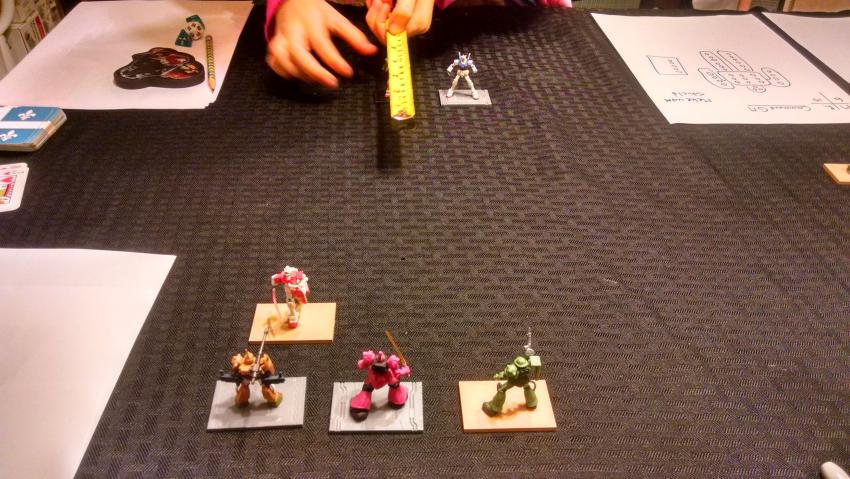
They wanted to play, being very excited about this. Here is a first picture of the play test... Here, Kitty using her Command GM charges my Zaku forces. It seems dire, but she would go on and destroy two of my mobile suits and greatly damaging the next one.

Saturday, January 24, 2015

Battle For Gytha: Tracking battle progress and play-testing

So with the creation and writing of "Cities of NeoExodus: Gytha", I resolved to write a major story arc to accompany the book. And to this day, I have two adventures completed. They will both be released for Winter Fantasy (and I may have a surprise or two...).

Now what makes these two events different than all of the other adventures and how did play-testing changed one of the biggest concept I had? Read on.

I won't lie to you. The Battle for Gytha series is about a war between the Arman Protectorate and the Janus Horde, and more specifically, of the Protectorate campaign to take the port-city of Gytha. By the same token, this has to do with the Janus Horde defending its territory from the "Invaders". I have been trying very hard to represent both sides making serious and logical efforts to achieve victory. I really focus on mundane means for things like logistics, defenses and movement. Then use magic for the special cases. In short, just because they have clerics and druid doesn't mean their army crosses the Tyranius Straight. What is possible to a small unit (such as a group of adventurers), rarely applies to an entire.army.

Next I have been reading a number of blogs and article on medieval warfare. Unlike today's wars, it is a lot more of a chess game than a speed game. That chess-like approach is the basis upon which the series is based on. Major battles will take place, usually as special, one-shot/interactive events. Expect adventures that include combat, supply runs, espionage, and a number of other dirty tricks one should use during war time.

But how can I come up with a system that is easy, elegant and that will allow me to track the PCs' progress and allows me, as a designer to reward them for their progress?

Taking a page from a Pathfinder Society adventure I really like, PFS2-01 The Bloodcove Disguise, I decide to track the PCs' progress through the series and affect certain encounters and events in-game. PFS2-01 tracks a number of successes/failures in a skill-encounter like way, making later encounters more or less difficult based on results. It's pretty effective and makes a fairly drab adventure into a good one.

Unlike PFS 2-01, I wanted to assume that PCs actions against the Janus Horde in previous adventures mattered. In short, if you've been there and killed a lot of them, then they would know who you are and start to notice. Eventually, act against you. So we now have one thing to track: How much NOTICE you have gathered thus far.

Next, I need to track how much the PCs' actions have impacted the Janus Horde. This is a war, and hurting the enemy's ability to wage war is important. So I have my second indicator: How much DAMAGE have you done?

Next, I counted a number of factors such as improving one side vs the other, or betrayal potential, but in the end, all of these other elements could easily be folded into Notice or Damage. So I went with those two.

Then I made a big mistake...

Yup. Major.

I had initially assumed that PCs would get just "a few" points of notice and could impose that number as a penalty on their social rolls. However, play-testing with veteran players (we played the APL9 version of "94-LC-05 Knee Deep")... the numbers just spiraled out of control. So I had to adjust the modifiers, or the system.

But how?

How could I use the system I had already without massively affecting the game, allow the PCs a chance to do their thing, but still make them pay for their previous meddling against the Janus Horde. Then I wanted to make it so higher-level PCs are affected more and lower-level PCs are affected LESS.

I must admit that I spent a few days thinking about how to do that.

So Notice will work the following ways.
   -  First: On certain encounters, the GM will take Notice average of the party and multiply it by the APL. This will give a percentage chance for the Janus Horde to have additional forces available. In other words, "they know you are there and they are acting against YOU".
   -  Second: Whenever the PCs are trying to be nice to a member of the Janus Horde, they will add their level to their notice and divide the result by 5. This will be the penalty players get when they try to talk to members of the enemy. That is, if they know who the PCs are and this can be mitigated by the PCs judicious use of Bluff or Disguise. In other words, "They are wary of you and don't want to say too much."

What do you think?

JP

Wednesday, November 12, 2014

When playtest go wrong

One of the things I am really attached to is that all NeoExodus Legacies adventure comes playtested by our players.

Their feedback is extremely valuable to us. I take these playtest as an opportunity to pick the brains of players to see if the flow is right. If they reach the conclusions I want them to reach. And overall see how they like the adventure.

This sometimes leads to situation where I as a writer or editor thinks a course is obvious and it is not. Or a case when dice bungle the equation. Or a case when a player reaches a third conclusion and walk completely off track.

It happens, and it is something I value. If I pick your brain, I must be willing to deal with the fun thingsthat dwell within...

As I'm sure you've devised by now... such a thing happened to the one of my playtest group.

We TPK'd.

Yup.

It happens. But it brought to life a number of points... important ones. Now however we have to go back to the drawing board on some of these issues to fix them.

Another thing that came to light is also one of the difference between Legacies and PFS: that of the gm is allowed to adapt and modify the adventure as needed to provide the players with as good an experience as possible. Running numbers has never been something that attracted me as a gm, but telling a good story still does today.

So it's back to work! I'll let you know how things go.

JP

Tuesday, January 15, 2013

Talking Interactives: The making of Opening Moves

I have been working on "Opening Moves", the NeoExodus interactive for Genghis Con. The original idea I've been toying with for a while, but the format and the details only took shape in late October. D'Anne, Linda and I got on a skype call and began talking about what we'd like to do.

I teased you with a few posts before here, here, and here. But today I won't be doing that. I'll talk about the way the adventure was developed and how we went from an idea to the final product.

First, "what are we doing"? I gave the ladies my first thoughts on what and how we would do it. This was a very high level overview "The Caneus Empire launches its Crusade against the Janus Horde." And go from there. War is something that is both a curse and a bane for authors. There is a LOT of adventure potential, assuming one does focus on the military aspect: seek and destroy missions, intelligence gathering, offensives, counter attacks, covert operation, etc. However, it can become stale. That is the danger we wanted to avoid.

Avoid having only combat encounters.

Avoid having too many role-play heavy encounters.

Find a balance for the event and make it exciting and new. So how to do it?

We discussed a number of things but eventually settled on a format that would allow the PCs to evolve through a complex adventure, make it multi-table (so the players can feel they are part of something bigger). How can we make this a trek into the lands of the Janus Horde that is both new and typical? So far, we've have a few adventures set in the lands of the Horde or that deals with them: Encounter at Ramat Bridge, Ruins of Trovaska, the PaizoCon 2012 Interactive Battle of Trovaska, and Shattered Peace... So there is a baggage of encounters there. The Horde's method of operation are known by players and GMs alike by now.

So we pitched a number of ideas, mixed typical encounters and new stuff we thought would make it interesting. The Horde got a number of write-ups in the Usual Suspect book so we shamelessly took opponents from that. I also went through books I currently have in production: The NeoExodus Players' Guide, a monster book whose WIP title is "Scions of the First Ones", and a book filled with GM resources and unique environments of Exodus (WIP title is bad but it's Magic of the First Ones).

With a list of combats, mini-encounters, RP encounters and yes, even foreshadowing of future adventures, I now had the task of finding a way to present this to the players in a coherent manner.

For the past week or so I've been hard at work trying to complete the adventure. It's coming along real well... and quickly too - always a plus for enthousiasm.

So, what do you, as players, have to look forward to?

Well first off throughout the interactive there are encounters, events, meetings, combats and locations we want to see what you will do? Will you ally with such-and-such? Will you let these people free? Will you fight that person? Will you listen to what NPC-A has to say? We won't tell you what these are, but by playing you will influence more than you might think.

Right now, we have split our encounters into 3 types:

The first is the "Super-Shorts". These encounters are small encounters requiring no more than a few minutes to set up and complete. They could be witnessing something, finding something, talking to someone, or a number of other events which are usually of a non-combat nature.

The second are the "Shorts". These encounters are mostly a straight combat encounter. The interactive is after all, a war. We have put a number of monsters in there, not just wave after wave of Hordesmen. I'll admit I was tempted to do so, but Sametia is wide and is home to many more things than just raging barbarians.

The third group of encounters are the "Longs". These encounters are likely to take longer to play. They could be larger fights, more involved role-play encounters, or even a two part encounter (if you do this then that). Long encounters may not be very long actually.

Also, we will have a few special Legacy Records (LRs) to reward some players who will do special things. We did that in LG and really liked being able to ask "did anyone slay the Troll General?" or "does anyone carry Lord Duncombe's banner?" These bits allowed for unique character stories, usually leading to additional information in adventures and sometimes recognition. One character really liked being the bannerman as he could wave the banner in any war scenario to give people bonuses. I still have to detail what these will be for the interactive. Okay I'm totally lying I know what I want to give out but I still have a few I am working on...

Looking at the almost 30 pages of material for the interactive (there is still a fair amount to polish), I believe this will really kick off the campaign in a positive way.

I think I already said too much...

JP

Tuesday, March 6, 2012

Free RPG Day: Undying Legacy Playtest report

Without spoiling anything, here is a play-test report of Undying Legacy of the First Ones, the NeoExodus adventure for this year's Free RPG Day.

I talked about this adventure in previous posts (Here and Here) as this adventure was the result of our Kickstarter project that ran over the December-January period. (So you know, we'll have another one starting in March.)

I've spent many long nights and a few mornings while "watching" the kids at my computer, frantically writing and expanding the story, tweaking the combats and adding some story elements. For although I want this to be an introduction to NeoExodus, I want the adventure to showcase and present what is NeoExodus.

The Party

There were five players (our sixth had to bow out at the last second (but I knew)): Martin playing Freija the human gunslinger, Homer playing Chenoa the prymidian bard, Jon playing Hans the human cleric of the Kaga, D'Anne played Karissa the p'tan rogue and Everett played Dema-ma (whom he played in a Sunday game of "Encounter at Ramat Bridge"). Of those, Martin had never played NeoExodus before, D'Anne never played it either but she owns the book. Jon, Everett and Homer all played NeoExodus before, so they had some idea of what NeoExodus was before.

No one opted to play Nose-Cutter, the Enuka Fighter, which I thought interesting. It would certainly make for interesting times.

I mean... When does an RPG adventure not interesting without a big, burly fighter? Or a cleric, or a arcanist or a rogue, you ask as I chuckle?

The Game

We started late (which is ALL Homer's fault, it has nothing to do with the fact that we were stuffing our faces with Casa Caliente's awesome burritos and we walked in 2 mins before him). So we sat down, introduced ourselves (this was the first time I met with Martin who freshly arrived from Australia), did some chit-chat and finally got down to playing.

A few words about Exodus, and boxed text...

The game proceeded well. I do have a few things, notably as transitions, things that are clear in my mind, but that didn't make it onto the page. The inevitable grammar and weird sentences to correct, some elements I feel are lacking to the adventure (which I noted, added and did not tell my players about).

The flow was good, the progression of the PCs through the story was good, I do not feel they were lost in the setting at anytime, they knew what was going on, what to do and the skill checks did not seem over-burdened. Although they did spend a lot of time in one location rolling an average a '2' out of about 10 d20 rolls!

The Setup

At the request of a priest of the Sanguine Covenant, the PCs travel to a small border village in the Caneus Empire besieged by a tribe of calibans. Aggressive, barbaric, cannibalistic and dangerous, the calibans are a threat to civilized people everywhere. More is afoot than initially believed. That is the blurb I am currently working on.

The Combats

Combats were challenging, without a doubt, but none could be considered overpowered. I found them fun, entertaining and exciting... and most of all flavorful. That last one is important to me. Flavor and "feel" of the monsters used is important

Overall

I need to tidy up things, and a few more notes before sending this one to editing. But overall, I'm happy of the adventure and it should be fun to run at play at Free Rpg Day. I'm very happy with what I have and look forward to making it... well better once all the tweaks and notes are integrated. I am very anxious for Free RPG Day to see how many people will play the adventure and provide some feedback to us.

The adventure is rather isolated from the rest of our NeoExodus adventures in that it does not use any pre-existing characters, nor does it work off of the main storyline, at least not directly. Still the style and feel of NeoExodus is there.

A level 3 introduction to NeoExodus!

JP

Tuesday, May 31, 2011

Playtesters saved my A##

For those who did not know, yesterday I spent my day at Enchanted Grounds in Highlands ranch playing Pathfinder. Not just *ANY* Pathfinder... but NeoExodus! Hurray! Before I tell you how it went and give you all kinds of crunchy bits about what worked, what worked less, what I need to add/change/tweak, I want to give a big heartfelt thanks to my play testers: Corwin, Jason, Jeff, Ken, Linda, and Matt.

Thanks guys for volunteering your time to NeoExodus and provide such clear, concise and really helpful feedback on the world, the game, the characters and especially, the adventure.

As I was writing Encounter at Ramat Bridge I had a few goals the adventure needed to address. In no particular order


  • The adventure must present the situation in Exodus (particularly along the Abaddon River) clearly,in a way the players could understand.
  • The adventure must introduce some of the major villains/typical monsters of Exodus.
  • The adventure has to provide the players with a sense of "something more is going on."
  • What the players do must be simple, clear and exciting.
  • The adventure must include a number of role-playing elements.
  • The adventure must feature a display that is visually attractive and really unque. (This is something I did tack on to it later as the adventure took form. Since it was to be the PaizoCon adventure, I wanted something to draw attention to the game.)
  • The adventure must have a natural flow, one the players can follow and even see or think they know what will is coming. (That can only be achieved by play test)

With those goals in mind, I wrote, tweaked, added, changed, expanded all part of the adventure until it reached its final, play-testable form. That was many, many, many hours of work, but work I have to say I enjoyed a lot. Being back in the adventure-writing business after a long time working on source books and setting books felt really great.

Before sending players into this, I had to make sure that all of my above-mentioned goals were reached, or I would have to keep working.

The adventure does not assume any Knowledge of the setting on the part of the players. CHECK.

The mission is clear, simple and direct. Very much so. CHECK.

The adventure uses iconic villains from NeoExodus. CHECK.

The adventure includes some role-playing scenes that can influence the adventure. CHECK.

The WIP of the 3d map can be seen in this previous post. Also, CHECK.

Iconics: (all of them are links to php character sheets)


CHECK.

The adventure SEEMS fine. So I was ready to play test.

Fast forward to Memorial Day Monday. Early morning. Travel. McD's breakfast. Bottomless Coffee (EG's awesome idea).

Not ot divulge much about the adventure itself. The biggest worry I had was the flow of the adventure. And that was right. The players followed the path set before them without resisting it too much, they moved the plot along, made the conclusions I wanted them to make without have to pull them through the force railroading I hate (to do and endure).

End of the adventure, conclusion, epilogue.

Okay, now the guys really began to provide me with valuable feedback and where this post's title comes from. In addition to a few rule items to tweak, some typos to correct in the adventure. But two big things.

First: Run time. Nearly six hours! OUCH! Must cut back. I have already identified a few encounters I will cut from the "PaizoCon version" Those encountered, while fun really do not further my above-mentioned aims. In the comfort of your own home, these encounters add to the feel and flavor of the world, but do not really add to the adventure itself. So they won't be added to the con-version.

Second: Intro The front-loading background of NeoExodus seemed overwhelming. The guys asked for a handout. This is such a great idea that it HAS to be done. After the fixes in the adventure itself, that is the next thing I'll work on.

So there it is... How I got my butt saved this past Monday! Still a few more things to work on but now I have a plan and I can focus on specific issues and have PaizoCon be a total blast.

Thanks again to Corwin, Jason, Jeff, Ken, Linda, and Matt.

JP

Wednesday, May 25, 2011

Worse than scum!

Today is the official release of Enemies of NeoExodus: The First Ones. A book I spent a lot of time on thinking about them. From the start they were already quite flavorful and plain old nasty. But I wanted them to be scary. Its one thing to write how scare and dangerous a monster is, but until they are WRITTEN and statted to be scary. I am looking forward to seeing what people think about them.

My favorite quote comes from Linda, my editor. As we talked about them, I asked her if she would like me to run her through an adventure that featured the First Ones. Her answer was "Oh no! They are too scary!".

Music to my ears!

Later, I asked her if she would like me to modify "Encounter at Ramat Bridge" to include them, again she declined. Then I told her I would modify the script and put a large number of encounter featuring the Scythians, the Exodites and the Khaynites, just for her. She laughed and said I would not do that because I wanted to play-test my adventure.

You know what... I hate women. I really do. I hate them. If you are a woman, I hate you. You are just SO FRIKKIN good at reading my mind! Even over social media. Whether it's my wife, my daughters (yes, I have TWO), my mother, Linda, D'Anne or pretty much any one of you!

[Rants off maniacally into the distance about why we guys are all dumb asses]

Anyway, the First Ones is now available right here RPG Now

JP

Thursday, May 19, 2011

PaizoCon next step: The Playtest

If you have read this blog for any length of time, you know that I am extremely devoted and focused on play-testing game material, particularly adventures. I have to say that I have been extremely lucky with those as they have vastly improved the quality of my work. By getting different points of view on the work done, you get to see the flow.

As a computer engineer, static diagrams are fine, but dynamic ones often tells more of how something acts or should act at run-time. Play tests gives that dynamic view.The thing is to see the adventure not just as a series of numbers and stat blocks, but as its own "living" entity.

On Memorial day, I plan to run the first play test of NeoExodus. People have been contact and my own but needs to get in gear about it.

To give you all a sneak peek, here is one of the NeoExodus characters I have already painted up! The rest should be completed later this week. I need to. Now that I have a date prior to PaizoCon, I can no longer procrastinate like I used to. Pressure is good.


JP

Monday, May 24, 2010

Last Minute Revisions

So it’s all done, you’ve fixed the immediate problems with your adventures, your tweaked a few things, added some extra details and completed that player handout you promised yourself you would be doing. Finally your adventure is done.

Really, it is.

You’ve done all you can for the adventure.

Seriously, you’re done.

Then why do you have a nagging feeling something is missing, that you missed a flagrant flaw, that the adventure is missing some added combat capability, that a new monster you just read/thought about would suit your adventure, or that you could fit that cool NPC you just made up watching TV?

That feeling is the revisionist in you trying to get out. It’s not a bad one to have, but one you must keep in check. The problem with over-revising is that you may invalidate your play-test! Yes. The last-minute addition you are thinking about may completely change your adventure, its flow, its own "thing". So you have to be careful.

So the question becomes… What do I revise?

Tricky.

The Encounter Flow

What you want to avoid is anything that could significantly alter the adventure or one of the existing encounters. Sometimes the alteration is in-game while other times it is a meta-gaming. As an author, you must seek to keep that flow.

Example One changing an encounter from a bear to a small dragon significantly alters the encounters and leads to a number of collateral damage. Dragons, even small ones, have hoards and thus players want to get their hands on them. Dragons often have servants. But the most important thing is… small dragons usually have a mother. So an encounter where the PCs walk through the forest, fight a bear and keep going turns into a risky and scary affair where they look over their shoulder all the time for Mama-dragon to show up or where they begin searching for a treasure hoard instead of being on their way through the forest... That does alter the flow and the adventure itself.

Example Two we replace the bear with an owlbear. Similar monster and its base purpose (a goon) is unchanged. No one thinks much of an owlbear in a forest. They don’t really have major treasure (except maybe in their stomachs). So we can change the bear to an owlbear without serious alteration.

Sometimes you may alter the flow so that the simplification completely alters the encounter. Reverse example 1. You have a small dragon, making the crossing of the forest fraught with peril and worry about the mother showing up. Instead, with the bear’s appearance the forest trek because rather mundane and not so worrisome. That can also alter the flow.

The story flow

This one is harder to spot and remedy. Here, through the addition or modification of a non-combat encounter – usually a non-combat encounter – the story changes significantly. Many of those are linked to in or out of character knowledge about an NPC or NPC groups.

Example One in the original document, the PCs met with a generic merchant who told them about the king’s evil plot. But you decide that this information should come from the local crime lord whose minions the PCs have been fighting for the last while. His inclusion into the adventure may lead to all kinds of unique tie-ins. Why is he suddenly helping us? Is the information reliable? Should we trust him?

Example Two instead of some existing NPC, replacing the generic merchant with someone you thought of and plan on using later on. Many players will catch on that "NPC joe" has a name and is not portrayed like everyone else. While the players may notice the man, they may simply note him down and continue. This does not alter the flow too much.

What to do?

Well, if your revision caused something you believe might alter the adventure in a significant way, the best thing is to run another play-test. I cannot emphasize this enough.

But if you do not have the luxury of doing that – and let’s face it running two play-tests of an adventure is a luxury, then you must sit back and play the adventure through your head, using the "QA Method". Be VERY thorough and exhaustive when doing that. If you can find a potential flaw, the best thing is to remove your fix. If you think fixing something will make it worse, then it’s not worth doing.

Why drop it? Your text is written taking into account what you had originally, not what you changed and creeps and other mistakes may appear because of the change. Many adventures in LG were branded as poorly edited or written when they were the result of last-minute edits or revisions.

JP

Friday, May 21, 2010

Play-testing: What to evaluate?

During my latest trip to Montreal - in the grips of Hockey fever - I play-tested this setting I’ve been posting about for the last few months. I was very excited about finally bringing my creation to the game table. There was a lot to prepare: writing up the pre-gens, sending a short background to each character, giving some details about the gods to the players, finish the adventure, pack everything up and then set up the game itself. All the players were on time and ready to go.

In short, things went well or as good as could be. The PCs "got" what I was trying to do, and did the kinds of things I wanted them to do. Their evolution through the adventure was as expected.

I could simply pat myself on the back and say how awesome I really am. But that would not be who I am. No, I have to dig to find some dirt, something to improve. So by trying to find out what was wrong, let’s see what went right with the adventure.

The timing is good since I was aiming for an adventure that would run around four hours. Including a lunch break, giving a description the world and its particularities, and the chit chat of a bunch of gamers who hadn’t seen each other in months, the whole thing took about five hours. By focusing on the game, the timing is fine.

The plot hook works finding a plot hook that works, that is original and that is engaging for players with different motivations. That is one thing I reproach to the Pathfinder Society, its plot hooks are terrible! I’ll let you in on a secret: they’re all the same. You have to do that because I tell you to.

The players’ flow make sense this is always one of those points that I personally find to be the most important. The "flow" is the player’s thought process and discovery of the adventure. Do they go from conclusion to conclusion based on the clues / discoveries logically? Do they have to reach very far to come to a discover something that’s in the adventure.

For example, that the PCs deduce that their employer is evil when they see a letter with his name on it is a natural deduction. That they come to the same conclusion because a painting on the wall shows him being dressed in black and sporting a goatee is not.

The fights are interesting This one is particular. LFR (the wrong-standard) defines an interesting fight by having something cool and unique in the encounter, over story reason. While that is a part of it, coolness and uniqueness are not the only factor in creating fun fights. Why are the villains there? Why do they fight the PCs? Is there a good reason for them to be there? Would other monsters be more likely? Should they be toughened up? Wussified? Diversified? Those questions all go through my head as I try to review a combat encounter. Do the players have fun with the encounter?

JP

Monday, May 3, 2010

Playtest Jitters

Saturday the 24th, I ran a trial, “alpha” version, of the adventure and setting I have been blogging about for the last few months. The game was an opportunity to sit down and play with my buddies in Montreal: Steve, Alex, Yves, Dan, and ET. Such a “reveal”, I always found nerve wracking as so many things can (and usually do) go wrong. Such things like impossibilities in the system, aspects or perspectives that were missed or overlooked in previous phases of development.

Again, many things can go wrong.

For one reason, play-testing always bring image of my good friend David (Bibi)’s vampire game for Helios 2000 where the adventure came to a screeching before we (the players) followed a path that was sensible but that he did not expect. Btw, this says nothing about the adventure, it was very good, but we put ourselves into a corner.

As I said, nerve-wracking.

So I was thinking. What are the best ways to avoid such pitfalls? This article aims to work on “convention” or “tournament”-style play, those games where the DM is not necessarily the author. A regular DM often gets the option to “explain things later” (and I do that a lot myself).

Use the QA approach

I am a computer engineer by trade. And thus, I often approach problems (and solutions) in gaming in software development terms. As a developer (author), I try to come up with code that work the way I want and I strive to make things work according to my vision. The QA guy’s role is to find ways to break my code. So he throws all kinds of weird things at it. As an author, the QA guy’s role is to try and solve problems by sending unique or strange case at it. “What if the PCs have a protection from evil spell up?” or “What if the party has a character with a ridiculous score in [Perception/Sense Motive/Diplomacy]?” See how the adventure reacts to it. Be realistic in your evaluation here.

Of course you cannot catch every single possibility, but try to catch most of it. The goal is to figure out how to break the story. Again, I say story because the artifices you can use are many to reach your goal.

Here is one example. The PCs are invited to a feast as guests of honor where a noble NPC will be poisoned by the villain. Sounds familiar? Yes. It’s a simple premise.

What if, one of the PCs, ignoring the laws of etiquette stands up and casts a detect poison spell? What happens to the adventure then? Here, using a simple spell, your premise may be broken. When thinking in D&D terms, I try to think of low-level spells and powers as those the PCs are most likely to throw around without any reason. Perhaps the villain uses a poison that is in two parts. Say something that reacts to wine?

At some point, however, the game must be allowed to go on. The rules for etiquette must apply and a certain measure of common sense and consequences must be applied. PCs that constantly break the rules of etiquette should be thrown out of the hall. They may also become suspect, “how did they know the food was poisoned?”

No substitute for experience

I said it a million times, nothing beat playing the game. Someone I strongly dislike comes to mind (Greg-I) immediately comes to mind as a good example (don’t worry the dislike is shared). The guy knows what every DM & author should and should not do. I played one game under him and it was as tedious as most of the lectures I had to endure while in college. He would read two lines, then whine about bad adventure design, then explain what is wrong and why he wouldn’t have done thing one way. Reading the adventure after playing it under him, I found that it really wasn’t half as bad as he said and in fact, enjoyed running it.

He knows everything. But he doesn’t DM for a million bogus reasons (truth is: he may find out he’s not as right as he thinks he is).

Be flexible in the design

Many adventures are made so inflexible that it’s like watching a movie. The players have no real say or impact on what is happening. You keep thinking “you know, I would do something different.” Slasher movies… WHY oh WHY does the hot girl run up the stairs instead of running for the back door? Dramatic effect, yes, but in an RPG, many will go to the door OR through a window if need be.

Now, certain types of adventure (such as dungeon crawls) are by nature linear, but putting some thought into the design and rooms is a big one. I generally prefer to write “point A” and “point B” and assume the DM/party will make their way through.

Come up with options/alternatives

Your ideas and writing are not sacrosanct and a holy gift from God (you) to the world! No. They are not. Really. Most of what I write end up in a “see you later” bin. Play-tests are an opportunity to expand and flesh out what is happening, with the benefit of having 4-6 heads and ideas flowing through into your adventure. Use the input they give you to make your writing better (and without necessarily telling them…).

Again the goal is to have a product that is very fun, interesting and that almost any DM can take and use in their game world. The more alternatives you have, the better the result.

Finally

I’ll detail how the play-test went next time.

JP