
JP On Gaming

Showing posts with label Response. Show all posts

Saturday, March 28, 2026

[Response] Jacob's comments on Ozaka

Jacob posted this on DrivethruRPG: (paragraph breakdown is mine since DT removed all line breaks).
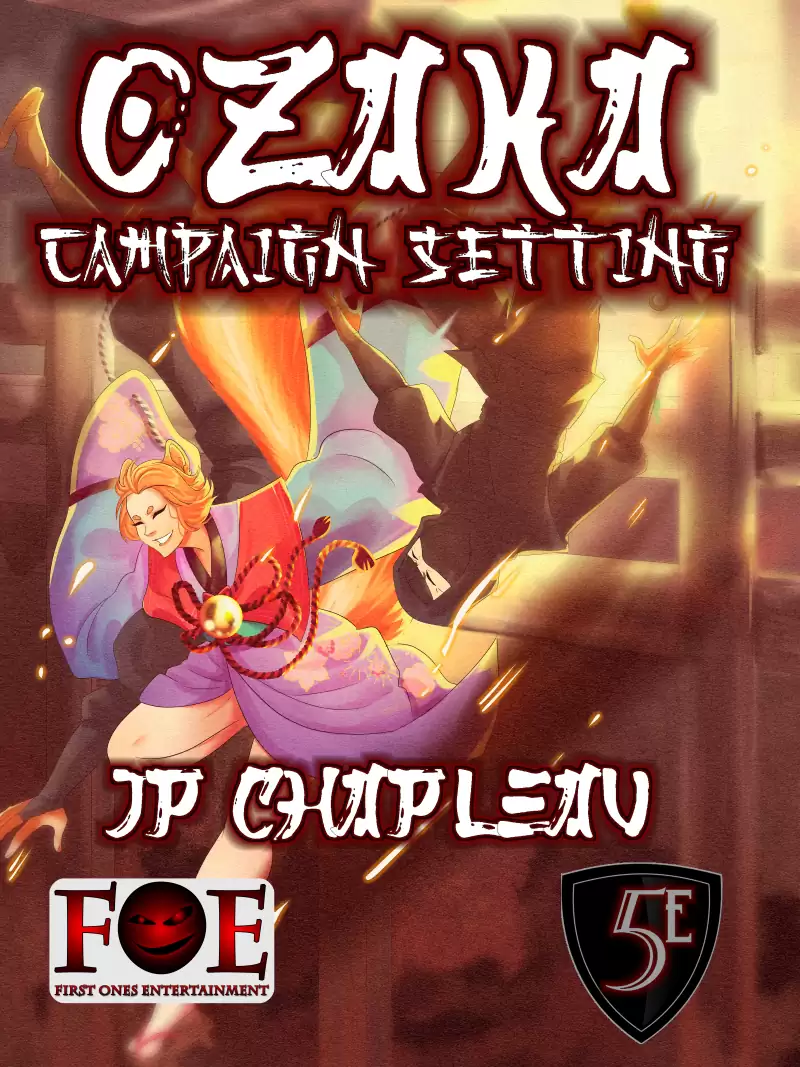
So, some constructive criticism... I saw your game at MidSouthCon (I was one of the two who couldn't make it to your morning game!) and decided to take a look at your game even if I couldn't be in it. Me 'n my BF have been reading through it, and we have a few thoughts.

My BF has phrased it the most bluntly: Ozaka needs to commit more to either being Classic Japan But With DnD Fantasy, or being Wild Dungeon-Crawl Fantasy In Magical Demiplane Japan. You have the basis for either of those, but there are a few things that keep either idea from soaring. If you want to feel like old-school Japan, you've taken out too much of the interesting parts of old Japan for them to pop. I understand not wanting to burden players with honor or bushido, but... really, suddenly having to care about another culture's social mores that you haven't internalized would make some great gameplay, which is why L5R focused on that.

Likewise, trying to feel like this period of Japan also blocks the "oh by the way Magic Missile and Cure Light Wounds are abundant" weirdness of it. I know you don't like characters that are inherently "scary" or would cause friction with the locals, but it feels extremely weird that warlocks get a pass when they're seemingly on the supply side of Ozaka's monster problem. If you really don't want to engage with old social mores or social constructs (the lack of the state religions really jumped out at my BF as something that made the game feel very not-like-Japan), I'd advise a revision of the game leaning into the fantasy-weirdness and making something less historically Japanese but more bizarre and exciting: "the demiplane of Hong Kong and all its precariously dangerous politics" would make for an exciting smaller-scale 5e setting whether the characters were locals or visitors.

If you want to really engage with Japan-but-it's-5e, I'd advise excising the more Euro-Fantasy classes (...mostly the non-bard magic-users) and relying on your homebrew casters to help convey the feeling of a world that isn't just not-Europe.

The overall presentation of the game is good and you've got some good art and functional layout. I am, admittedly, also not a fan of 5e, so seeing your game work with 5e-isms instead of break out from them frustrates me a little. You have the start of something really cool here, and I'd love to see it bloom outward into something that really draws eyes across a crowd.


Thanks, Jacob. A lot to unpack here.

TLDR: I took a middle-of-the-road approach, but whenever I had a choice, I picked that “let the GM decide for his/her game.” Also, I tried to be cognizant of future class/player options that may come in later books.


First off, thanks for your purchase and feedback.

Second, you will have an opportunity to try the adventure at Gencon (search for "Legacies First Ones Entertainment") when the games become available. It'll be called "Fiends of Dreams," but there will be 3 other adventures set in Ozaka: "A Stolen Daisho," "Friends we make," and "Battle of Shiro Azaki."

The points you note about 5e-isms and the design of the settings are among the elements I had to determine early on as I laid the foundation for Ozaka. Do I write my own game or use 5e (or Pathfinder or GURPS)? The decision to go with core 5e was a deliberate one (driven by sales and game attendance). Which brought some oddities and 5e-isms with it, I agree. But do they detract from the enjoyment of the game? I think moreso while reading the book than when playing.

HOWEVER, if you look at the design of the book itself and skip the sections on character options/ monsters, you will find that the setting itself was written in a non-system-specific way. (Also deliberate). As such, the setting itself has no stat or system built into it.

I don't want to create a full game - don't have the time, people, or interest in doing that. So that decision has worked well for me and for FOE. As I write more and more, I find my role is to provide YOU, the GM, with the tools to create a compelling campaign for your table. Which WILL be different from another table. And that’s fine

That’s great!

The Honor system... Ha... Yes... I wrestled with that more than anything else. Being a fan of the original Oriental Adventures and of L5R (where that is less burdensome), I remember its system for honor, which became almost a mini-game in itself, with everything the player did adding +1, -2, +3, etc. I like the game to focus on... It inevitably led to its abandonment, or seppuku. And going back to “regular D&D where I don’t have to deal with that crap.”

Let the PCs do [stuff], rather than count beans for every off-colored joke or thinking of a dishonorable plan. Samurai were honorable, but also practical men. Let the world/story deal with the consequences of their acting like bandits, burning towns, stealing from temples, and the world around them treating them like garbage for it. Therefore, I chose this "light" system.

Okay, okay.

"But JP, you don't have a system for honor," you say. I admit. I present the concept, but let the story dictate how it's used. I prefer the less rigid approach to the rules (where my old-school roots shine through), and let the players do their thing - but now they have to worry about their honorability. I chose to place the onus of adjudication in the GM’s hands and to dictate the consequences.

Now... for "realism" vs "magic missile." I have spent years trying to create material historical gaming, and experience taught me that most people want to PLAY and don't want a HISTORY LESSON. As proof: The GURPS historical supplements are great. I have several of them that I read regularly. Whoever played them? No one. (Not sorry to the one guy who played it). Why? Because people have a passing knowledge of these subjects, and when they come to play RPG, they want the Japan-flavored D&D. Not the full-on Japan where the GM must spend 1h of the game slot explaining how it works, but that doesn't factor into the GAME.

I do.

Players don’t. They want to do “cool things.” (and they should be given the opportunity to do that.)

You are 100% correct that warlocks should be hunted. However, there are several types of warlocks that don’t deal with fiends or Cthulhu. There are some with angelic or divine ties. Would those be treated the same? How would the average person know of the pact vs a sorcerer? Or a strange type of bard? What happens if a daimyo is a warlock? Or one who becomes one? Or his wife? Would it be the same in Kobochi, Makida, or Midori? What about the Wakou?

Again. That leads to “the GM will decide for his campaign,” the story, and story potential dictating what should happen.

About the state religion. It is in there, perhaps not explicitly stated as such. The 5 gods of the pantheon (plus the Thousand Gods) are the only deities presented and discussed in the book.

I do not mind scary characters, don’t look at anything with the First Ones... (Power is Fickle, Tarsyn, Akhamet). What I mind are characters/players who have whole side-games designed around them. For example, the rogue who sneaks everywhere and never works with the party. Or the player who plays an orc just to get the NPCs to react to him. EVERY NPC.

Now, I’d LOVE to talk to you more about this. You can find my email on FoeLegacies.com (I can’t post it here). We can zoom/discord/phone. I’d like to hear about your idea for the Hong Kong setting…

I think I addressed everything. But let’s talk. I wanna pick your brain.

JP

Monday, August 4, 2014

[Response] How Arcanis made things better

In a previous post (read my rant-astic prose), I ranted about my dislike for the carpet-sweeping crap-tacular rewards offered for an 8-hour game: 100xp and some minor stuff (a one-time boon to save your butt and lots of money, which serves little purpose in that campaign).

Well, I was not the only one who complained.

Many of us complained, spinning a massive thread on the PCI forums. The situation spiraled, but managed to remain civil and with an overall aim towards constructive results.

To their credit, the PCI campaign staff responded quickly, first on the forums to say they would "do something about it" and then through concrete actions. The other day, I received a new reward cert: the XP was upped to 500, and the rest of the rewards staying as is.

In as few words as possible: Well done and thank you, PCI. That was a nice move!

In addition to giving reward more in-line with what we the players expected, they provided a rationale for why they want to lower the XP given by adventures. Their explanation, one I do not agree with completely but can understand, actually drew in players.

Masterful stroke indeed! You got us to agree to sign up for less rewards in the future.

JP

Saturday, June 28, 2014

Tweaking Pathfinder: Mobs vs Hordes [Response]

One thing I've really enjoyed since I started writing this blog is to read comments, responses and counter-proposals. It is always my goal to make the game better overall.

This past Thursday, Perry-S posted a reply on G+ regarding my mob rules. In his response, he directed me to his post on Paizo.Com (found here). In his post, he offers an alternative to the mob system I presented.

At first glance, my gut feeling was "It's 4e monster roles re-hashed". In many ways it is, but with a few things that got me thinking. What in there could I use myself? I read and re-read his thread. I thought the way he presented his stuff was simple, intelligent, and really using 4e's roles well. Not only does the thread present his thought process, but also some guidelines on encounter-building, which had me fascinated.

I was quite intrigued by his simplified stat block, which was a very 4e/5e thing, which for minion-like things, I really find a good thing.

Mobs vs Hordes

Since he posted in regards to mobs, he uses "hordes of minions". Both represent a similar thing: large number of (generally) weaker opponents fighting in a somewhat coordinated manner.

If I understand his post correctly, the two are similar in the following way:
   - They move all at once (a mob as one creature and the horde as a unit)
   - PCs are able to take them down fairly easily

Here is where a mob has an advantage:
   - quick to run
   - no extended tactics or options (makes them very easy to run)
   - swarm attacks scare players (minions are likely to miss constantly)
   - focuses only on damage rather than tactics
   - uses existing and current game rules and stat blocks

Here is where a horde has an advantage:
   - blocks space (each minion must be bypassed individually)
   - minions have attacks of opportunity
   - action economy (you must take the time)
   - use of tactics (flanking, aid another, use of special abilities)

I can see how the two groups could be used in different instances. They both have their advantages.

So... which is best? That's a toughie. I am personally tilted towards mobs, but I cannot discount the use of a more complex encounter provided by the horde.

I will be talking to Perry on his math. That thread of his shows that he put a lot of thought into it and I would like to see more of these house rules. I am quite intrigued by his take on Commanders & Solos. Stay tuned guys for more word on this. A Gostor product? Who knows!

JP

Wednesday, May 8, 2013

Is OSR the problem child? [Rant, Response]

The internet is abuzz with the recent posting of a certain Peter Bebergal's post on boingboing.net. You can read the full article here.

Everyone got their shield and holy shields raised with a case of "oh no! not me". And they went off rants of their own.

I am NOT a fan of this OSR, even if a lot of the things I do and like would put me in league with the old schoolers. However, I have a profound dislike for the rules set of these old games.

I think he has pros and cons in his post.

Where we agree

Recent editions are only for money I mean really. Yes. But it's not unique to WotC. *EVERY* company is in it to make money. While a few guys may seek to "just put out stuff", the time it takes to produce something is non-negligible. Yes, they all want money. Is WotC more money-grubbing than say, Paizo, or LPJ Design is a WHOLE other debate.

WotC missed the boat on the PDF/PoD ship I think that is also given. While their competition embraced the digital age, WotC isolated themselves from the RPG world. I cannot quite fault them for that. By doing so, they really supported local game stores.

WotC published on a "Magic: The Gathering" model I think 4e in particular was build with that in mind: change your whole stock every 3-4 years rather than the 15+ years of 1e, 11 years of 2e, 8/5 years of 3/3.5. 4e had a life of what 2 years before 4.5 came out? And I think they felt the whiplash from that one. Many friends of mine left 4e at that time.

WotC's republishing their old material is a good thing I will admit that I had no interest in buying any of them, but I saw the wisdom and the good sense. For them, it is "free money" in that they do not have to spend a dime on re-design. The sales of PDFs of old products is also a windfall of freebies for them. Since they have no cost to themselves: only PDF sales.

Where we disagree

OSR promotes character development That is a common reason given by the OSR crowd to why their game is/was better. In my experience a good player will be good whether he plays OSR, 1-tru-4e, Pathfinder, Warhammer, Gurps or Fate. I've seen "cardboard players" in all of the above and I've played with awesome people also in all of the above. The ability to play a role is more dependant on the PLAYER rather than the background/ campaign/ character/ setting/ rules. For some - even in the "olden days" - it was all about leaving a trail of bodies behind them. I remember that all people wanted to do was kill stuff and become known for brutality and lovely elf maidens.

Ah.... Elf maidens... I haven't forgotten you...
Sigh.

OSR had fewer rules Just because there were fewer rule books in those days does not mean fewer rules. Going from one group to another in those days meant you had to learn how each DM had house ruled everything. Even things like hit points, AC calculations, ability checks could be massively different. If you had the change of getting a stable group - I didn't until I was MUCH older - then you were constantly learning the rules.

While interesting and fun, I never felt I could have a good handle on the rules (something the then-future-wargamer in me had difficulty adapting to).

OSR is all about nostalgia Though I disagree with him on this, there is a measure of truth. Many have gone to OSR as a way to "play something different". But to state that OSR as a whole appeals mostly to old nerds who refuses change... I disagree. Those guys have never stopped playing their BECMI edition or the books from the original Greyhawkbox. OSR for them is "Only School". Doesn't matter what, they would not move away from their prevered holy version.

Then there is a new phenomena, one of players going to try it to "see what the buzz is about".

OSR games were all about the plot No. No. and OH HELL NO. While a given GM may have put the focus on the plot, most adventures' plot involved you breaking down a door and beating up some poor schmuck for his gold.

Like OSR = character development, this affirmation is equally as false. For given groups/GMs, yes, but a blanket statement cannot be made.

What he does not say

One thing I have learned in my years of gaming is that gamers are a mixed lot and no two are alike. Making blanket statements on gamers as a group is difficult to hold to any scrutiny.

Similarly, assuming one person means you cannot derive a rule is wrong. "Nobody plays elf these days." "Not true! I have an elf character! You are generalizing." Touchy subject.

... Still thinking about the elf maidens...

Sigh.

JP

Tuesday, July 31, 2012

Response to Paco Garcia Jean. and Richard Whipple

Monday, I got a tweet that pointed me to the following article by Paco Garcia Jean talking about "Is it WotC's responsibility to bring new people to the hobby?"

The question at first prompts a simple "yeah, unless they're stupid" type of answer (which I admit was the one I had). But as you start thinking about it some more, the question is not that simple to answer. And Paco's expose is very good.

Richard Whipple's opinion:

The hobby is shrinking and it is because of the attitude of WotC towards the game industry and the edition wars that ensue every time there is a new D&D edition release. Dungeons & Dragons is still the flagship and gateway game by default and people recognize the brand, whereas other games are not recognized, thus if you try to use another game to introduce people to the hobby, people won’t be interested since there won’t be any familiarity. WotC doesn’t do enough to bring people into the hobby – instead, it’s just trying to bring players back and not expanding the demographics of the hobby.

I both agree and disagree with Richard.

I do not believe the hobby is shrinking, I think it is growing, but in a more diluted form than what many of us now-longer-so-young gamers used to see. In the old days, everyone would play board games, table-top (which was usually D&D or AD&D), bizarre card games, etc. If you were geeky enough, you would play whatever would be brought for the entertainment. Nowadays, many gamers won't bother to show up unless you play the specific version of the setting they like. Forget about bringing the games' club together for "whatever night".

I admit I'm super guilty of this... I won't show up for 4e games, won't show up for board or card games, but I try to attend most other RPG events. I'm a war gaming guy and a table top guy, and will (try to) participate in those events. This dilution of the gamer pool certainly help the "hobby is getting smaller" opinion.

Next, I agree with him that D&D's brand as a whole is getting smaller. Good computer games, like the gold boxes where the game mimics the table top closely - or closer than first-person shooters and RTS - have gone away. Now we have DDO (which I liked, but it didn't really feel like D&D, more like "D&D-flavored water", and with the latest upgrade gone too 4eish to my taste so I stopped playing and gone back to... BLOOD BOWL!!!), the reviews for the latest Atari 4e game were just DISASTROUS, so even the 14$ price tag allowed me to safely leave it on the shelf. The D&D movies were not exactly great - I think they were better than most SyFy movies, but not Willow or Arny-Conan great!

His final comment... That WotC seeks to bring players back is really what lead to the disaster of 4e. A lot of the old guard - myself - dropped 4e like a sack of unwanted goblin steak. With that old guard walking away, they did not have these die-hard fans who would support the game. When most of the "old time GMs" start running something else, you need to scramble to find a GM who is willing to put the time to run AND who can do a good job of it.

In all fairness, I think Colorado was blessed with a number of old timers who enjoyed 4e enough to keep it going strong for much longer than other, much bigger markets. There are a number of GMs with whom I like to play, most of them are older, more experience guys who have played for years. I'll give a shout out to Mario (Warhammer), everyone from the NIGA (Non-Irish Gamers Association who GM'd: Kristian, Christophe, Darryl) and locally, there is Lenny and Stu whom I always enjoy playing under. Now don't go flaming me if your name is not on the list... I only mentioned guys who I played with more regular games.

The Edition War

Over the past year or so (and with the announcement of 5e), I have come to the realization that the edition war lies squarely on WotC's shoulders, at least the initial salvoes. I remember talking to Lenny who was a Gencon 2007 when they announced the death of Living Greyhawk, the death of 3.5 and the coming of 4 as the savior of all RPG-kind. I felt... I felt offended by what they were saying. Then reading blogs, comments and forums only convinced me that I felt attacked, that the outcry for the terrible overall product the 3.5 was, which really offended me. 3.5 had flaws, but it wasn't THAT bad... especially when you don't have an alternative that's out there right away! That we had to wait about a year before we got to see what was offered (okay I got to see it early and I didn't really like it then either). But that's the thing... if you are gonna blast it, provide something to replace it right away, not promises.

Which does explain why they have been VERY careful when they talk about 5e, which is encouraging because they now know that without the old guard they don't have the critical mass to maintain their product. That's good to see.

D&D's image as the flagship of RPGs

This is something I never paid to much attention to. However when doing my interviews with Organized Play People, I realized that the brand itself is beloved by a lot of people. More than I expect. My parents still say I play "dungeons" no matter what it is I play. As such, yes people have a rough idea what you do when you say "I play Dungeons & Dragons" more than "I play Gurps/Pathfinder/Robotech/whatever else".

Marketing

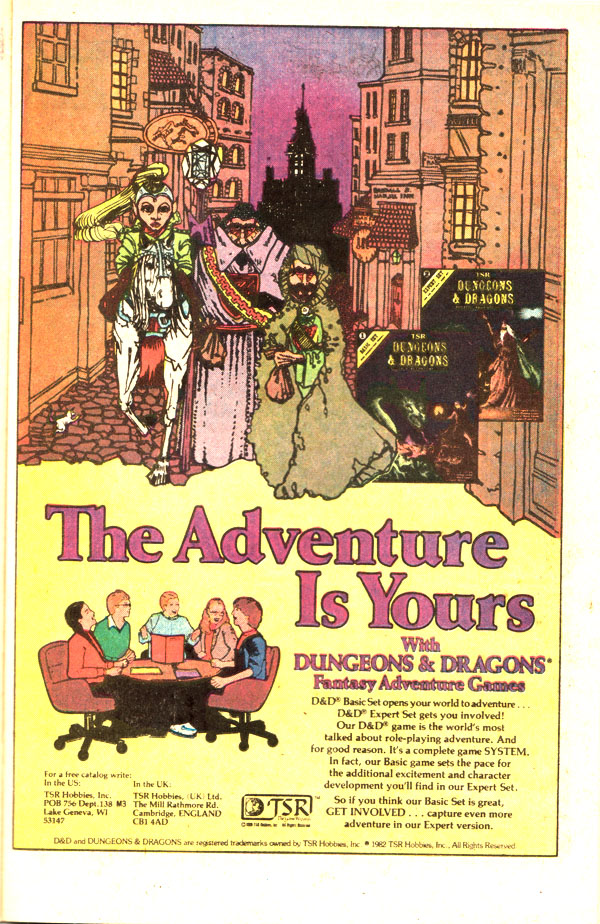
When did you see an ad for D&D anywhere outside a gaming magazine? Okay, those ads in comics, when did they look interesting and not a bunch of kids about to discover what comes out of the box when "pop goes the weasel" finished playing...

Even more telling, google "4e D&D ad" or "4e D&D marketing" looking for images... You'll get wrestlers, cos-players and a lot material you don't really care for... But little in the ways of advertisement. And what you find looks a lot like: Click on the links to see them in full glory...

I know. It's scary...

The one from the 80s is odd... it looks a little like those ads for the x-ray goggles that would allow you check out girls' underwear (why else would you need them?). It's not great, but it was in the spirit of the time. I mean you have these oddly shaped characters walking through a town... The two guys look like they are planning some nefarious activity. Not what you want to see and the young kids there seem to be having seizures of happiness. Again scary for parents. And what does the text let you know? Once you have the basic, you're hooked you can become an EXpert? Now what is that?

But it was the 80s, a lot of what we did back then didn't require strict scrutiny. Surely, the recent one would...

*FACEPALM*

The 4e one doesn't even let me know what else I could be doing in a significant way. So... I'm going to meet people in person and... what? play? do the same thing? That add is just scary bad because it doesn't tell you what the problem is. It seems like an ad for sex addicts anonymous... I'd be worried about going there.

So... Should WotC be responsible to bring in new people to the hobby

After all this, I think the initial response of "yeah, unless they're stupid" still makes a lot of sense!

Because like any creator/manufacturer of product, they need to maintain and grow their client base. How do they do that? by creating material that is aimed at new players. By giving people something that will intrigue them enough to fork hundreds of dollars into this hobby. They are the gateway into the world of RPG, want it or not, like it or not, they are. Schools, youth events, friends will often talk to you about D&D before you head out to the store to buy that memorable first D&D product...

Because of their "regal" status among RPG, they are the ones people compare themselves to. When you create a new game: a number of concepts and elements will come or be created in opposition to something in D&D.

Don't like the D20 skill system? Make if D100!

Hit points bother you? Replace it with a system of health by location!

AC? Thac0? Claw, claw, bite? Again, many other games are designed "in opposition" to D&D. My own NeoExodus was designed with a similar thought process: Let's do something that is similar but not the same as Paizo's Golarion! And go from there.

WotC has to be good shepherds of the gaming community. Not just because it makes sense, but because it will help them in the long run. Why is Paizo currently the top publisher in the game industry? Why/how did they overtake something that seemed impossible just 2 years ago? They made themselves be good shepherds of the herd that we are. They put themselves out there, answered questions, made themselves available AND they published quality products. I won't go into the specifics of why Paizo rocks at this time, but suffice to say that the biggest thing is that Paizo HAS DELIVERED what they promised. Remember the Virtual Table Top for 4e? PDFs?

But the "No, not really" is also good.

Then again, it's not *JUST* WotC's place to be the sole bringer of new players to the hobby. That would be unfair. While they have the name and the following, we, as a community are no responsible to it. We have to be good shepherds, includers and ambassador to the game. Whatever your game of choice, there are people who need/want to play. By being inclusive, by talking to them, you grow interest.

One of the things I keep telling my players and GMs is that if you want to set up a game, set it in public. In a game store. When players see people playing, they will want to buy and try it out. Don't only plan massive 12-year campaigns that no one who starts will ever finish. Plan short one-shots. Get people playing. Get people excited. That's what we need to do. Don't hide in your dark basement with you 20 year old edition of Champion and wonder why no one ever comes to play. Make it easy.

Sure, true, the game environment in a store is not as cool as in your basement you tricked out with light and sound effects. But for those who don't know you, its a lot less worrisome.

It's not just WotC's role to bring in new people... no.

It's all of us, WotC included. For the new person that comes in to play D&D could be at your Pathfinder table tomorrow! (They should, anyway).

JP

Thursday, June 30, 2011

Response to SRM: DND-flavored water

Stephen Radney-MacFarlane (SRM) has been blogging in his latest post about the impending announcement of "AD&D"... Now. Where have I heard this before? Some ranting and raving lunatic talking about and Advanced Dungeons and Dragons game. That's just silly.

Oh wait! It was in a PREDICTION OF DOOM!

Could I have magically influenced SRM into my way of thinking? In a 3.5 world, I could. In a 4e world, the effects would've stopped at the end of our encounter at the Paizo Banquet! The odd thing is, though 4e was discussed during the banquet as we all wanted to know some dirt from Stephen - he gave us enough to feed our ravenous appetites while staying very diplomatic. Kudos to him on that.

So Stephen's post (see above link and previous post) lets us hint at a few things. First, The name AD&D is spoken again. Also the "changing of the guard" at Wizards" where many people lost their jobs. I believe SRM is much more "on the pulse" as to what is going on in the Seattle area than I (high up in the mountains). I just rant and try to project the past into the future. Looking at Wizard's press release for Gencon 2011, I doubt 5e/AD&D will be coming this year, so my original prediction of AD&D for Gencon 2012 still holds.

The fact that the name AD&D is out there I find exhilarating, but not-so-surprising really. After all I said it first...

I agree with most of SRM's post. There is something to be said about being part of something exclusive or unique: from the cheerleader squad to fraternities to the football team to D&D groups to better schools to high-profile jobs, rarity creates a sense of belonging. Being able to learn then advance and finally master a system is part of the fun. It's the buy-in. 4e was designed to bring in new players and on that note I believe it succeeded. It did bring in new faces (and brought back old ones) to the hobby. But when something is so easy a caveman could do it... it does lose some of his mystique, some of its prestige, some of its draw. While it might be fun for a day... It may not be something you want to do.

Like SRM says, 4e expanded its audience by turning its back on a lot of traditional gamers. Those guys who have tirelessly GM'd and organized events for them. With LFR leading the pack, they flushed away many free volunteers running cons and event in favor of small time events. How many LG-only cons were they in 2007? How many LFR cons are there now? Heck, guys drive from Denver to Colorado Springs to play LFR because nothing happens up there! (it's a 50 mile drive I am well-accustomed to.)

I think they have done something right using old IP to generate knowledge of a product. The red box did bring in some people through sheer nostalgia (though many gamers quickly put it back when they discovered it was a 4e product). Their themed boardgames based on Castle Ravenloft gives players something to build on. Since they played a light version of the game, jumping into the full game isn't that far of a leap. Get people in the door with a simple game and go from there. I met a Pathfinder player or two who got into the hobby by that particular game! Gets the name out there, gets product out. And the old guys (like me) can tell you all about what they did in I6 Ravenloft... That should be a series of posts... I was 12 years old...

I personally enjoy DDO (D&D Online, since it gone free) and at least look at any D&D computer games out there. I did not get the 4e computer game after reading reviews of how terrible it was, but I did consider it. Why? Just because it said D&D on the cover. I would be okay with playing 4e on the PC since it seems designed for it. But again, this would be what I'd call "D&D-flavored water". Its not the real juice but it reminds me of it. I don't play DDO or D&D computer to replace my table top experience or to experience deep in-character debate or inner party conflict. Comes 11pm, I have an hour to go beat up on monsters. Beat up monsters I do!

Switch brain off. Kill kill kill. Sleep.

The future? The name Dungeons and Dragons still has a lot of commercial value and potential. Anything with the name immediately draws interest. Should WotC move to a board Game only release? I don't know. They won't get my money for that. Then again they aren't getting my money right now either.

I might fork out cash for 5e. Then again I might get a "free" PDF first, evaluate it and then decide. The guys might have a few surprises left in their think-tank and the new system may learn from the 4e/Pathfinder situation, take what I like from both or either. Let's hope they draw the right conclusions from their 4e adventure.

Stay tuned folks.

JP

Monday, March 7, 2011

Mike Mearl's "call for unity" is BS!

For a few days now, I have been thinking about how to react to Mike Mearls’ blog (see the full article here) where he calls for "gamer unity". The message is simple and concise: he wants people to play the game and unite by a love of D&D. But the more I think about your message, the more I think there is something not right about it. It feels wrong and sounds wrong at the second reading.

Would he REALLY be trying to feed us that unity spiel if 4e was the leader and everyone played 4e? Did they post similar kind of messages during the 3e days? (Yes I realize Mike Mearls wasn't the head honcho in those days) Did anyone at WotC post any such "gamers, unite by your love of D&D" anytime before?

No.

I cannot escape thinking that what he saying is "4e and 5e are the only paths to the future. Everything else is a fad." He is calling for people to "play D&D". But many of us don't want to anymore. Many of us dislike what D&D has become. Since there is no turning back according to WotC (not just Mearls), I see no point in going back to a bad RPG. It reeks of the 90s era TSR, when TSR put out something and we'd swallow it up. We were so starved for new content that we'd buy whatever TSR would put out, and a lot of it was interesting and new. Today, this is no longer the case. I do not see the creativity today that TSR exhibited in the early 90s. Back when they were coming out with new Campaign Setting on a yearly basis. People are leaving the D&D boat for other boats in large numbers. The boat is sinking and calling people back to it won't work. The edition war is lost for WotC. 3.5 is winning by the day.

I CALL BS on that call for unity!

I do not consider myself strictly a D&D player, I am an addicted to role-playing games (I say it as the games as a whole, not because I'm a "role" snob, even though I kinda am a little). RPGs are my thing, whether Call of Cthulhu, Mutants & Mastermind, Marvel Super Heroes, Savage Worlds, Doctor Who, Pathfinder or any other game where I can sit down and take part in a story. It's like saying that I drive a Honda. No. I drive a car (which happens to be a Honda).

In a previous interview, he tells us that "If you're unhappy with 4th Edition, I say take a look at Essentials and see where we're moving." Essentials - which according to some readers is not 4.5 - but according to Mike Essentials is not 4e. So which is it? It should be clear that many in the community have said "NO" to 4e. Re-branding (or 4.5ing it) is not going to bring back the people who turned their back

Malibu Stacy can have a new hat... I STILL won't buy.

If she were to move to move back to Denver, change her name back to Mary, stop dying her hair, throw away her hybrid car, her house, her slutty clothes, her dog and dump her metro-sexual boyfriend Ken. Oh wait. She could keep the clothes. Yes... Then, maybe I'd buy a "Denver Mary" doll again.

But as long as she keeps getting a new 1983 red hat as a sales gimmick, she will remain on the shelf.

Mike, how about this for gamer unity "Stop playing 4e and join the rest of us!" That's a call for unity I can get behind.

I won't buy the new hat.

JP

Thursday, February 24, 2011

Predictions of Doom: 4e is the new Coke

This is not a 4e rogue!

Yesterday, I posted a collection of Predictions of DoomTM regarding 4e, LFR and the RPGA (read it HERE). The post was one of subjective observation. My dislike (to say the least) of 4e is great. But the column poses deductions and observations I had regarding the above-mentioned subjects. I presented a number of facts and examples of things I thought were going to happen in the future. I thought it was actually pretty upbeat about 4e. Past behavior is best predictor of future behavior.

Then Scott, a man extremely devoted to 4e, posted a lengthy comment accusing me of 4e bashing. 4e sales are dwindling is something I have been observing locally and across the internet in the "markets" where I have some interest (which includes Denver, Montreal, Paris and Dublin). The game IS losing steam. It is losing players too. Pathfinder is eating into 4e sales big time. My local game stores can't hold on to PFRPG core books (or Bestiary, or APGs), but their 4e stuff gathers dust (not really 'cuz they clean up everything, but you get the idea). It sells MUCH slower than it did a year ago.

The funniest thing about this article? I thought it was the least amount of 4e-bashing I did in months. My Predictions of Doom were laid out clearly with what I thought would happen, with the basis of my analysis and deductions.

If people want to play 4e, they sure can. I won't. The Predictions were not aimed at stopping people from playing.

Now on to my response to Scott:

My first reaction to the 4e announcement was one of cautious optimism. There were things I liked about what they announced and things that made me wary. Being pessimistic by nature, I remained cautiously interested until I can see the final product.

One thing about playing D&D is that is had its own universe, its own uniqueness, its "D&Disms" that you loved or hated and its distinct game worlds. 4e stripped away most of it and mish-mashed everything together. Had 4e been called "Wizards & Warriors", "Table Top MMO" (or anything else) I would've enjoyed it for what it is: a different game paradigm in a different rule set. It’s like an Battlestar Galactica episode where people come in for a short cruise, spend a few days and leave totally in love as the crew feeds them cocktails and scamper about in bikinis. You would alienate the fans. 4e is the Love Boat in the world of Battlestar Galactica.

I left 2e in 1993 because it was too restrictive and did not give me enough control over my character. I was not in charge of my character. Everything had been hashed by someone else before me. Someone did everything and all I had was to match race, class, equipment and I was done. If I was a fighter, customization meant choosing a sword or an axe... The only difference between the parties I was in was that we had a cleric/ rogue, a fighter/ rogue and a wizard/ rogue. I didn't like it so I started playing other games and dropped D&D.

I tried 3e in January of 2003 and found it had addressed issues I had with the game. *I* was the one who would create his character in the way I wanted: I could assign skill points, chose feats, chose a different classes as I leveled, my cleric was very much like my "typical" 2e characters but with new bells and whistles and he was very different than other player's characters. My buffing cleric had to manage his resources, including healing. There was a system to handle things like knowledge and talking to other people! Good times! So I began playing Living Greyhawk and enjoyed 3e.

When I got my 4e pre-release material around January of 2008 (yes, I got it before all of you), I devoured its content wanting to like it. I WANTED to be as seduced by it as I remember when I opened my 2e PHB at the Travel Agency where my sister worked. I wanted to LOVE it, to EMBRACE it and to become the best 4e spokesman there was. But the more I delved into 4e, the less I liked it. The reasons I left 2e were back. Customization: not there (very limited). Non-combat situations: not there (if you are not in an encounter, you are wasting time). Good skill system: Not there (over-simplified and now a player does not have to invest or make a choices about his skill). Multi-classing is gone (I now get to use one ability 1/encounter). First I stopped having fun with it, then I stopped GMing it, then I stopped writing for it then I stopped playing it and finally I just gave up.

I have this concept I wanted to build in 4e (mostly because I never played that character in other games): an ELVEN ROGUE using the bow as his main weapon. Not shuriken. Not daggers. Not a hand crossbow. I wanted to use a bow, ANY bow would be fine. It must be a concept that is too far out there to handle as part of the basic game. It must be something that never happened in fantasy literature. I mean... 1-3e and Pathfinder handled that concept very well out of their core book. I generally try to find concepts that do not require me to carry 50 splat books (I'm lazy that way).

Throughout your post you accuse me of taking the designers’ criticism of their work at their word. Why shouldn’t I? Aren’t they proud of having the job they did? If there was something that was so bad about the game, why did they wait 3 years (4e was developed Jan 2005-Jun 2008) before they came up with a fix for it? If 3e was a PoS why did they attend major cons pretending 3e was the bomb? Why did they tell us that 4e was a paranoid gamer’s fantasy? Don’t they have the job many of us would LOVE to have? If what they produced before was such crap, why would we expect them to suddenly come up with great material? Wasn’t the new Coke supposed to be so good that it would make old Coke disappear?

That’s not what happened… After trying out the new coke, people hated it, and Coca-Cola realized it quickly enough that they were able to get back their clientele and trade blows with Pepsi once more. 4e is the new Coke that WotC keeps saying is what we want to drink. It’s the Coke that we’ve been told we’ve been wanting for years.

But we moved on to Pepsi/Paizo products.

Scott, if you honestly expect (any flavor of) 4e to stick around beyond 2013, please contact me at that time where I will publicly apologize, recognize the non-validity of this prediction and even play a game of 4e! I'm serious. I'm willing to put my money where my mouth is. You have me on record right here. Oh wait... It will not be 5e... it'll be the "AD&D"!

Yes folks! You heard it here first... AD&D is coming back. The net result: 5e/AD&D will be *kinda* similar (same basic mechanics) but not so much so that you can use all your 4/4.5/RB with it. There will be just enough that you need to re-purchase all your stuff for this new format because it will have the "super cover of awesomeness" or some other gimmick. They will just avoid calling it 5e.

But it will be 5e.

All the fatalism and humor aside... Seriously Scott... Do you REALLY expect 4e to stick about 8 years like 3e did? WotC is re-branding it after "just" 2.5 years...From looking at your blog, you are an intelligent guy. Did I say something that sounded perhaps a little too right?

4e will be around until a suit comes in and says "sales are down, time for a new version!". 5e / AD&D will be on the shelves a few months later.

JP

Monday, December 27, 2010

More Thoughts on Fantasy Warfare


I recently red a post by the GM Oracle (http://www.gmoracle.com/?p=619). In his post, he comments how mass combat is unrealistic a fantasy setting. His point is "proven" by an example of a single wizard with a wand of fireball. In many ways, he is right. A single fireball (or 50 in a wand) will decimate a unit of simple commoner.

In a med-fan setting, adventurers rarely tend to stick around one place for very long. After a battle or two, they drift off seeking treasure and - as their name implies - adventure.

Instead of thinking in terms of a human army (with clerics and wizards), first, let's think of an orc horde. The vast majority of its numbers is composed of disorganized individually dangerous creatures.

Why do I disagree?

1- Communications

Communication is key to any battle plan. When running small-scale action, it is easy to use magical means to coordinate. However, when the numbers grow, such cohesion and means of communications become confusing at best. Imagine 10, 20 or more people each talking, or relaying information at the same time.

Communication is not just knowing how engaged troops fare, but also where the reserve are, when and where to commit them, knowing about the enemy's movements. If a general cannot see where his troops are, it is impossible to provide support when and where needed.

Good examples of this includes Napoleon's victory at Austerlitz where he maneuvered his army while his Russian opponent was hampered by the fog, and assumed Napoleon would not risk battle because of it.

2- Limited Magical Means

It is false or simplistic to assume that only one side has access to magical means. Both sides would be likely to have destructive, scrying and dispelling magics. The rules in D&D and Pathfinder make such means of roughly equal level. Requiring a minimum of 5th level for the most common large-scale destructive magics (fireball), thus making it uncommon.

Next, people with limited, valuable resources (such as spell casting) rarely seek to expend those frivolously (like PCs do). Wasting fireballs on a mob of commoners is not something I would generally wish to do.

3- Target Priority

Same as modern artillery firing blindly at an enemy is not ideal. WWI showed us, massive barrage achieve only limited success unless backed up with an infantry assault (read about the creeping barrage tactics and the fall offensive of 1918).

YES, as a wizard, I can just throw my fireballs at whatever moves, leaving me with much less to fight against real tougher opponent (remember that wizard on the other side I mentioned earlier?).

4- Modern Military Tactics

GM Oracle's post mentions that fantasy warfare would be very similar to modern warfare. Good quality modern armies (such as the US) have one thing in common: they are a volunteer, professional military force. This means they are highly-trained, well-equipped and well-disciplined. Very similar to adventurers.

When gathering his military forces, a fantasy lord would call upon a few groups of well-trained warriors (such adventurers, knight-retainers and religious orders), but most of his forces would consist of local militia and commoner with little to no training, equipment and discipline.Thus the "mob" or "big block" formation makes the most sense.

Those elite groups would use tactics that would be more in line with modern warfare, yes, absolutely. But the poor little farm boy who leaves his farm to serve his lord with his club or pitchfork...

5- Intelligence

Knowing the enemy and his resources is crucial, even in fantasy warfare. The presence of high level spell casters in a city is something that is known. The presence of someone who can drop a mountain from the sky rarely goes unnoticed. People talk. Casters scry. Spies listen and observe.

Anyone quickly notices adventurers coming to town and selling for 1,000s of gp's worth of gear and loot. Merchants and people talk. They do so without malice, its just common sense. Since those merchants would have an influx of magic items for sale, they would spread tales designed to attract customers.

This forces an attacking commander to do something about those very dangerous individuals: assassins, distractions, bribery or even plain old magic. Nothing prevents an attacker from using many of those methods. PCs and high-level adventurers form wild cards that must be dealt with.

It also assumes that those around the PCs and other important NPCs haven't fallen prey to the means mentioned above. While it is often true that a PC could take command of the army, morale is likely to drop cohesion may not be the same. Why take out the impossible god-like adventurer when you can take down his few aides.

PCs can rarely be everywhere at once and an attacker would try to take advantage of that. Feints, counter-feints and all kinds of stratagems would still be used. Opponents would know that. Add to that illusion magic that would enhance those stratagems.

6- Castles and fortifications

Castles and fortifications protect little from a flying wizard/dragon, it does protect one from bandit and more "conventional" attackers. Adding machicolations and other defenses would help. At least delay such an attacker.

Elements that would change would include more elaborate underground structures to protect from airborne attackers and those underground structures would need additional defenses to keep enemies away. Do I hear "dungeon"?

Castles also make a great statement to the local populace that you are here to stay and defend against invaders (as they did in England after the Normand Conquest).

Plus... if we're very honest... They are really cool to think, design and research...

What we agree on

I think the biggest point we both agree on is that fantasy warfare cannot be modeled exclusively on medieval warfare, even though it takes a lot from it. Camps and bases would be more spread-out to avoid decimation by fireballs.

Personally, I see med-fan battlefields as blocks of lowly troops in the centers with elite forces and splinter "modern" groups fighting on the wings, seeking to gain an advantage. The result is a hybrid of both methods. Thus the basic elements of medieval warfare such as supplies, communications, logistics, organizations and the stratagems are all there, but use of magic makes such stratagems more complex, and in the end interesting.


In the end, I guess that it is simplistic to merely assume that common medieval tactics should be discarded simply because of the presence of magic. As usual, the answer is more complex.

JP