JP On Gaming

Showing posts with label Good Adventures. Show all posts

Monday, October 12, 2020

Adventure Creation 101 Friday Oct 16th

This Friday evening, I will be running a short seminar with the kids of my Friday group. However, if a few starter GMs want to join, I would be fine with a few join in.

The event will run from 18:30-21h CDT on Friday night using Skype.

We will go over the basics of writing/ preparing your own adventures. From the original idea to the production. We will cover encounter creation, overall adventure creation, polishing, and running.

The theme will be Halloween monsters. I asked everyone to think of a monster typically associated with Halloween. This can be skeletons, ghouls, vampires, witches, whatever, anything you want.

Next preparatory step: think of a short way to use the monster in an adventure in a few sentences.

The vampire lives in a dark castle and feeds on maiden from the village

Bring a few pieces of scrap paper, a pen/pencil/sharpie and your ideas.

If you are interested, contact me directly through email, Facebook, one of the many ways in the internet.

Sunday, October 4, 2020

"Stealth Missions" are not all about Stealth!

I was lurking on Reddit about how to run "Stealth" adventure. He was thinking ofrunning a game in the style of Assassin's Creed: mostly moving around, avoiding detection, and fighting the least amount possible.

I thought this was worth cross-posting here. This is the answer I wrote:


The thing about "stealth missions" and how to run them successfully and in an interesting way, is to NOT be "just about Stealth". True, the goal is to not be detected but unlike in computer games where you just have to move from mob to mob and hide, TTRPG require "more".

This include:

- Using Deception to disguise yourself as guards or servants
- Find out what a password is
- Prevent the enemy from raising the alarm
- Climb around obstacles/well-guarded areas
- Parcour

Notice that I avoided to give specific checks because the players may have a variety of spells/ feats/ abilities to mitigate the challenge. Spells like alter self, disguise self, invisibility, spider climb, or even sleep may be used. And those are just BEFORE the action.

There is something to be said for Before the action: obtain duplicate of keys, passwords, outfits, and plans.

Sunday, December 23, 2018

What is the ideal size for an adventure? Part 3

Part 1 | Part 2

There is one thing about writing as a stream of consciousness, the way I started with the first two parts of this series. You keep getting ideas and more thoughts cram into your head. One thing I like about blogging vs vlogging is that the mass of craziness that fill my mind has to be organized. I can't just blurt out twelve things at once. So while I originally planned a two-parter... I had to expand this to a third part...

Because of the many side ideas and thoughts I came up with were related but not really formed, I put them at the bottom of the text file for later as I kept on thinking about shorter stuff. But then, after I completed the two posts (it was one I decided to later split in two), I saw the many ramblings and partial thoughts: "Masks x 3", "I3-5", "longer=more dev/harder" and a few that just don't make sense. Enough rambling, here is the post, after a little clean up...

Mega-Modules or Adventure Path

Having put down my thoughts on one-shot modules (Part 1) and on tournament adventures (Part 2), I had more to say about mega-modules or the adventure path format.

Those old modules, with names we all know: the Tomb of Horrors, the Expedition to the Barrier Peaks, and Castle Greyhawk became household names the same way Paizo's Runelords are now part of the gaming universe. The reason is deceptively simple:

Because we played them.

Old guys like myself all have tales of someone doing something stupid in one of these adventure and creating comedy gold. I mean, it is funny to see your friend getting disintegrated because he touched the big red button.

I do not play many of them, because of the logistics and time to complete. I was able to play through one of Paizo's adventure paths (Reign of Winter, shout-out to Chad and Evan who GM'd it for me), but never got a chance to play in a 5e mega module all the way through (I played parts of them as part of the Adventure League).

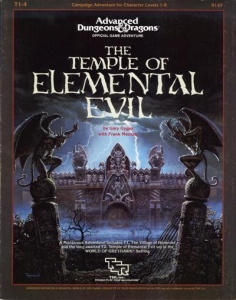
Back in the days, I played Desert of Desolation (I3-5), Egg of the Phoenix (I12), and significant parts of both Queen of Spiders, and Temple of Elemental Evil (T1-4) back in the day, including the PC game of ToEE.
The best thing about them is the amount of story and adventure there is to do, all in the same theme. It's not just to get in, beat up the goblin king and get out. From fairly innocuous beginnings, your character becomes involved in a greater plot, in some massive affair. This means that you get to take part in something massive.

That is also their biggest downfall. Because there is so much to do, and often the plot becomes personal to the PCs, after one or two characters die, or after a few player cycle in and out, the party's motives are difficult to maintain. I will tell you of the Mask of Nyarlathotep in another post for a good example of this. Plus remembering all the details of what you did two years ago because of the long time between games. Back on track, After the 4th book of an adventure path - or the third full dungeon level - the initial motivation for adventure is not as strong, and the question of "why are we doing this again?" props up. I find it difficult to keep up the interest from that point.

Another strength/weakness is that such large-scale adventures have a theme: WotC's Curse of Stradh and Paizo's Carrion Crown is Gothic Horror, Reign of Winter deals with the mythology of Baba Yaga, Tyranny of Dragons deals with Tiamat and dragon cults, Wayof the Wicked deals with evil characters, etc. There is a lot to do. The flaw? Some people have no interest in the theme. Say you don't like long wilderness exploration (I'm not really that much into it), then a mega-module is just not for me. The chance of me running it is zero and the chance of me playing and giving the game a high level of interest as something I love is not the same.

Dang... the strength of these modules is also its weakness.

Looking at their physical size, WotC's Curse of Stradh, Dragon Heist, Princes of the Apocalypse all are 256 pages, while Paizo Adventure Paths and 6 books of 64pages (each book has 32 of adventure and 32 of setting), they are now reducing this to 3 books, a decision I am very happy about because it will keep the plots more concise and address the issues I mentioned above. Three books means your opening motivation easily holds through. Also, the best ideas are the ones that win through.

These adventures are written by different people, each with their own style. As a small publisher, this is one of the toughest type of product to create. But as a GM, and as a player, a bigger scope adventures are more rewarding to take part in because you get to delve more into the party dynamic, get to play with more things.

Tuesday, December 18, 2018

What is the ideal size for an adventure? Part 2

Check out Part 1 of this essay or sort.

The Convention Adventure

What used to be called "tournament modules" during the days of RPGA... These are mostly self-contained adventure designed to be run and played in a 3-5 hour time slot. These are the adventures for Pathfinder Society (PFS), the Adventure League(AL), and the Legacies Organized Play Campaign. They adventures average around 20-25 pages, with a high variance (typically on the higher end).

The Adventure League has a large boiler plate that takes a number of pages, but that provides a good way for the GM to interact with the setting.

Pathfinder Society adventure do not have that, and tend to get right to the point, often without giving the GM some important setting notes or sending the GM to a different book with more information, later years have remedied this problem to an extent.

Legacies adventures are the shortest of the lot, around 15 pages. The older Pathfinder averaged around 20 pages, while those for 5th edition average 13 pages.

So there is a wild disparity of size here. The amount of dungeon and plot differs wildly between all of them, making an accurate comparison difficult. I personally like the idea of doing 1 thing on 1 place to avoid confusion. Since there is limited time, focus is better. I think the 2-hour adventure of the AL are a great example of this. You have one job and you do it. There is little side plots to speak of.

Monday, December 17, 2018

What is the ideal size for an adventure?

What is the ideal size for an adventure?

A fairly simple question, but one that requires a lot of clarifications, and different answers. I will go over a few types of adventure: the stand alone and the convention product. Each has its own answer, and subset of questions and precisions. I may do one for the larger-scale adventures in a later post.

I am more interested in the format, and especially the amount of dungeon locations to include in each.

Stand alone module

I am not thinking of a Paizo-style Adventure path or a WotC hardcover, but a one-shot stand alone adventure.

When I think of like the classic I-series of adventures, like I3 Pharaoh or I6 Ravenloft, these adventures are "only" 32 pages long, with the maps printed on the covers. These adventures are very tightly coupled with location of events, with the overall plot woven through the rooms of the dungeon.

Paizo has followed suit with a similar products. However, Paizo had the advantage of years of play, their adventures do have a stronger plot (usually), and many elements are tied to a time or other event and they are better organized (20+ years of gaming shows), but the overall is still quite similar to the original.

Looking at the two products, the old TSR had much more dungeon in them, typically 1-4, while Paizo's adventures are much less dungeon-focused, relying on encounter locations. Still, they both end up at the 32 page mark.

So this makes me think I am looking at creating a product between 30 and 40 pages, with a sweet spot around 32. So around 15-16k words.

More to come in Part 2 of this self-interrogation.

Monday, January 8, 2018

[Adventure Writing] The Employer

Every adventure has a point therein where the PCs meet with some type of employer. There are a wide variety of "employer" from the Mr Johnson to a man dying on your table with a dagger in the back.

There are a wide variety of these people. Their background change, their motivation change, their means change, but they are all the same under the mask: [someone] [asking] the PCs for [something].

Every adventure hook I ever wrote boils down the following five main questions.

- Who hires them? This one gives an overview of who the person is and comes first (usually) because it drives a lot of what comes next. A king or a local merchant or a street-side beggar.

- What does that person know about it? (publicly and secretly) Not every employer is forthcoming with the information they have. Perhaps there is a secret tied to the plot, perhaps the employer wants the affair put to rest, perhaps there are external pressures on him/her. What he is willing to share and what he wants to hide creates many possible plot twists.

- Why doesn't that person resolve the problem themselves? I was always amused how Elminster shows up all the time to ask PCs to do things that are completely trivial (one of the reason I'm not a fan of Forgotten Realms). If you are a super-powerful wizard, why don't you resolve this in the blink of an eye? It is a legitimate question in my mind. Plausible denyability, laziness, distaste for the affair as a whole.

- What is the preferred outcome for that person? Just because the person sends the PCs to resolve a situation doesn't mean they want things resolved the way they ask for. If the PCs and the dragons killed each other might be a great way to remove problems. A partial success may help the vizier more than a complete success. Failure may serve the king because he would rid himself of a troublesome step-daughter. This completes the motivation for the adventure.

- What is that person willing to offer to get it done? Very few PCs will ever do things without some form of compensation or reward. This is an opportunity for the PCs to gauge the importance of the task in the eyes of the employer and might get them to re-evaluate their involvement. From a previous 4e LFR special "So you want us to infiltrate Zhentil Keep for 25gp?" The adventure from there had an air of silliness to us. We fan-boys knew it would be really cool to do so, but there is no way our levels 1 and 2 characters would undertake such a voyage. On the other end of the spectrum an overly generous reward may hint that the employer has no interest in paying.

Using the questions above, sending your PCs against bandits in the Nearby Hills will be very different one way or another.

Try it with simple quest and you will see how your adventure quickly changes from one type to another.

Saturday, February 21, 2015

Secret Project X: Thoughts on Game Design, Part 2

The answer I was looking for will sound very simple and obvious: Make sure the players have a chance to learn everything. This sounds very easy, but how can I make sure that every element you put in an adventure has a reasonable chance to be discovered by the PCs.

Therefore:   -   NPCs meant for straight up battle should have a very simple background. They are meant to get their butts beaten up. If you want them to have some piece of information, then they should know that. The PCs don't want to hear about the type of cooking their mother made.
  -   Extending the above, when writing a back story or "how things got this way", only provide as little information for the GM to understand why things have reached the current state. Avoid spoilers as much as possible.
  -   Focus on the important and let the GM fill in any blanks. This is one thing I struggle with. I keep trying to cram so much more into my adventures.
  -   Avoid trying to force your GMing style through the writing. Each GM has their own style and strengths.
  -   Remember that everything you put in there, should have a reasonable chance of being known to the players. By reasonable, I don't mean DC 50 checks or a random "I look through the third house, four street away." Kind of things.

I take the view of "the players must know everything in this adventure."

SOOOOOOOOOOOOOOOOOOOOOOO

Where was I going with this and Game Design you ask?

I took all this to FINALLY get to my point. Anything you do in game design must be experienced. Players must play the game. Others must know what you are talking about.

Otherwise, you do what I call "mental masturbation" where you flatter yourself and think and rehash some really cool concepts that no one else will ever understand. Coming up with awesome ideas for settings/ campaigns/ locations/ games I had so developed in my head that there was no way anyone else could play it.

4e initially spoke of "Points of Light" and that is an awesome concept. Get a basic, overall idea for things, and develop them as you go along. That way, ideas that you don't need, can be dropped and those that work naturally receive more of your time.

And how does this relate to SPX? Quite simply, I have decided to approach the project with this minimalist approach. Present something, expand and use it. Everything else can get a broad stroke definition. "This place is full of elves" is more than enough.

A company who I think has done this very well? Paizo. Golarion is full of holes. So little is defined until an Adventure Path explores it in more details. And even then they left areas for a GM to add to it. Quite simply, this has been brilliant as a strategy, and definitely something to emulate.

Another setting that had this approach - though I do not believe it was by design - was Greyhawk. Outside of a few select countries, most of it was empty wilderness for the GM to populate. I worked mostly on two nations: the County of Urnst and Tusmit, both of which had effectively no details provided for them. Lucky for me, previous triads left me a lot of work. Unfortunately, too much of it was done away from the players. I work to change that.

Looking at Wizards, here we have a very different situation, seeing how their settings, for the most part, have existed for at least a decade (Eberron being the new kid). So the comparison is not quite fair. But still, with each edition, they present re-worked settings and offer adventures for them. Look at Forgotten Realms and Dark Sun for 4e.

Now with SPX, I thought of it with the players being front and center of everything. Simple and focused design limited to what I need, allowing me to change it based on a better, later idea OR expand what I have there. Right now, I have a number of documents totaling over 150 pages of dumped rules, ideas, and an overall idea about the world and its history. Again, I left plenty of holes in there to be able to add more to it later.

So... after all this thinking (often in circle), I realized that this approach was very much like many of the Extreme Programming methods in software development. I could not help but laugh at the idea that I was using my engineering background to write game material.

Awesome.

JP

Wednesday, February 18, 2015

Secret Project X: Thoughts on Game Design, Part 1

Most recently at Winter Fantasy, I got drawn into a number of discussions about game design. Not really the nuts and bolts of it, but really the philosophy behind it. Now I know many will disagree with the positions I will take in this post, but my approach is rooted in gaming history.

When I first started writing seriously (for Helios 2000), I would come up with complex stories, big secrets, and a final reveal, much like whodunits. Once the players had played through the adventure, I would be able to reveal "this is what the secret plot really was." I could sit back with a smug, content smile on my face as my players went "That's a cool story".

Throughout my time in France and Ireland, I wrote events with that method. I enjoyed writing a number of adventures, many of which I still enjoy to this day. The "big reveal" model worked for me well enough.

Then in 2003, I started working on Living Greyhawk adventures, and that model began to feel flat for me. I guess the adventure that brought this problem to me was VTF3-01 Nor Crystal Falls. In the adventure, PCs traveled to Verbobonc and went after the Cult of Elemental Evil.

Once they entered the temple itself, (under a waterfall), they traveled down through levels that each had an identical map. Each room had a priestess of the Water Cult, complete with a half-page of background for the character. Why they joined the Cult, who they were, their current goals. The stories brought a lot of flavor to the adventure.

BUT the players never got any of it. Why? Because for every room, the scene went like this:

GM You enter this room in the temple. There is a statue of a water elemental in the center. On the other side of the room, there is a woman in blue robes.
Player Does she have a symbol of the Cult?
GM Yes.
Player starts counting squares for movement and waits for initiative, oblivious to anything else. Offer of talk were met with axes or charge movement...

That's exactly how that adventure went, floor after floor. I pondered on this adventure. "How can I make it better?"

The answer I had took a long time to find out, but implementing a fix took much longer.

JP

Wednesday, July 2, 2014

I HATE IT!

Okay I'm almost done with one of my Gencon adventures. And I hate it. Just reading it, it bores me to tears.

So I am tearing out a large section of the it.

I have what I think is a great hook, but the adventure fizzles out. The story I have is good, just NOT HERE. So what to do?

Restart.

JP

PS: I wonder how many of you thought this would be an anti-5e post?

Monday, March 26, 2012

Best NeoExodus Adventure: JP vs. LPJ

The other evening, LPJ asked me the following question: What are the best three NeoExodus adventures written? I was taken aback by the question (a little). For one main reason: What makes a good adventure?

LPJ does not hide the fact that for him, White Plume Mountain was the best adventure. He likes big, nasty traps, and death. For me, Call of Cthulhu's The Masks of Nyarlathotep is the best adventure/ campaign ever published. The scope of the campaign, the story, the involvement needed from everyone makes it unique.

If you ever talk to LPJ about adventures, he'll ask you two things: 1- How many death will it generate? and 2- How many are you planning to kill? That's the honest-to-goodness truth, and why he constantly posts that I keep saying "NO" to him.

Which I do.

All the time.

Not because I'm opposed to death (quite the opposite), but killing a PC is not a goal in itself. It's too easy.

So I began to think -again- on what makes an interesting adventure. I thought of the process by which I select for an adventure location and setting. It is important to note that sometimes I think of my main plot in generic terms then as I refine and define more of it, the other pieces fall into place.

I'll use the Scarlet Pimpernel as an example of each of those points. Love the Pimpernel... If you don't know who that is, I recommend reading about it. Its great fun.

I see four elements in there that need to come together.

A story This is the biggie. What are you trying to say with the adventure? What does the adventure add to the overall knowledge or feel of the world? Is there some revelation you want to present the players? Every adventure should advance the plot somehow. Getting some big treasure is not a story to me, it's the plot device.

Every one of the Pimpernel's adventure has him rescue or plot the rescue of a person in France using a particular clever scheme to do so. Who they are and how they got into their current predicament is important as it gives the Pimpernel a reason to hop into action. Why would the SP save THIS person over the thousand of others?

A location (or setting) I've bemoaned about this in many Organized Play: the setting is not used enough as justification for adventure. The setting IS cause for adventure, not just a backdrop. Too often great settings are pushed to the background where only our fan-boy nature revel and giggle at their utilization.

The Scarlet Pimpernel travels to France to rescue French aristocrats (and others). The location is France, the evil, bloodthirsty regime of the Grande Terreur when the Revolution turned upon itself and its children serves as both the backdrop and the catalyst to the action. The setting forces the SP to do a number of things: it marks him as an enemy of the state; it gives the Pimpernel a number of antagonists; it forces him to avoid direct, lengthy or noisome confrontations; should he get caught he will be guillotined at once.
But the setting does much more, The Pimpernel puts his life on the line every story. This makes him a hero. He embarks on these mad quests to free people, out of his moral sense of right and wrong. The SP is helped by a number of contact and good folk who also risk their own lives to help him. In many way, the SP serves as a beacon for good people in an otherwise dark and dangerous time.

Sounds familiar?

Combats/ Challenges I've stated before many times. Combats must make sense. It's okay to surprise the players with a monsters/enemy they don't expect. It's NOT okay to suddenly pop up a villain the PCs had no way of knowing or that breaks the flow of the adventure. I also call this challenges because it is not always a combat. Sometimes, the PCs have to think themselves out of a bad spot, so "challenge" may be more appropriate than combat. This logic in the set up and apparition of the challenge must fit the setting.

Back to the Pimpernel, his arch-nemesis Chauvelin appears at inopportune times, or the Garde Nationale blocks the SP's way or prevent him from doing what he wants. Their apparition is often a surprise (to the reader), but they do not feel out of place.

Integrating everything The best adventures are those I cannot take from one place, slap another name on it and be done. Generic adventures are be fun but they don't give me a feeling of completion, of overall cohesion in the game world, that I don't matter in the grand scheme of thing. They feel... transitive, between two bigger and better things.

For the Pimpernel, this creates a mixture: Chauvelin would not make as much sense anywhere else. His nemesis' power comes from the fact that he has the power of the French government behind him. It wouldn't be as great if the stories were set in Russia, America or Austria... So you have a package that provides a venue for adventure. Every elements of the story works to create the atmosphere and the adventure itself.

Back to my talk with LPJ about quality adventures. Applying those four principles to NeoExodus, I came up with the following top 3.

3- Slavers of the Dominion/Undying Legacy of the First Ones I know, I promised 3, but really these two come at the same spot, but for completely different reasons. "Slavers" is an adventure that has heavy role playing potential - and extremely funny. "Undying Legacy" is great because it is such a great introduction to NeoExodus. Not as role-play heavy, but a nasty, fun discovery of NeoExodus.

2- The Sashenka Incident written by the excellent Jon McAnulty, this one has more to do with a political thriller. Following events in Ramat Bridge, move to the political scene of NeoExodus... For some nasty surprises. Just because you are in town doesn't mean things are civil and polite...

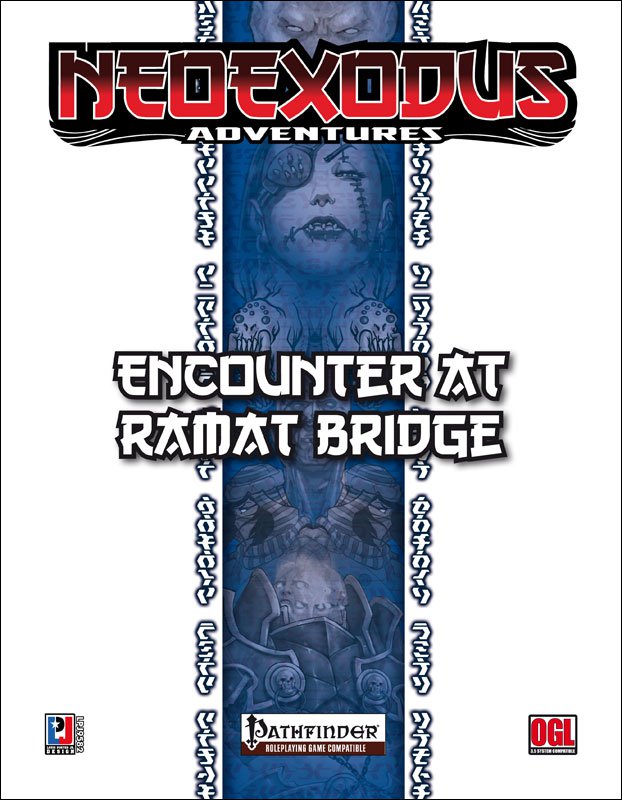
1- Encounter at Ramat Bridge this was the first adventure and really one I think sets the tone for what comes later. I have to put this one at the top. Having ran it a number of times, I know this one is fun for BOTH the GM and the players.

I'm torn putting them in order... I love all four for different reasons. One thing is for sure: NeoExodus adventures are a different breed than what other companies offer right now. Their mix of role-play (based on player decisions) is the only one out there for the Pathfinder RPG. One of the fun things is that a GM running NeoExodus can easily adapt or include material from other companies to give players some breathing room.

Those are "just" four of the NeoExodus adventures we have in the works right now. I have been working on a rework of previously-released (3.5) adventures, but updated to include some material from the Campaign Book and some of the other books I am working on. I hope to get a full list of them out shortly.

JP

Thursday, March 24, 2011

The Mini Guide to Editing Adventures, Part 2

My buddy Jay Babcock posted the following comment as a response to my earlier post about editing. Jay brings up good points, and I feel I should expand upon his points, clarifying my thoughts. I think we are both thinking about similar things, using different words.


I have to say, I truly disagree with two of your points:
> word tense

What if the PCs *don't* go to see Lord J. How you've revised that, it makes it sound like the players need to go see him to progress.
...
Personally, I would probably lean towards a bullet list or subsections (depending on bulk), for keeping it clear and efficient:

"The PCs may progress though several avenues:
* They may go see Lord J. He can tell them...
* They can talk to random beggars in the street..."

> Boxed Text

Yes, there is certainly a thing as too much boxed text, and too much unneeded detail... but your bit about 'use as little as possible, then cut it in half'? Ugh... it leads to boring, flat scenarios, that judges hate to run.

Even if you can find a score of judges that want to 'write your scenario for you' (as I call it), you're not going to be giving the players a uniform experience, especially when it's in the hands of a weaker judge.


Word tense:

The examples I used in my examples were especially short and to the point. He is right to point out that what I have seems to be very directive and cutting out “may”s really make the text seem hard and inflexible, when that’s not the case at all.

In a context where you have a finite number of words to write, "may" and "can" hurt you in the long run. In a context where you don’t have a word count constraint, they are less obtrusive. Writing any material for publication generally involve a word count – or so was my experience.

While they make a lot of sense in a grammatical and syntaxic perspective, they just make the narrative heavy for the DM. Now that said, there are cases where the use of “may”, “can” and the future tense cannot be avoided. There are. But those are generally few.


“The PCs have a few avenues open to them:
* Lord J know X.
* Asking random beggars yield Y.”

That’s 20 words vs. your 28. That’s 28% fewer word for the same information! Over a whole manuscript, this adds up. And it adds up fast! That said, I am 100% with you on the usage of lists and subsections. They make information easier to find and quick to reference. Using them is a BIG plus for the GM. Note of warning, don’t go and embolden everything! That just makes it worse.

A good use of bullet points and subsection often makes all of this redundant. A well laid-out manuscript stands on its own.

Boxed Text:

Boxed text is a necessary evil. A good GM is annoyed by it and a bad GM is bad regardless. Longer boxed texts are useful at the start and at the end of a scenario to link elements together into a cohesive story. They bring the story together and opens the topic at the end.

But in the middle, give the GM the information and let him work with that. Let him work the information into the adventure based on his players. A party composed of noble fops and a party composed of lowlifes would not gather the information the same way.

Something that happened to me (in LG IIRC): arriving in a new town, my Charisma/Gather Info tweaked character is ready to go and do his thing then boxed text tells me everything without a chance to shine. As it stood, I did very little during the adventure when I built myself up that my skills would give the party an advantage. It didn’t happen. Disappointment. Allowing the GM to handle this by himself would make my experience more fluid and gave me the impression that my investment really added something to the adventure as a whole.

There are elements in an adventure that HAVE to be resolved using boxed text. An gripping moment, a specific thing players need to be made aware of, those should be in boxed text. However, my warning is for prospective authors to not consider everything to be important.

I’ll take a recent adventure that I wrote as an example. (The Adventure is Amoran-01 Past Echoes). In the intro: A boxed text 4 paragraph long bring the PCs into the city, tell them what’s unique about the city (narrow, crowded streets, tall buildings and the need to adventure with a license) and even directs to a common place where they can gather. Encounter 1 The PCs go and meet with their prospective employer. A short boxed text describes the location and the particularities. A later 2-sentence paragraph describes the man they meet.(so on).

After play testing, one of the boxed text had to be expanded because some information that was judged important by the PCs was missing.

A GM who needs boxed text to run a good adventure is rare. Put the information in his hands and let him work his magic. You need SOME boxed text, but less boxed text leads to added fluidity in the adventure, which leads to involving the players more.

I guess a parting point, while some organized play campaigns are/were particularly interested in “offering the same game experience”, I don’t think that this is a idiom that is still holds true today. Campaigns like Living Arcanis have always encouraged their judge to play with the players. Others like LFR initially encouraged “DM Empowerment” before they stopped talking about that and that fell into obscurity. Campaign like Pathfinder Society are all about minimal boxed text.

Without going into a campaign-war, I think the way PFS does it is right: Less is more, allow the GM to shine and you’ve got a winning recipe right there. LFR had it right at the start (yes, this is not a jab, they got it right).

JP

Wednesday, August 5, 2009

Writing Good Adventure Writing, Part 5


  1. How is this adventure different than other?
    When thinking about your adventure and its setting, think of what sets it apart from other adventures. Here you want to find out whether your adventure is simply a re-write of an already existing one or something new. If your main plot, main villain, main plot hook and main plot twist is taken from another adventure, you may want to rethink your adventure. A good adventure is not simply a re-write of another one.
    However, this might be what you want to do if you are adapting an adventure from another...
  2. Play-test it!
    Play-test your adventure! Run them yourself or have someone run them for you while you discreetly watch and take notes. I will not go into the theory of finding a good play-test group at this time. Try to play-test with players from a wide variety of backgrounds, playing styles and interests. This will insure feedback that is as varied as possible. Take in that feedback and use it to make your adventure better.
    I know many authors cannot stand any criticism about their work, but it WILL happen. If you do not get that criticism now, be prepared to see your adventure slammed and burned on yahoogroups, web forums and at local and distant events. Better to have people you know and trust criticize your work than total strangers. Gamers as a whole tend to LOVE or HATE things.
    Once the play-test is done, sit down and evaluate the major points of the game.

    1. Were there points where the change was due to a lucky dice rolled? Like rolling a critical perception check at a bad moment, a long series of good or bad rolls?
    2. Was it just a lucky build or item used at the right time? If so, then make sure you ask yourself: how common is it that this situation returns. If a common detect evil spell ruined your whole plot, you may want to look for alternatives or extra plot twists (undetectable alignment, ring of mind shielding, etc.)
    3. Did the players guess your style? Some players who regularly play with a DM or author will guess how the adventure flows.
      I will take for example Chris Chesher, a rather plentiful Living Greyhawk author. Before every adventure I would say. "Okay... this is what will happen: we will be hired to do a mundane task and then we will be presented with a side-quest or side-trek that has nothing to do with why we came and that is where the adventure will happen." I do not believe I've been wrong a single time since I came up with this theory. I got Chris's style pretty good. Now that said, Chris wrote some good and some bad adventures, but his formula remained.


    Another thing I like to go over in more details are the interaction scenes where the players interact with a particularly important NPC. Were there questions the players asked that I have not covered in the text? Frequent question I have a bad habit of forgetting: How much will it pay us? and How long do we have to complete the mission? After play-test I rush to add those information in, always better to cover more questions than too few.
  3. Players can be kept in the dark, but the DM must know where he is going at all times
    There is nothing worse than a confused DM. DM confusion usually leads to a lowered enjoyment of the game and players who start goofing off or laughing at a DM's "load time". That players be confused (at least some time during the adventure) is fine. A DM can be Like a captain in a storm, the DM must always know exactly where he needs to take his ship. Players can EASILY know when their DM is lost or confused.


JP

Monday, August 3, 2009

Writing Good Adventure Writing, Part 4

In this installment, let's go over those things to think about when you are actually writing.

  1. Write with the players playing the game in mind
    This one will get a lot of people go "Well, DUHHH". But it is a lot more insidious that it might appear at first glance. Writing for the players means that whenever you design scenes or encounters, think of what do the players have to do. If all they have to do is listen to an endless tirade by some NPC, then that's wrong. What RPGAers often call "failed save against boxed text". In every scene, encounter and adventure section, the PCs must have something to do.
    Players don't *HAVE* to do something, but they can if they want to and the DM is not completely lost about what he should do next.
    One thing we started doing in LG was to have two section/encounter "Before leaving town" and "Word on the Street". Those two sections were (usually) completely optional to the main adventure, but they definitly added flavor and could sometimes give the players a small edge. Usually arranged in mini-encounters, the DM would gain a lot of insight over what was going on in and around the area where the adventure was taking place..

  2. Write with the DM running the game in mind
    All right... This one is definitely a pet peeve of mine. When you DM an adventure, there is nothing worse than to have to look around a thousand places for information you remember seeing somewhere in the adventure. This is why I always try to write "with the running DM in mind".
    Why? When preparing an adventure, you read it over, digest the content and imagine a few scenes in your mind so that you can render them to the players later.
    Then the players sit around the table.
    Now the DM has to think about a million things: the motivation of the NPCs, their reaction to the PCs, the trap that's coming, how to set up the next encounter, sequencing of scenes, potential side-story between on of the PCs and an NPC, etc. Many details are forgotten in the heat of the moment.
    "Writing for the DM running" means that all the information should be easy to find and as concise as possible. Use of headers, bullet points, shorter paragraphs and clearly-defined sections does help. A lot. That way the DM can simply run the game and not have to search through mountains of text for vital or important information.

  3. Boxed text should be kept in its box!
    Boxed text... the bane of many adventure… Although usually integral to the story, many authors used boxed text to create novels. This is something I personally struggled with a lot, especially in adventures where there is a lot of story. Adventures such as The Ekbirrian Job and The Bull and the Swan where a lot of story and storyline development happened, are particularly difficult not to wrap in boxed text to ensure that every player gets the main plot points. To do that, break down the story into smaller parts so that you don't have to put everything together at once...
    I've played in some adventures where the DM reads a page of boxed text ending with. "Finally, you see the castle up ahead." After the PCs respond "We go to the castle", the DM starts again with another 5 paragraph of boxed text... THE PAIN!

  4. Boxed text on the outside only!
    Boxed text should be "on the outside". By this I mean that boxed text can be more extensive at the start and end of the adventure, when you do not expect or wish PCs to interact with what is happening. The PCs are soaking wet, so they headed for the inn for food and drink is something that makes sense but that they decided to side with the outlaw rebel lord of Sherwood forest is not.
    Still avoid the pitfalls of assuming what the PCs feel, think or react. It is acceptable to assume that if they are in full court, with the king and all his knights surrounding them that they will behave themselves. But not that they assume the king is cool or that his daughter is interested in them. This creates all kind of strange possibility with female characters.
    By keeping boxed text to the start and end, the adventure itself usually feels more dynamic to the players because the DM is often more spontaneous. I know when I have boxed text I often find myself reading it and breaking the "game flow" because I want to be sure I do not miss anything important.
    "Oh yeah, I forgot, there is a big sword pulsating with evil in the center of the room!" is something I once did (OOPS). Not my proudest DMing moment...

JP

Monday, July 27, 2009

Writing Good Adventure Writing, Part 3

Continuing my on-going series about adventure writing. Today's theme: breaking things down into small bites.


  1. Be realistic!
    Don't attempt to write a 400 pages campaign if you've never written a short adventure before. Start small and build from there. Starting small allows you to gradually build up your campaign, refine your themes and ideas, those things do not come overnight. Until someday you wake up with a 400 pages campaign! Crawl, walk then run. This is valid for both veteran and novice writers. Think small and expand. If you think too big, things sometimes get very blurry at a granular level.
    I have found that the basic idea I started to write gets modified, replaces or even discarded as the creative process happens.
  2. Points of Light
    The term "Points of Light" was coined by Wizards of the Coast as part of their enthousiasm-creation for D&D 4th Edition. Although the concept is not new, I really like the name. The theory behind Points of Lights is that an adventure contains just enough to run an adventure. Over the course of many adventures more and more come into the light.
    Thus you start your PCs in the small village of Hommlet. There, they learn that bandit infest a nearby Moathouse. And then that those bandits are in league with the temple of Elemental Evil...By the end, the PCs have visited a number of previously unknown or mysterious locations all surrounding Hommlet. Yet each location was discovered gradually, thus not overwhelming the PCs with monsters and challenges they could not realistically face from the start...
  3. Cover and address the most likely courses of action / KISS
    KISS stands for Keep It Simple Stupid (not just a great rock band) This principle should apply to everything. If something is COOL but does not really ADD to the adventure, then drop it. Copy it somewhere you will review later. A cool idea can be cool in a number of places, not necessarily your *current* writing project.
    Do not try to tackle every possible outcome and every possible way the PCs can crash through the adventure. You need to cover the main 80% of possibilities and leave the other 20% up to the DM. Not only is that impossible, but it is also a waste of time. You want to give the DM the tools to ad lib in a way you would like the adventure to proceed, but that is about the extent of what you can do.
    Your adventure brings the PCs to a fork in the road. The adventure and clues should lead them to the left path. You need to describe what they encounter there (obviously). Some PCs may head down the right path for a number of reason: missed clues, just to be annoying, etc. The other option is simply not to detail the fork (see KISS, later). That PCs head down the left or right comprise the 80% possibility. There should be little need to detail what happens for those parties who decide to go straight, or go back where they came.
    In the above example, mentionning that the forest where the fork is has a lot of hungry wolves who attack people leaving the road. This gives a good idea to the DM what the PCs might encounter if they leave the road without any more details (and your 80% target just went up to 95%!)
  4. Many shorter adventures are better than a massive one
    This one I want to drive the point to you the reader... It is better to write many shorter adventure than one big, never-ending story. Whenever possible, try to break your super-world-shattering adventure into a series of smaller adventures. Not only is a climax easier to build through a series of adventures, but also it allows for good break points, for a DM to place some transition adventure(s) of his own design in-between. In short, it allows for breathing room.


Good Gaming everyone...

JP

Friday, July 24, 2009

Writing Good Adventure Writing, Part 2

In a previous installment of this blog, I tried to identify what was needed to write a good adventure. My conclusions were that the Introduction and the Conclusion where the most important parts of any adventure. Here I will continue my reflexions about adventures... By focusing on the adventure as a whole.


  1. Trust your Experience
    You wrote other things before. Use and call upon that experience when writing. Think especially of games the did go really well and games that didn't go so well. Think of those games another DM ran for you that you liked or disliked. Your experience is what will allow you develop your own style and bring together different elements into one coherent and personal whole. Your experience gives you reference points to use.
  2. Play the Game!
    There is no substitutes for actual game playing. If you want to write, I recommend you play or run something. Keep a notepad handy because sometimes inspiration might strike as you are playing... And the idea that gets away might be the one. The One. You'll hate yourself for missing it and you'll hate yourself for missing the game because you keep focusing on your idea!
  3. Know the game
    This does not mean that to write an adventure, you must have intimate or thorough knowledge of every bit of rule ever published. Not at all. Things you need to know are:

    • What makes that game unique? Use the setting elements to your advantage. This question could also be phrased "Why can't I write this adventure for another game system?" For example, I would prefer to write adventures centered around knightly virtue using Pendragon (or BRP using allegiance/virtues) rather than D&D. Why? Because the rules allow the DM to "help" the PCs along to take the right path. Similarly, if I wanted to have a heavy magic system, I might prefer D&D to Ars Magica because it is simpler.
    • What do players when they hear of the game? I do not expect the same type of adventure when playing Vampire than when playing D20 Modern. There are things I expect to see or do. In Vampire, I expect a lot of interaction. In D&D, I expect action & combat. In Call of Cthulhu I expect death and insanity. This is not to say that a Vampire game can't be centered around action or insanity... But I would expect at least some interaction with NPCs.
    • You are writing, not DMing when trying to write something, especially something you would like to publish, let the DM run his game. It is illogical (and foolish) to assume that every DM will run every adventure the same way. House rules, personal preferences and party composition will affect how a game will run.

  4. Know the format
    When you decide to write an adventure, it is important to be familiar with the format of the adventure. I have met with many DMs who always write "Campaign starters" leaving a million plotlines open, when the adventure is only scheduled for a one-shot game at a con or game story.

    • If your adventure is a con-game or one-shot format, I personally advise to keeping the plot simple and concise. There is no need to start a major campaign arc during such game. Keeping the plot simple allows for the players to develop their characters more. Focusing on a difficult choice or role-playing decision the PCs must make usually creates an interesting role-playing experience.
      I personally believe that in a one-shot game, the PCs should have a reasonable chance or guessing or figuring out at least 90% of the adventure background. If they cannot, then the author is writing too much and wasting his time. Here, I will use Star Wars as an example. The First Trilogy (A New Hope-The Empire Strikes Back-Return of the Jedi) does not need or go into any measure of detail for
      Having learned that the man who hired us is an evil SoB, do we still continue our quest, or turn on him?
    • If the adventure is to serve as the introduction to a campaign, then you can expand on the theme and leave more loose ends. However make sure that your first adventure gives a good taste of what is to come. If you are planning a combat-heavy campaign, then have the intro be combat heavy. If you are planning something investigative then your first scenario should be investigative.

      The important thing is to come up with a good sampler of the campaign. That way the players will know right away if they like or dislike. This is something I have been very guilty of doing. Setup a first game that was combat intensive for a political campaign. Then I ended up with hulking brute PCs who could not realistically perform in the campaign.

      Notice my use of the word "theme" earlier. Using theme sets a tone and allows you to change it. You may or not introduce or mention your main bad guy during the adventure.

      For example, if the theme is "Struggle against oppression" then your intro could have the PCs unjustly thrown in jail, break out of a prison camp or be abused by some ruler or authority figure. This sets the tone for the campaign.


That's it for now !

JP

Wednesday, July 15, 2009

Writing Good RPG Adventures, Part 1

Recently, I have been thinking what makes a good adventure and how to write something that is fun, interesting and entertaining. This question is of particular interest to me since I have responsibility with the Living Forgotten Realms campaign and I like to think the adventures for the Moonshae Isles (those I have responsibility for) are a cut above the rest. And I want to keep them that way.

Having been guilty of putting together some good and some (usually very) bad adventures together, I have been thinking about those mistakes I did in the past and how to avoid them over and over (it's called "Gaining Experience"). So that each adventure I come up with learns from the mistakes of the previous one I wrote, ran or played in.

I mean it is easy enough to tailor adventure specific to one's gaming group, but writing adventures and campaigns when you don't know exactly who will be playing, what they will be playing and what they like to play. Those good adventures I am thinking about are those adventure one writes for everyone. Like those published adventure you would buy and run for your friends.

My Quest


First, I hit my friend google.com looking for "tips on writing good adventures". There amongst a number of methods and ideas, I found a few sites that kinda hit the mark... Most of them offered a variety of formulas and tricks in writing adventures. Many of the formulas present make for very repetitive adventure formats. While they are definitly good for a game system that lends itself well to formula (I'm looking at you D&D 4th Edition), I wanted my article to be generic. I may yet write about formulaic writing at a later time, I wanted this article to be useful for all genres of RPGs.

However, I strongly believe that "Variety is the Spice of Life" and what I like writing and playing mirrors that. So the ready-made formulas for adventure writing don't do it for me... I find them predictable and after a short while, boring. This caused me no end of angst. How could I write an article about writing good adventures when I did not even believe that a unified formula existed...

Another thing I found were how to find inspiration. That is definitly a topic I will want to cover in a later entry, it really was not what I was looking for.

Next, I sat back and began making a list of those adventures and campaigns that have marked me the most as player or a GM. Maybe there were some similarities there I could find.


  1. Call of Cthulhu: The Complete Masks of Nyarlathotep This campaign is really the supreme overlord of all campaigns. It has everything: a world-spanning and affecting plot, memorable villains, action, exotic locales and best of all, a deep and complex storyline. If you have not played this yet, you are missing out.
  2. Rifts: The Aliens Game This game was run by a guy named Alex back when I was in high school. This adventure ranks as my favorite all-time game. We were sent in this complex that was full of Aliens (like the movie)... This is the only time I ever saw dead PCs come back for part 2 just to see what was going to happen. My own operator (Bob Mackay) managed to live through somehow... Awesome! Alex killed no less than 8 PCs as only Sim & I got out. Although this one ranks #1, it was not a published adventure, so I'll have to count it out... But take those things I like from it as Alex didn't know or care who showed up, only that his adventure could handle it.
  3. Call of Cthulhu: The Winged Stalker I ran this adventure in Sherbrooke on a cool evening. It was greatly inspired by "The Family" in the "Adventures in Arkham County" book by Chaosium but expanded it. The tempo of the game was right, the dangers were right, the players' participation was awesome.
  4. Macross ][: The Fringe Wars This campaign I ran in the 90s was largely inspired by a mixture of Macross II, Robotech, Gundam (the good stuff, not what's on now) and battletech. It pitted the PCs, who were pilots for the UN Spacy against asteroid belt miners and enemies. I later integrated all of Robotech: Strike Force into the campaign.
  5. D&D: Eye of the Phoenix I remember running this one early on while in high school. A lot of investigation, nasty dungeons, cool plot twists and uber-elemental evil. This one had it all. Although I don't remember the PCs living passed the Necropolis, the rest of the adventure was pretty cool.
  6. D&D: Eye of the Phoenix I remember running this one early on while in high school. A lot of investigation, nasty dungeons, cool plot twists and uber-elemental evil. This one had it all. Although I don't remember the PCs living (or playing) passed the Necropolis, the rest of the adventure was pretty cool and a storyline I always hoped I could run all the way through.
  7. WHFRP: The Lustria Expedition This was a campaign I pieced together from a number of ideas I had. It took the PCs from being dirt-poor in the Empire and forced them to join an expedition that landed them in Lustria. This was one of my first true attempts as incoporating downtime into the campaign. Thus the PCs were given tasks and X time later they were done and adventure called once again! I haven't published it or anything, but during my design, I had no idea of the PCs who would play through the campaign.
  8. Rolemaster/MERP: The last Retid This campaign was my first and most successful historical campaign. To this day I salivate at the idea of this mix of history, fantasy and epic greatness... Campaign that pitted us PCs against the gods at the dying of an age. Just awesome. I originally thought my DM had run us through the Mythic Egypt stuff but he went far above and beyond. I still hope to find his notes and stuff he had about his campaign on-line so I can run it for others...

Pretty bizarre bunch... A lot of fantasy, some historicals, some sci-fi, some "Modern"... Though there are many campaign I loved, I have not mentionned in here: my World of Darkness Montreal & Dark Ages stuff and then some games I played while at Sherbrooke's or in Europe.

Not to narrow it down to some of the stories/chapters adventures is even harder... Still what did each of them have.


  1. Introduction Okay not a revelation but each of them started by making sure the PCs were situated. Why are they here? What is their immediate goal.

    • The Masks opens with the PCs getting a telegram from one of their friends.
    • The Aliens Game opened with us money-hungry mercs meeting with a local king (or was it a wizard?) who offers us money to clear out and investigate this strange place.
    • The Winged Stalker also opened with a telegram.
    • The Fringe Wars opened with the PCs being assigned to the Asteroid belt, the ass-end of space.
    • Eye of the Phoenix had the PCs hired by a church to investigate some strange indentured servants in a remote village.
    • The Lustria Campaign opened with the PCs committing some crime that inevitably failed and they were thrown in jail.
    • The Last Retid opened with us low-level PCs being offered a position in the Pharaoh's administration. We were put in charge of an outpost and charged with meeting our quarry's quota.

  2. Development I will not go into complete details about each of the above games. However, suffice to say that each of them had the PCs evolve from that introductory level.

  3. Conclusion If there is one thing I can say that made all those games great is that they ended. I know it sounds strange, but the fact that they ended (most of them with a bang) made them memorable. To this day, I always prefer campaign or games that have a stated goal or a projected end... Than those that just go on and on... Nothing wrong with ever-going campaign, it is just a matter of personal preference...


Hummm... So to me, the Introduction and the Conclusion are the two most important parts of such a game. While important the Development can have some lame duck parts and still have the whole work and leave a good impression on the players.

The Introduction


The intro is very important. It gets you hooked into the situation and changes the PCs. The introduction is what makes them the focus and center of the story, not just average joes. The hook that takes the PCs into the story needs not to be completely different and unique. As the name implies, it needs to capture the imagination, draw the PCs into the story and interest the players so they will want to know more.

The introduction is unique in that usually the course of action taken by most PCs (not the ones who always refuse any hook offered to them) can be predicted. Most PCs will try to see what has happened if they find an overturned carriage on the road or a burning farm or castle in the distance. I have found that players are not as opposed to have circumstances somewhat imposed upon them during the introduction of an adventure. "You all walked in from the rain to warm up" is something we have in every Moonshae Isles adventure so far. Beyond the very early stages, PCs should be freed from any DM-imposed action. This is what happens in the major MMORPGs' storylines and Fighting Fantasy books.

I have found that a number of DMs put so many fireworks into the introduction that the rest of the adventure cannot live up to the hype. To me, movies like T2 and Gladiator are exactly like that. The opening scenes are just awesome... but then the rest of the movie is well... not as interesting.

As long as the PCs are drawn in and want more, the introduction has done its job...

The Conclusion


This I find that many authors have issues with. A terrible ending completely ruins a good adventure. It leaves the players with a bad taste no matter how thrilling or exciting the rest was. Rigid solutions to problems/riddles or single path through should be avoided. That the PCs have to defeat an opponent is not a "single path". That they have to defeat the opponent by saying some strange key word and dance the macarena is fine, but if that is the only way to do so when the Big Bad Guy (BBG) is standing under a big chandelier with a balistae in the corner of the room while he is surrounded by highly-explosive power crystals, is. And it is bad.

I can't help but think of a local Dark Sun adventure that a DM wrote for a local con. I took part in the playtest for his adventure. The hook was good, the plot proceeded forwarded in a decent manner. When we got to the finale I was thinking. "Wow! This is gonna be good" There were so many plot elements to play with. A nasty defiler performing some rite that would transform him into some kind of lich being, a giant chained to the wall struggling against his bonds, chanting cultists, a powerful tree of life. The party spent a good deal of time plotting what we would do next. Finally we had one of the players turn invisible and free the giant, hoping the giant would rampage through the room killing cultist and (we hoped) soak up a number of the defiler's higher-level spells.

After all this plan, using as many of the provided elements of the setting, the DM went "Okay, you all die because the defiler kills everyone." I was stunned. My reaction was "Dude! If I'd've paid for this I would be punching you in the face right now for wasting 8h of my life!" I was fuming! The worse part is that most of the comments we gave him did not register and his rigid ending where we had to wait for the defiler to turn into the lich then kill him remained. Players who played at the con hated the adventure as well. I have NO issue saying that I will not play under that DM again. I like the guy, but won't sit as a player with him DMing.

Conclusions, I believe should be broadly scripted because two groups of PCs are likely to get there using very different means. "The PCs confront the evil Duke in his castle" or "The PCs must race to stop the cultists" or "Using the artifact of greatness, the PCs lift the curse upon the Country". Those are clear enough an allow for some variation. Let's just take the first example where the PCs have discovered that the Duke is a BBG. Some parties may be given to stealth and try to sneak into the castle at night, ninja-style until they reach the Duke's chamber. Other parties who have a more social-bent may try to pass themselves off as travelling knights to enter the castle. Finally a third party who is more magically inclined might scry upon the court for a few days before teleporting into the castle.

In the end, any group of PCs should be able to complete any given adventure. Some groups might have an easier time than others but all should be able to complete the adventure. By "all groups", I assume that within a certain setting a given group has a decent chance of success without relying too much on one PC or one given ability. "You guys don't have the Open Lock skill or a knock spell so the unnaturally resistant door of unmoving can't be open. You guys can't access the treasure room of awesomeness!" Ends a game pretty badly.

Do not mix a good conclusion with a mega-happy end. Some adventures end with some character death. That's fine. Sometimes heroes die too, make their plight more real. I mean if Frodo fell into Mount Doom with Gollum, it would've been a victory for Middle-Earth even if one of the protagonist did not make it out alive. Call of Cthulhu is a common game where player deaths are more than commonplace. But vanquishing an enemy they thought they could not do is often a bigger reward and makes for stories one can tell to generations.

One such example was the culmination of The Last Retid campaign where in the final act, we took on the God Set himself! Our warriors and the archmage fell fighting. I, the priest of Anubis, was the only one who remained standing (barely). When our Pharaoh arrived, crowned with the Glory of Horus. He told me "stay down and witness this for the ages." As he and Set began fighting it out for control of Egypt. In the end, they killed each other, ending the rule of the Gods upon the Earth. My character lived to tell the story. It was grandiose!

Some authors have what I call the "Forgotten Realms Syndrome" where each author (and each adventure by an author) tries to out-do each other by having bigger and bigger impact on the game world. The first one levels a small tribe of barbarian, the next one levels a town, then a country, then a plane of existence with bigger and more ridiculous spells and artifacts. While it is true that in most fantasy RPGs, as the PCs go up in levels they begin to weild bigger and greater items. While it is true that level 15s should not be travelling around clearing out level 1 goblins, every adventure does not need to, and indeed should not, end with the destruction of the world.

Another good thing about Concluding adventures and campaigns is that after that, you are free to start something new or different. Now that the evil duke is dead, the PCs can begin to search for his long-lost brother he had imprisoned in the Fortress of Veryfaraway. Though sometimes conclusions are just that ending, they can also lead to other, greater things to come. I know many DMs are scared of ending adventures just because they are under the impression that nothing comes afterwards. If the DM's intention is to continue or expand the adventure into a campaign, then the Conclusion should lead into the next one. The chapter has ended and the PCs are ready for the next phase of their lives.

For example, the Fringe Wars featured a number of different story arcs that concluded and rolled into each other. When the PCs got off planet Italia, they returned to their lives at UN Spacy only to be reassigned to another sector and more adventures.

In The End...


I started this trying to find out how to write good adventures... And this is turning into much more as I drift and mingle Adventures and Campaigns... Still the two parts that I personally find most important in either is the begining and the end. Start Catchy and End Strong.

JP