JP On Gaming

Showing posts with label Living Forgotten Realms. Show all posts

Saturday, February 11, 2023

JP on DMPaulG about Living Forgotten Realms

A few weeks ago, I discovered DMPaulG's YouTube channel as he was delving into the now-classic LFR adventures I wrote and edited for the Moonshae Isles. Talk about a blast from the past!

It had been almost fifteen years since I even thought of those adventures. With the recent OGL situation, I spent a few hours listening to him try to glean information from these adventure, to extract lore he could use to produce newer content. A trip down memory lane... I reached out to him to talk about it and we agreed on a having an interview for his channel live on Twitch.

You can find the whole interview here on YouTube.

I had a lot of fun. I can't wait for the next one.

Monday, January 27, 2014

Advice to start an organized play group where you live

A few things I personally did with LG, LFR, PFS and NeoExodus. Many of those are NOT what the PFS establishment will want you to do. But they work.

1- Under NO circumstances should you EVER cancel an event. EVER.
2- Show up ahead of time and talk to people in the store. Don't assume the store owner sells the product for you.
3- Be inclusive, sell your game to everyone you meet. EVERYONE
4- Don't get discouraged.
5- Never, EVER cancel an event (unless attending would be dangerous (and even then))
6- Work with the store owner, keep him in the loop of what's coming, when you plan to run more event. And ask them whether people have been asking about PF/RPGs, if he has other things running so you don't clash. NEVER leave these guys in the dark. The more they know, the more they will help you. The more they see you run events, the more they will pimp you and your game out.
7- You will have kids, noobs, morons, "old gooks who never played an RPG since 1991", the "guy who plays only obscure indy games in his basement" or the "guy with the same group since 1977". But you will gradually see more people and many of those people will be great players, and often some people you don't like initially turn out great (and vice versa).
8- Run in public, and make it seem awesome! So that people seeing you play will to play WANT to join you.
9- Talk to people who stop to look. Take a minute to give them a quick run down. Introduce the game, selling the high points. Always invite them personally to the next session, no pressure, but make them understand that if they miss it, they miss out on something really awesome.
10- While new players are important, make sure you talk with the old ones and keep them interested and engaged. Get the local "well-known GM" on your side.
11- One thing that always worked well for me: use a single point of reference. Don't direct people to a website AND a facebook AND a google group AND a meetup AND on-site AND on your phone. One place, one source of information, and direct the traffic there. This has a number of advantages for them but also for you: you don't have to scan or post updates to different places for people. Allows YOU more time.
12- Network, network, network, talk to people, email, skype, facebook (and direct all traffic to #11).
13- Rather than selling "PFS" focus on selling "RPGs". "Learn to Play" events (where you teach PFS) are often successful, expect kids and new.
14- Encourage players to buy at the store, never encourage purchases from illegal sources or online. This will really encourage the community and the store.
15- You're in charge, don't let any loudmouths talk over you or be over bearing to noobs.
16- Consider any money you put into this lost. (Includes meetup costs, advertisement, gas, meals, and the occasional purchase).
17- Never, EVER cancel an event unless attending would be dangerous (I mean snow storms)
18- Remember that the adventures are irrelevant, change whatever you want and need, focus on providing a quality, fun, entertaining game experience. People will remember how your orc limped, but not that he has 8 or 10 hit points.

Oh! And outside the gaming world, people don't know what Pathfinder is.

That's a collection of thoughts and ideas.

JP

Monday, January 7, 2013

More tips to create fun characters

Following my Friday's post, I received a few additional emails through various sources. I chose some "choice morsels" to re-post here.

Sean Clark is one of the "old guys". Okay not so much because of his age, but because he was around in the days of Living Greyhawk. Sean really creates unique and colorful characters... I like his advise. It's simple and to the point. I especially like the catchphrase idea, what a great idea to get into your character.

Don't stress on fleshing out your characters life story - work from a solid concept and let the character develop over time.

If you have problems staying in an accent, work on a catch phrase for your character, using that accent. That catch phrase can help keep you " in the groove" and also helps people remember you character. Example? Try saying "That's freakin' huge!" With a Scottish accent ;)

One of the great questions that I always ask myself about each character is "what motivates this character to risk life and limb to go adventuring?" Kind of a basic question, but it can really help nail down what drives your character.

Make sure your character is really good at something. Role playing is awesome, but if you party TPKs because your character has a lot of personality, but brings nothing to the table, the players WILL remember you, but not in a very positive light.

And Jeff Kokx, owner of Enchated Grounds added to the discussion. I consider Jeff one of the best player (and GM) I've played with over the years. His point reaches mine about not predetermining everything about your character. Play and interaction with others creates ties and recurring relations that make for unmistakable moments.

His advice is great. Great point.

I'll also add on to Sean's idea about letting your character develop over a bit of time: don't be afraid to let other players' influences define who you are. One of my favorite characters to play is Khaldun, my dwarven guide. He is uncouth, butchers names on a regular basis, and respects people with really nice hats. The uncouth and hat parst came from another player's input, and I love those aspects of his personality.

Eric Ives shared the following thought which I really liked. A character is never "mysterious". In an organized play setting, Eric is 100% right that a mysterious character remains mysterious. If, as a player or GM, a mysterious character is someone who simply gives you no hook.

That's not to say that the "mysterious" thing cannot be used. Having a character with a mysterious tattoo or mark or a weapon of mysterious design at least prompts the question "what is that?" But being a mysterious stranger... Well see Eric's comments.

I've played at quite a few of the Learn-to-Play nights over the last year and one mistake I see a lot of new players making is to define their characters as "mysterious", thinking that that means "cool", but in this context it usually means "boring", both for the player and his teammates. In this setting, no one has time to draw your character out of his shell, and most people just aren't going to care about the slow reveal of your secret origin. From what I've observed, the people that have the most fun playing in PFS are usually playing characters that are relatively up-front, understandable and at least somewhat entertaining to the other players.

Do YOU have any tips, comments of advice?

JP

Friday, January 4, 2013

Making Fun Organized Play Characters

I have been talking to players who asked me how they can create unique characters - particularly for Organized Play. Though many campaigns focus only on the combat and ignore or minimize the non-combat to "a few dice rolls", many GMs and players enjoy doing something than comparing the amount of damage they did.

One thing LPJ and I have talked about has always agreed upon is that art must make a person go: "Who is that guy?" and "What's his story?" Those two questions seem fairly simply but how many times have you looked at a piece of art in a book (RPG or not) and asked yourself those two questions?

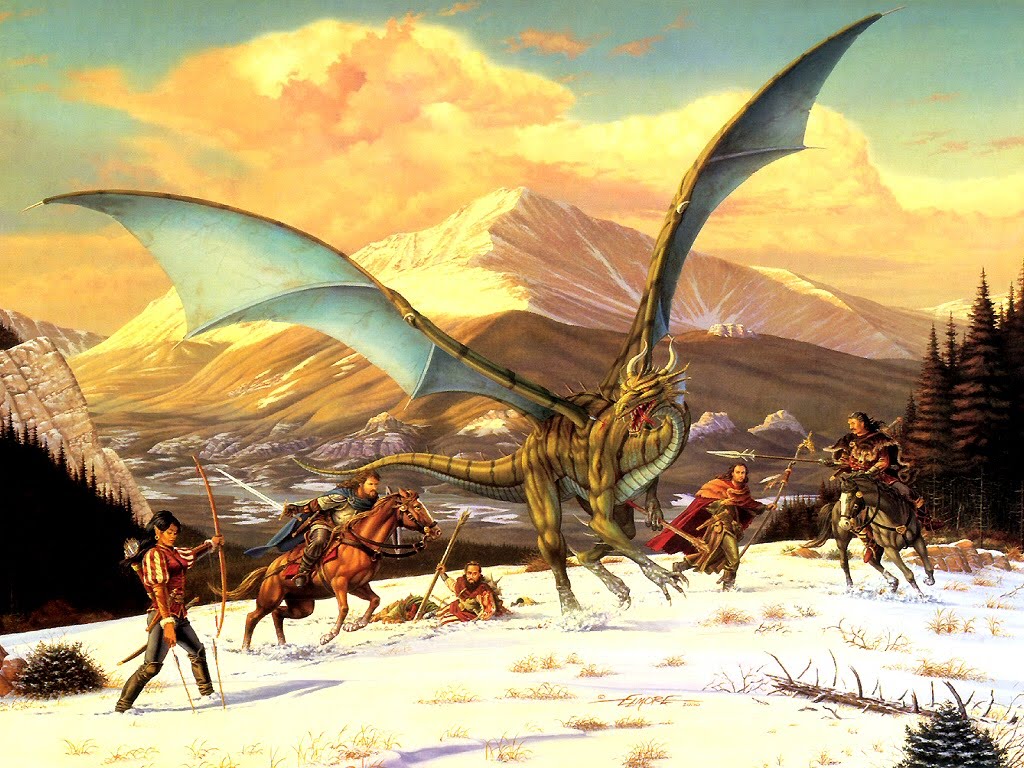
One of my favorite artists is Larry Elmore. Other than a great realistic way to draw, LE always created scenes that made me want to know more about how things got the way I saw. When I look at the image to the right, I don't think "That elf girl is a 6th level ranger with bow focus, and the Manyshot, Rapid Shot and a bow +3" or "that mounted swordman is a 12th level cavalier with a +25 in Ride and a +3 demonslayer sword".

Let's look at what we know from the Archer Girl: She is an elf. She is an archer wearing light armor. Her dark hair could indicate a tribe or even half-elven heritage. She has been here for a while, perhaps having set an ambush (why would she plant arrow in the ground rather fetching them in her quiver). She seems poised and calm amidst the chaos of battle. The hair + earring combination makes me think she might be from a gypsy-like culture.

And now the mounted swordsman: he carries a sword and shield. He wears some type of breastplate with a simple cloak - making me think he is either used to the cold perhaps coming from a place where this weather is common. From the way he handles his horse, it is obvious that he is used to riding and his horse used to be taken into combat. His eyes are on the dragon's head but he seems to be preparing for an attack behind the dragon's legs.

From either of those two simple description one could make vastly different characters. For the fun of it, try the exercise on more LE's art. Feel free to try it on any art you find on Deviant Art or Elfwood.

If you only saw two sets of stats, then there is little I can do for you.

Creating a unique character

When creating a character for it (whether NeoExodus or PFS), I try to think of my character in the following terms. "What will MY character bring to the table that would make me a useful member of a team?" and "What will MY character bring to the table that can help the party succeed?" By answering these two questions, I generally try to answer in terms that are not strictly in-game.

Next, I try to think of a few quirks. Those familiar with GURPS will know exactly what I'm talking about. These are small personality tricks that make your character unique. This could be an accent, a little trick they do, a basic character trait, in short something that cannot be quantified in pure game terms.

From the 2 questions and the 2-4 quirks, then I start building a concept. This makes characters completely unique without having anything to do with his stats.

Here are my first three PFS characters with the basic idea I had for them: People often remember them simply on the basis of these quirks.

Katharan al-Zawree: "This character will be an awesome face and highly utilitarian caster" Quirks: Acts like a spoiled brat, speaks with a "Borat-ian" accent, promotes her business "Al-Zawree oil"
Sir Alexite von Crispin-Thrune: "This character will be able to do almost everything non-combat" Quirks: Speaks with a french accent, strongly devoted to Asmodeus as the "lord of contracts"
Naadhira al-Zawree: "This character will be a kick-ass necromancer" Quirks: hates Katharan, speaks with the same accent, hands out "if you find my body" cards

Now I have a concept that can be ported to any game system. I now have guidelines upon which to build my characters.

Playing a unique character

It's one thing to have created the most unique character in the history of the game. If you forget everything once you sit at the game table, you simply wasted your time.

You now have a character with some interesting traits. It is time to bring that character to the table and explore the world.

Here are a few tips.

Your quirks should be easy to remember and play If you can't make accents, do not build a character based on a stereotypical Italian pizza man. YOU are the one playing your character, others will not be reminding you "doesn't your character stutter?" They won't.
Your character will evolve based on his game experience, go along with it One of the worse things you can do is to plan your character for the next 50 level of his life. This is convenient, but completely unneeded. It makes you unresponsive to what happens around you. Some of the best characters I played completely happened when I least expected it. One such character was my cleric of Berronar Truesilver in LG who I planned on making a Clr/Ftr. However as a CLR2, I met an oracle who told me that I would become greatly involved in magic. During the adventure, I found a spell book. Well, Torgga finished her career as a Mystic Theurge! She became one of my favorite characters, and a memorable one at that!
Focus on what YOUR character would do, not what YOU would do Your character should have thoughts an ideas that are his own. Your character is not YOU. He is influenced by you, draws from your experiences, but he should have goals and thoughts of his own. And alignment should not be the determinating factor in his personality. Some of your characters may hate such another PC but like others. Most players dislike playing Naadhira because of her abrasive personality, yet about as many like having her around because she keeps people alive and does her job well. Yes, she's abrasive and threatens people all the time, but she also keeps them functioning (though a few people would rather not...)
Don't talk about your character in game terms That's perhaps the easiest. Use non-game words to describe your character. Don't say "I'm a fighter". Say "I'm a veteran mercenary" or "I live to slay [orcs/ dragons/ demons/ ninjas]". This makes is fun because your character does not have "fighter" or "barbarian" or a unique combination of classes. Never lie to the GM, but don't be afraid of passing notes to him about your class. If you ever pull out the surprise where your fellow players look at you with round eyes and go "you can do THAT!?" is well worth the reward.
No one else wants to read your background, you have to make others interested in it Many players believe that writing a novel for your character and giving copies to all your friends and fellow players is a great way to give yourself depth. It does not. It gives your character a back story. The experiences you had should affect how you play. How did the experiences he had in the back story affect how he is today? Did you characters grow cautious or brash? Did he gain a fascination for spiders and other things? That's one thing. The next is to have your character bring in tidbits of his story. Let that be the catalyst for in-party discussion. Understand that your character's views and story may not be the only one.
Do not get discouraged Many players get discouraged because others only care or focus on the stats and the number. One of the things about Organized play is that not everyone wants the same thing. Some people are just there for combat and others are there for the social. The goal is to make sure everyone gets their fun and perhaps find that there are some bright spots. Campaign culture really plays a big part of that. Campaigns where AC 30+ "wins" and all you need is a mindless barbarian dealing 50+ damage at level 2, will result in players doing exactly that.
There is no difference between in-combat and out-of-combat character unless it is part of your character, your character doesn't have a personality that turns on or off during combat. If your character is shy, he should act that way in and out of combat. Try to stay true to your character.
Combat should not trigger that type of surprise change.

Yes this was just an excuse to put one of rock's most awesome and insane anthem: Genesis's 1972 "Supper's Ready" the sweetest tale of the Apocalypse... When they were great. Really. Awesome... All the way to the raising of the sword at the end... NICE

Practice, Practice

Now all this is simple and easy to say, but you should practice, practice, practice. You won't be good at it the first time around. But the more you practice and keep reminding yourself of your quirks and how you want your character to be.

Oddly enough, I found this to be easier to do when GMing. Take a few NPCs and think of them in that way. Make them unique. The reason it is easier is that you do not have to play the same character for X hours. Rather the character comes in, does his thing and leaves. You may them think back upon your performance and practice it.

I practiced - quietly - my Joker laugh/ giggle at work for a week before I got it to a point I thought was both sinister, funny and insane.

I didn't tell my players, but WAYYYYY back in an era of innocence, youth and craziness, known as the 90s, I practiced that... ON MY PLAYERS. At the time, I used to have 2 groups of Vampire: The Masquerade I would run. Both of them in the same in-game town (but I had one group in Montreal and one group in Sherbrooke). One of the things I (still) like about VtM is the fact that you have relatively few Vampire NPCs, so they are frequent recurrent characters. By having 2 groups, it quickly became obvious that they would both come in contact with each other.

And contact they had. So many times, I played PCs of group 1 to the PCs of group 2 and vice versa (then off-screen I would tell the player I impersonated the gist of the conversation he had). Then one time, I had a "party merge" where they all got together for some big event (can't remember what it was). The players were amazed at how smooth the transition was. And I was happy about it too.

If your spouse - or significant other - is like mine, she should provide you with ample quirks to mimic. Mimicking my wife - usually behind her back - is great and hilarious... Until she finds you then you pay for it.

In short, there is no "bad way".

JP

Friday, April 27, 2012

Organized Play People: Talking to the Admins about GMs

When I started this whole thinking process few weeks ago, I had an idea and I wanted to see whether my master plan could be applied to all products. However, as the conversation evolved and more input was added to it, what I came to realize was that with the variety of organized play campaigns out there, nearly every play style was catered to and the variety of systems and campaign goals was pretty wide.

Now, different campaigns mean different strokes for different folks, and the can only benefit the community in the end. By making a comparative presentation, it is my hope that you, my readers, can find and promote locally the OP campaign that you prefer. We talked about Organized Play in a manner that was system-less, focusing on game play and what GMs were allowed, not allowed and methods of empowering them to allow them to shine.

This conversation took place between the following people appearing in alphabetical order. Many of whom you will recognize from previous chats on this blog, and a few new faces. They are all known faces and names in the field of Organized Play campaigns.

Teos Abadia (Ashes of Athas) Interview

Jay Babcock (Living Divine) Interview Part 2

Kitty Curtis (Legends of Arcanis) Interview Part 2

Cory Mills (Legend of the Five Rings) Interview Part 2

Steven "Bull" Ratkovich (Shadowrun Missions)

Pieter Sleijpen (Living Forgotten Realms) Interview (with Dave Kay, former campaign admin)

James Stepanek (Serial Pulp) Interview

When I started this whole thinking process about two weeks ago, I had an idea and I wanted to see whether my masterplan could be applied to all products. However, As the conversation evolved and more input was added to it, what I came to realize was that with the variety of organized play campaigns out there, nearly every play style was catered to and the variety of systems and campaign goals was pretty wide.

Now, different campaigns mean different strokes for different folks, and the can only benefit the community in the end. By making a comparative presentation, it is my hope that you, my readers, can find and promote locally the OP campaign that you prefer. We talked about Organized Play in a manner that was system-less, focusing on game play and what GMs were allowed, not allowed and methods of empowering them to allow them to shine.

This conversation took place between the following people appearing in alphabetical order. Many of whom you will recognize from previous chats on this blog, and a few new faces. They are all known faces and names in the field of Organized Play campaigns.

Overall

Although in different ways, everyone agreed that the goal of this is to provide a fun experience for everyone involved. The how varies, but that is the obvious end goal. Talking with these guys really bring out their passion and really makes for a dynamic conversation to say the least.

Everyone strives to make their campaign unique and successful. This is where I see a lot of variety and really opens makes it so that we - the players - get to pick and choose campaigns we like best.

One thing that came up multiple times was the "GM who ignores whatever is written" and run his own version, completely ignoring the adventure. This subject was heavily debated without a solution that really satisfied everyone. Although this happens in every campaign, I believe that this is the minority, that most GMs do a good job or running and keeps changes to a minimum and keep closely to the written script.

The Two Parts

Two elements really popped that I think we should separate that in their own word, every campaign administrator separated.

First, the Fluff, or the story itself has almost everyone agreeing that all major story points should be kept unchanged, or altered as little as possible. These points, in campaigns that focus heavily on a bigger story (I'm thinking of Living Divine and Arcanis), can really hurt the campaign (and the player's involvement) if the PCs fail to learn or experience a critical event.

Second, the Crunch, the crunch or system-specific numbers (things like hit points, armor, number of monsters) see more versatility and GM freedom. Some campaigns prefer to keep it simple: run as is; others give GMs near total freedom while a third group provide the GM with guidelines on how to adjust (either in the adventure or in their campaign documentation).

But don't take my word for it. Here is what THEY had to say about it.

Steven "Bull" Ratkovich

The general position is: "In the Gamemaster we trust". We have to put our faith in our GMs to do what is best for the adventure and for the players sitting down at the table. And if that means changing things up to handle whatever the players bring to teh table, so be it. At the end of the day we want to provide a challenge to the players, but we also want them to have fun. And if it's not fun, then we (both the Gamemaster and the Missions development team) have failed.

Our guidelines are simple.

1. GMs should hit all the major plot points in the adventure, even if they go "off book" a bit. Seasonal Missions are designed to be complete adventures by themselves, but they serve as part of a larger storyarc as well. So we encourage GMs to play out all the major events, so that players don't miss out on anything.

2. Players get a Debriefing Log at the end of each adventure that the Gamemaster should sign. on this Log the GM should note anything major that happens "off book", so that later GMs can see it and incorporate it (or at least know that the GM really DID let them steal an attack helicopter).

Teos Abadia

We ask DMs to stick to the adventure's plot and to not rewrite the adventure (don't put in new encounters, don't change the monsters, etc.) but you can play with how many monsters you use, etc. In AOA the text of the adventures really allows for whatever is fun - that's the real goal. If it isn't pleasing your table, don't do it. We expect home play DMs, for example, to often hack up the adventure and do different things, and that's ok. We see pretty wide improvisation at cons, which is cool. Because in AOA rewards are specifically tied to the adventures and chapters (you level every chapter, you only earn what is specifically granted) anything else they do is just for fun.

With Ashes of Athas we took DME a bit further (than LFR) by more formally writing it into the player and DM guidance documents, plus making it clear in each encounter that the DM can make alterations for fun. We do this by first stating the intended challenge level of the encounter, then suggesting various things DMs can do, including several suggestions to scale the difficulty. It becomes really clear that it is up to the DM to create fun play. We're very happy with how it has gone and continually increase this aspect. We have recently had adventures where there is mapless combat and the DM is encouraged to play around with the particulars, for example. So yes, our DME policy has absolutely been something that influences our design and that of our authors.

Kitty Curtis

Arcanis has judge empowerment and common sense. Stat-wise, do whatever is going to be the most fun for the players. If the players are going to completely wipe out an encounter which is clearly supposed to be a challenge, and the group really enjoys combat, the judge should ramp it up. If it was supposed to be a routine encounter, but due to mustering they are having a hard time with it, the judge should bring it down. This is stated explicitly in the core rulebook, the Bestiary, and our Campaign Guide.

Plot is where we are sticklers, especially in our core story line. The core story line has a *lot* of foreshadowing, but some of it is pretty subtle, so a judge who hasn't read the entire story arc isn't necessarily able to tell what can be swapped out.

Jay Babcock

Living Divine is particularly niche, and all of our content is heavily vetted to make it uniform with where we want to be. When a player sits down at one of our tables, they have a reasonable expectation of what they are getting. I find it makes our crowd of 'customers' smaller, but happier overall.

A judge at any given table doesn't know all of our intentions, our symbolism, the history and content of every scenario. It's just not possible. If they start improvising a whole new scenario, they're likely to break some of that. To this end, our Gamemaster Guide lays out what we expect: If it's in the scenario, play it as is. However, there are section of the scenario that are left intentionally skeletal (for instance, you're at point A... get to point B, then point C). Those are for you to improvise. Just don't mention mimes and clowns, or energy drinks, as their appearance is tied tightly into our symbolism.

One of the big things with LD is color. Color *never* appears in an LD scenario, unless it is meaningful, and only in the context of living immortals. If the text mentions two NPCs having a staredown, one dressed in all white and the other in all black, there is special significance there. Now, traditionally, that would be a good guy and a bad guy squaring off... but, in our world, white signifies control, and black the unknown... so, that's more likely the current ruler being challenged by an unfamiliar opponent.

Now, if a judge starts adlibbing, and adds in all sorts of color references, that breaks down. It implies meaning that isn't supposed to be there.

Combats: the biggest problem is again, a lack of knowledge about our intent. A judge may see a combat against a squad of stormtroopers as life-threatening, and may softball it, so the PCs don't risk death. But what if the point of that combat was to convince them to run when they later run into a larger group of them?

Pieter Sleijpen

For me, the biggest argument not to meddle too much with actual fights is that sometimes players like to brag a bit/feel rewarded for their choices (especially when they are niche choices) and modifying fights on the fly to get the proper challenge does invalidate the choice of players somewhat. Hence I pay close attention to why something is making something particular easy or hard and how much influence players have over those factors. It is one thing to keep things as is when the players lack burst attacks with a home group that always play together, but another when you are running that same adventure during a convention for a last minute table where two people joined so that 3 people with a ticket can actually play. Making such judgment calls at a convention is hard though, and in that regards, I seldom make them since chances are that indeed the designers/developers did a good job at their intended challenge level ;) Still, each time I hear a DM tell he dazed the same PC over and over because he kept rolling that 5 or 6 on the recharge dice and that PC was known to be the most effective to the monsters I cringe.

Now that I gave my personal opinion. The official opinion for LFR is not too different, but there are rules in regards to what can and cannot be changed (you can find those on-line btw). You can add/remove existing monsters, you can definitely play around with tactics. You cannot redesign monsters, or add new monsters (whether as an addition or replacement).

It should be noted that even though GMs abusing DME are relatively rare, it is apparently common and extreme enough for two major organized campaigns (LFR and Pathfinder) to change their rules and take a stricter stance. In LFR the reason was definitely that a few people did some very extreme things at large public conventions that forced us to change the rules.

Cory Mills

I know that basically every GM runs their adventures/modules/encounters/everything differently from every other GM, and while the official modules for the campaign are written fairly specifically in terms of mechanics and interaction, I honestly think that it only matters in the context of the campaign as a whole. Essentially, if a GM completely changes an NPC in a module to fit their table better (or because they have a creative idea, or they don’t get the intention of the NPC, or for whatever reason), it only really matters in as much as that NPC may appear in future modules. It is highly recommended that the GMs make clear to the players after the module any changes that they made, so that the players understand what the rest of the campaign is dealing with, but I don’t think it’s possible to police every single table. And, as much as I would love to, I cannot run every single table personally, so it is absolutely imperative that I trust the GMs to run the mods for their groups.

Ultimately, if the players have fun, the game is a success.

James Stepanek

Serial Pulp, being rather small has some luxuries that other campaigns don’t have. Our pool of GMs is selected by me, and I know them well. They are all very good, and are capable of dealing with things on the fly. Also the fact that it is a focused RP campaign, with a general sentiment that killing PCs is highly discouraged sets a different tone. All of this means I trust my GMs to ramp things up if necessary but still keep it in line. The modules are generally written with this assumption in mind. Combats are generally written in such a way as to be adapted to party size and composition. Encounters do not have hard scripting.

Given how people build characters (often almost completely combat ineffective), it’s necessary to grant that kind of flexibility to the GMs to adapt on the spot. Were the campaign to be a lot larger, and with a pool of GMs that I would not all know, I can’t imagine it would work. In some ways it’s pretty hard on GMs, but we’re lucky enough to have the people to pull it off. I think part of that luxury comes from how Doyce set the tone when he started the campaign, and as long as someone is familiar with the campaign, they will likely be capable of running it and keeping that tone (given as certain level of GM quality).

A conclusion?

When I started this I thought that we could wrap something up, all agree on something, but the more the conversation went on, the less I believed this could happen. That what works for one campaign may not work for all of them. There is not even big vs small cohesion, D&D vs. Non-D&D settings.

And thinking back on it, that's a good thing!

It means that when you play one campaign, you submit in to a certain paradigm that may or may not apply in another. It gives options. It gives variety. It makes it so new ideas always come into the pool. Organized play campaigns are not one-size-fits all, they are tailored to the personality, likes and goals of their administrators - and their players. While you may or not like something about one campaign, you may find something else to your taste. For example I've been bitching about Arcanis' D12 initiative on which I am starting to come around (but don't tell the PCI people). Similarly I'd like to see Pathfinder Society have a more involved storyline, like Arcanis. But at the same time, it makes me miss those elements and bring me back to them when I play other things.

And that really gives our hobby - and its organized play culture in particular - a unique vitality, a dynamism that is unique in its uniqueness.

Thanks to everyone who participated in the discussion, let's keep the lines of communication open. I found the discussion extremely interesting.

I am very grateful that everyone in these campaign works so hard to bring ME a lot of options to play and participate.

You really didn't think I was that altruistic, did you?

JP

Tuesday, September 6, 2011

Tacticon is over...

Let me get back on Tacticon in Denver this past Labor Day Weekend.

Back in June, I publicly stated that I wanted PFS to be the biggest organized play event at Tacticon (and going forward) (See this post). I made no secret of it, I wanted to be bigger than LFR (that had so far been the biggest event).

Well... I am proud to say, that my goal has been reached. We ran 58 tables at the con while LFR ran 50. Making me very happy! Still Wes did an awesome job of mustering all those people! Now comes the hard part... staying on top! It sounds a lot easier than it is to do. Still I believe that we have a strong community that CAN support it and that will once again turn out for some exciting PFS action. I can't wait to start setting up Genghis Con this February.

That's right, I agreed to run PFS at Genghis Con. A few among you have already offered to GM, staff or Iron Man (Marathon) the con. I won't marathon it for sure... But could...

I want to thank Linda Weygant who was the RPG coordinator. She took a lot of my whining and pleading for "more tables" (especially for the Gencon Special). Now I'm sure she will make me pay for all that when she gets her hands on the upcoming NeoExodus Campaign Book... (Stay tuned I will have more news about NeoExodus to post soon!!!)

It was good that I was able to release a few of my judges to play. The only reason I was able to do that was because you guys provided me with enough volunteers that I was able to do that. Having a few spare GM on hand really helped me relax and enjoy the con.

Now those who attended the con had a chance of getting one of two boons: Extra Trait and the chance to play a Tengu. In all, I gave out over 60 of those boons... so the little squakers should make an appearance near you! All of them should be signed using my patented stamp technology, but a few might have escaped my vigilance, so if a players asks you (the GM) to sign one, go ahead and sign it.

The Tacticon boons I got with (again) a lot of pleading, whining, grovelling and asking. I have to give great thanks to Mark Moreland, the current PFS developer. Mark came through for me big time. I have thanked him personally. I invite all of you to let him know how you feel about the rewards (through the Paizo Forums or by email). Having these boons were "nice to have" and just more icing on the cake. It was fun to pass at people's tables and see them wish for a "20" or a "1".

On a more personal level, I want to thank the poor GMs who had to suffer through me as a player (in play order): Nick, Ted, Homer and Troy. The Mistress is Great!.

Speaking of GMs... I have mixed news. First off, the number of "perfect 10" GMs dropped from what it was at Genghis. However, the numbers of 9s and 10s was very high. Yes, there were a few lower scores, but the VAST majority was right up there. I am waiting on Linda to give me the final numbers for PFS GMs. Seriously, you guys did an awesome job and I received a LOT of positive feedback from players who wanted to play more. I hope to see increased attendance at local events.

Continuing my thoughts on the GM rating system the DGA (Denver Gamers Association) uses. Linda, Jennifer and I thought about it and it may get revamped somewhat at upcoming DGA events. I won't say specifically WHAT we discussed until Linda announces her final decision on the topic, but I think there might be some new development there.

The reason we got on that subject of the rating... Players, if you plan on rating a GM below 7, PLEASE leave a comment for the GM/Coordinator. Some people gave ridiculously low scores to your GM without explanation. That's is NOT GOOD. The GM then comes to me and says "what did I do wrong? They didn't say anything!" If a GM was bad, tell him what you did not like. Why was he unprepared? What ruined your fun? There are many things to put down. The important thing is to get the GM to improve for the next con/ event. Some GMs scored average-to-poor at Genghis really got some nice scores this time around. I was very happy about that.

Don't simply copy the score the player above gave. Think for yourself and give scores that you feel is appropriate. The goal is not to blast the GM (please come and talk to me about that). Like all the coordinators, I seek to make everyone's experience better and sometimes a quick chat works. I took time some time to talk one on one with everyone who asked a minute of me (no, when I'm stuffing my face I'm not available).

Next time: The final Fame totals, GMs scores and looking forward to Genghis

Yes. That is a great ploy to get you to come back again!

JP

PS: Thanks to Russ Brown for the picture of the RMPathfinder Banners featuring Rocky.

PPS:If you have more pictures of the banners, please forward then to me! I'd love to post more.

Monday, August 15, 2011

Organized Player People: Dave Kay (LFR, 4e and ranting)

I quit Living Forgotten Realms back in January of 2010. After deciding that campaign was not for me, a number of great volunteers stepped up. One such volunteer is my good friend Dave Kay.

I first met Dave when he was “that high-level guy from Boston” that came to our events in Montreal during the days of LG. Many encounters and high-level thrashing (usually of my monsters), Dave and I became good friends. He came up to the cold white north and I went to his house for an unforgettable weekend (featuring the ugliest cat you ever seen). That’s story for another day… A funny one too…

It was a conversation with him a few weeks back during which he told me that he was now an admin for LFR. I began thinking about this series… so in effect, thank (or blame) Dave! Obviously, he was the first person I contact for this series and he was the first person to get back to me! Enough of me yapping, let's start with OPP.

JP: Hi Dave. Thank you for accepting my offer.

I know many of my readers are expecting me to go on a 4e-rant, and I’m not saying they’re wrong… Just let me know if I get too excited.

Can you give us your RPG-Pedigree?

DK I started playing D&D when 3e first came out back in 2000 - I know, I'm not all that old school by comparison to some of you grognards. However, I've always been a gamer to some extent - I played MERP and Rolemaster throughout grade school.

I got my first taste of a Living Campaign in 2002 when I tried Living Greyhawk for the first time, and from there I was hooked. I traveled to conventions, organized game days, and formed lasting relationships with like-minded gamers. Towards the end of the campaign, I tried my hand at writing and realized I was pretty good at it - I knew how to really challenge players, even power-gamers like myself. After a few celebrated local adventures, I co-wrote the adventures in the finale plot arc of the campaign.

When Living Forgotten Realms started up, I quickly became a prolific author, producing 4-5 adventures per year, many of which were highly regarded. After two years, I was asked by the global administrators to plan, launch, and oversee the Living Forgotten Realms Epic campaign - the first Wizards organized play adventures to feature Epic-level game content. I've been running the show on the Epic campaign for the past year and we've had some tremendous success.

JP: What is your official title in the campaign?

DK I'm the global administrator and Writing Director in charge of the Living Forgotten Realms Epic campaign.

JP: What draws you to 4e? What particularly attracts you to that game?

DK I'm very strategy-oriented. Whether at work or at play, I love to think strategically to solve problems and overcome obstacles. My love for strategy games is an extension of that. Combine that for my love of fantasy and epic stories, and you've got the perfect game!

JP: What is your favorite RPG game of all times? Your favorite supplement/ adventure?

DK I've always been a fan of D&D - probably because of the setting. I've tried many of the White Wolf games, and the mechanics just didn't do it for me. I recently tried Witch Hunter and I have to say, the storyline and emphasis on storytelling really makes it stand out as a high potential game. I also love the genre.

JP: What draws you to organized play campaign the most?

DK I'm probably one of the few guys you'll speak with that doesn't have a grand recollection of a particular supplement or adventure - every home game I've played in just hasn't felt "real" or "official" enough for me. I always found myself wondering "well, other than these five or six guys, who cares what we do here?" I think that's what has always drawn me to Living Campaigns.

JP: What are the high points of a home game you run? What elements do you particularly enjoy in a campaign?

DK Back when I had the time, I ran a home game that was focused very much on storytelling as well as creating a strategically challenging game. D&D is all about teamwork, and I've always worked to encourage teamwork and strategic thinking as key ingredients for fun. As a player, I never have fun playing easy encounters, or encounters that don't force me to think, so why should I write them?

JP: What would you say are elements that define your writing style? What elements would I expect to find in one of your adventures?

DK You probably won't find much disagreement that the defining characteristic of my writing is strategic and tactical challenge. I try to find innovative and exciting ways to challenge the players in every adventure I write - I always try something new.

Sometimes I fail, but oftentimes, I'm able to provide a unique experience the players love and other authors can build on to keep this game exciting. Story is also a defining characteristic. I'm passionate about the stories I tell. Gaming is escapism and players want to have a chance to do something truly heroic (or epic), and have a chance to kick some ass. I'll never write an adventure that features caravan guard duty.

JP: What would you tell those out there about your campaign? Why is your campaign the best there is?

DK Living Forgotten Realms is a wonderful campaign because of the tremendous community behind it. We have dedicated administrators that have dedicated their time and energy (not to mention blood, sweat, and tears) into supporting the campaign and making it grow. We also have an equally passionate community of thousands of gamers that are incredibly passionate about the campaign. What makes the campaign stand out is that it's a shared experience - being a member of the Living Forgotten Realms community means being a part of something larger than your individual table of gamers. Your experiences are helping to shape the experiences of thousands of players around the world.

JP: When the campaign first started, there were regionally appointed admins, but the concept or real-world admin and game-world admins was quickly moved to the side. How is the campaign organized today?

DK There's no question that the campaign is more centrally-focused than it started out. The regionally-appointed admin model was an artifact carried over from Living Greyhawk. It worked in LG because of the regional system, but it just doesn't make sense here. Now, there are simply "story areas" with a writing director assigned to each story area, responsible for the content produced within that story area, and the writing directors report up to the global administrators who manage the campaign holistically.

JP: Why do you think a complete newcomer to organize play should join your OP?

DK It's a chance to be a part of something bigger - to expand your gaming community and meet new friends. If you like the idea of playing the same character(s) that you've invested time and effort into with different groups of players Furthermore, it's a chance to learn more about the game you're playing. There's no question that the average organized play participant knows far more about the game - whether it be best practices on how to run adventures, how to play well strategically, or how to play well with others and ensure a fun experience for all.

JP: Why should an old grumpy player – yes… think of me as that grumpy old troll – what is the biggest strength of the OP?

DK Not to sound brash, but I don't think organized play is ideal for grumpy old players. Organized play campaigns are living, breathing things. They strive on positive energy and suffer from negative energy. From my experience, grumpy old players typically have little to contribute to the campaign. My advice is for all those old grumpy guys to just stop being so grumpy. There's nothing wrong with being old.

JP: *Stumped* But… But…

At this point JP talks a walk outside to grumble about the fate of the universe and why all his complaints aren’t being addressed immediately.

JP: How did you become a campaign administrator? Why?

DK Simply put, I did a lot for the campaign before I ever became an administrator. I wrote adventures, I championed the campaign on the forums, and I showed an interested in bettering the campaign. When it came down to it, I didn't need to ask for the position - I was asked.

Why I became an administrator is another question entirely. I avoided the position for a while, simply because I didn't think I'd have the time to contribute. However, when the prospect of running the epic campaign presented itself, I couldn't say no, because I knew that if I left the task to someone else, I'd be on the other side of the fence, complaining about one thing or another along with everyone else. I decided that if I wanted the epic campaign to be great, I'd have to take it into my own hands.

JP: A-HA! So you too were ready to grumble and complain… I knew you had flaws!!!

JP then dances around doing a little victory dance.

JP: What are you main duties as part of the campaign?

DK I'm in charge of storyline and adventure production for the LFR epic campaign. I also have a voice in the decision-making process for the general administration of the campaign.

JP: In an average week, roughly how much time do you devote to campaign-related duties?

DK It all depends on the week and my due dates! Some weeks I spend as little as 2-3 hours, some weeks, I spend as many as 20.

JP: A difficult one: I give you a magic wand and you can only use it to make your campaign better… What do you do?

DK Give the players more chances to have an impact on the campaign and encourage travel to conventions. Living Greyhawk was great at this, but it had its own problems - one of them was the "old boys' club" feel that discouraged new players from joining. I'd love to see players more committed to the campaign and the storylines created by the adventures. Unfortunately, the only way to do that is by requiring more oversight and more volunteer work.

JP: Play, GM or write? Which do you enjoy best?

DK I love writing - creating something new and exciting and hearing about the enjoyment that other players derive from my work - but I'm a player first and foremost. I GM my fair share, but I usually have more fun on the other side of the screen (the winning side).

JP: Now LFR had a major change during the course of 2010, Wizard dropped the campaign as cannon, all the regions became one region. Everything changed. Can you sort this out for us?

DK Simply put, it had become obvious that Wizards was a bottleneck for the campaign. Because the Wizards' story team had to approve each and every adventure, as well as any campaign-wide decisions, the campaign's throughput was constrained by whatever resources were available at Wizards. It just wasn't worth it for them to dedicate more resources to a campaign that was for all intents and purposes not directly generating revenue, so they handed over the reins to the global administrators, who had worked with their liaisons at Wizards for long enough to know what was acceptable and what wasn't.

The elimination of regions was a decision made by the campaign administration and with good reason - there were too many stories going on at the same time - we were spread too thin and as a result, none of the storylines were compelling enough. We narrowed down the regions to a handful of "story areas" so that we could give storylines the attention they deserved and the new writing directors have been working hard to develop them. We also introduced the Epic campaign, for which I am responsible.

JP: How is the campaign organized today? Any known names?

DK The campaign is managed by some incredibly talented, dedicated, and creative people that help keep it all together and bring varied skills and experience to the table - Sean Molley, Pieter Sleijpen, Greg Marks, and Joe Fitzgerald. I couldn't think of anyone more capable, and could only think of a handful of guys who are as capable - and those guys are all involved with the campaign in one way or another.

JP: I went on the record saying that 5e is coming at Gencon 2012 (announcement). What are your thoughts about that? When do you expect 5e to come out? Any secret info???

DK I have no insight into that, but I can share my opinion that I don't think Wizards' is making the right decisions with where they're taking D&D. I was always a supporter of their decisions - 3.5 and 4e came out at the right time, and each change was a change in the right direction. A common prediction is that 5e will look a lot like the essentials rules, and that could come in 2012 (I wouldn't be surprised). I personally think that the next edition of D&D won't be 5th edition. I think they'll branch out into an essentials line of D&D, less focused on role-playing and more focused on modular board games. I guess we'll have to wait and see!

JP: The board game shift is one that we have all seen in recent times, with the reasonable success of Castle Ravenloft, do you think that perhaps Wizards is gaining the board game community, while losing the table-top RPGers?

DK It's difficult to say. Hasbro has some pretty huge market share in the mainstream board game space, but traditionally hasn't performed so well with specialty board games. I'm a huge board game fan, but those D&D board games aren't for me.

JP: I always said that most gamers are REALLY into one or two things: table-top RPG, Card games, board games or miniature gaming (regardless of company/ theme). I’m personally a RPG/Minis guy (I have a blog dedicated to my painting). Some of the recent “4e” products I’ve seen include cards, board games, essentials line. Are they diluting their honey pot?

DK I don't know about dilution, but it's clear that they're trying different things, which I'm in full support of. I wouldn't be surprised if some of those products just don't pan out.

JP: In a previous blog posts (here and here) I went on record predicting 5e at or announced at GenCon 2012… What do you think of my idea that it won’t be 5e: it will be named and branded as “Advanced Dungeons and Dragons”?

DK As I mentioned earlier, I wouldn't be surprised if the Essentials line was branded as the latest and greatest, so you're probably not too far off.

JP: How do you think 4e – and LFR as a result – is doing? I know that in many places the game is dying while others it is thriving. Any insight or input you would like to add?

DK I think D&D as a whole is in a state of transition. There's a lot of product confusion between the essentials line, these new board games, and the more traditional D&D products. The next year will be critical for Wizards' to really show their cards, so to speak, and solidify the future of the game. LFR has certainly suffered from some of the recent decisions, but there's certainly a chance for the campaign to bounce back. We have a vibrant and dedicated community, and talented contributors that continue to produce some fantastic content and compelling storylines. However, I won't be around forever - we need new people with fresh ideas every day!

JP: Thank you Dave, it has been very informative. I love frank exchanges of ideas and opinions and for the smack I talk about 4e. I know you are a definite good guy among many… I am not surprised the campaign leaders went and got you for that position. Good choice… The floor is yours for some final words.

DK It's been my pleasure! I'm honored to be asked to share my thoughts!

Wednesday, February 23, 2011

Predictions of Doom: 4e, RPGA, LFR


I read with some amusement about the apparent demise of 4e, LFR and the RPGA announced on EnWorld and the Paizo Forums. In a rare instance, I will not jump onto the bandwagon of doom. That’s right... Mark your calendars folks! I do not think this is the death of any of the above. Those animals need to be taken separately as to what I predict will happen. This post is bound to include a number of predictions of doomtm.

The RPGA

Ever since the arrival of 4e, WotC re-branded everything: the game, the logos, the presentation, the art. Everything! The common use of RPGA has been disappearing in favor of newer brands and terms. We now have the WPN or Wizards Play Network. I don’t read much into this re-branding, other than WotC’s desire to link people’s minds that D&D = WotC and not D&D = RPGA. My own company does it on an irregular basis: change the logo, bring in a new mission statement, move a few directors around, etc.

I guess the question is: what was the RPGA? Before it got turned into the WPN, I mean.

Starting around 2003, the RPGA began to drop many of its organized play campaigns (such as Living City, Living Jungle, Living Dragonstar and later Living Rokugan, Living Arcanis and Living Force. What remained? Living Greyhawk was the flagship and the D&D Campaigns (Green Regent and Mark of Heroes) supplemented play.

As far back as 2006, I started to consider the RPGA as "just" a marketing tool. A very efficient one at that - so I believe. By the time 4e started in 2008, you had the dying gasps of LG and LFR which was coming on-line. That was it. Came 2009, LG was gone and LFR was what the RPGA offered.

Like many things, brands, names and images have power. How many of us saw the red box, picked it up and said I haven’t seen those in twenty years! NICE! Then you learned it was 4e and either swiftly put it back on the shelf or bought a copy. While some people might have liked or disliked the RPGA, it was one thing you knew you could count on: you would have a seat at a game table.

That said, I think the RPGA, its logos and its presentation is on the way out. WotC will let it sleep for a few years then re-brand it for 5e with new logos, new colors and a big fanfare. With the re-launch of the of the RPGA! the universe will be at peace once again. You heard it here first, folks! That’s my prediction of doom. The RPGA will re-rise like a phoenix with WotC saying that they listened to their fans and brought it back.

I mean when the RPGA was formed, it was to promote play and unification. It was for GAMERS, to provide an umbrella of legitimacy to cons and game events.

Living Forgotten Realms

The news that LFR was getting dumped by WotC hit last summer. I was not overly surprised by it. Being over LFR, my emotional reaction was indifferent. With some time to digest this, I think this might be the best thing that could have happened to the campaign. Yes, I believe that!

Pick your jaw off the floor.

A number of factors contribute to this. First, WotC and its edicts are no longer the only driving force behind the campaign. This should allow the authors and admins to gain additional freedom and putting what WotC refused us in the adventure.

1 - A strong storyline.

2 - Role playing encounters that don’t start and end with Make a Diplomacy check, get some *ROLE*.

3 - More creative adventure writing and formatting.

4 - Interactives. That would be a winner on their part, but seeing blogs from Gregg Marks, I doubt it will happen. Though now it doesn’t matter... I was very happy to see Timmy’s LFR interactive happen this past weekend. It was a huge draw (only problem is that it was all day). Interactives are the one place where they could make some huge gains over Pathfinder Society. Special and unique content brings people to cons and to the table. Like everything in LFR: It doesn’t matter.

5 - Consequences... I make a lot of fun about LFR and saying that the campaign’s motto is It doesn’t matter. But now with them gaining some freedom over the content and story, I truly believe this might change. I HOPE it will change.

6 - Finally I doubt it will die in the blink of an eye. It will die slowly, after a long agony. That is because of the many dedicated fans and volunteers who week-in week-out run the campaign. Those volunteers who spent a lot of energy on 4e want to see it succeed, but I fear it is a losing battle. Denver has a big LFR community that will remain thriving for the coming year or two. As long as Paizo and Pathfinder keep up what they are doing, more and more people will be migrating back to the more stable game system - I don’t see a Pathfinder 2e coming out next year.

7 - Another prediction of doom: Unless there is a big change in Campaign Admin staff, I doubt much will change from what it is now. The campaign directors have been too close for too long to really come up with new ideas.

4e’s Future

Now, I do believe that the 4e ship has come and gone. WotC gambled on the edition war and lost, thinking they could simply dictate what people would like/ play and simply guess wrong. Two and a half years after its release and the community is still heavily divided about 4e. Going back to 2002, the same time after 3e and very few people still played 1e/2e. Most D&D games had moved on to 3e or some variant of 3e.

Will 4e disappear tomorrow? No. Far from it! 4e fans will still enjoy their game. Their numbers will dwindle until only the die-hards remain.

Now no prediction post about the future of 4e would be complete without word of 5e. Ever since 4e was announced, 5e was in people line of sight. With the Essentials/ Red Box being released, which WotC CLEARLY avoided marketing as 4.5 (even though it IS a half-edition). This 4.5 will be around for about another 2 years and at Gencon 2013 - mark your calendar folks...

Gencon 2013

At Gencon 2013, you will be given the chance to experience 5e in all its glory. After all, they will say, 4e lasted 5 years (avoiding all references to 4.5). After all this time the game needed an overhaul. Your 4e stuff will become unusable and obsolete.

Good news: 5e will clean up the game, save the universe, make you a chocolate sundae, tell you when to shower, give you a dream job and provide you with a voucher to make the rain stop! In short, it will be perfect from day one! In those blessed days, 4e will be reviled as the devil itself and proof that gamers in those days were forced to play with sub-optimal and incomplete games...

Ahhh 5e, you will be so perfect that Jesus himself will come down from Heaven a second time to run a game of Eberron using you. Buddha will break his eternal bliss and play a 5e ranger. Mohammed himself will reveal to his people that the 72 virgins in Heaven form 12 tables of 5 5e players, each with their own sets of dice and rulebook. As you can see there will no longer be wars in the world and everything will be right. Oh happy day!

That is, if you drink the Cool-Aid. Remember at Gencon 2007 how bad and horrible they said 3e was? How they spent a full year pointing out problems in the system (many that weren’t)? How obsolete and monstrous 3e had become? How terrible a system it was? How they could not understand how people could play it? How so easy and fun it was? How cluttered the game had become with all the supplements?

Yep.

Yep, yep, yep.

You’ll hear it again I’m afraid.

WotC missed the point that they simply cannot discard the old-guard and simply focus on new players. Today’s game community has just so many rpgs to play. Assuming your old guard will follow to 5e simply because you said so is simply not realistic.

It was true in 1989 when 2e came out.

Twenty years later, the situation has changed.

Finally

4e won’t just go away just yet. It is still supported and has many very loyal fans who will continue to make the game run and have a local presence. While 4e has many issues, that make me recoil in its presence, it’s not dying. Nor will it simply vanishing out of existence.

The RPGA as a brand is being phased out only to rise like a phoenix in a few years’ time. I mean... I’ve been hearing WHAM! Songs on the radio recently... and if that can come back... *Shudders*

And LFR may actually experience a renaissance of sorts. Away from WotC’s stranglehold and by allowing more freedom to authors and administrators, allow ideas from the community to influence and shape the campaign.

JP

Monday, July 19, 2010

Not another Moonshae mod by me


I surprised myself earlier today. I was asked whether I was interested in writing the final Moonshae adventure for LFR and said no. There were a number of reasons I was tempted to do it: closing the “story arc” I promoted over the last few years, bringing a final adventure and an end to a quest whose story I enjoyed designing and thinking about.

Then, I went back and thought to myself what I would have to do: think and expand on a story, design combats, design encounter location, come up with magic items no one care about and spend hours working with a game system I dislike. I could’ve lived with all that and written an interesting adventure (I still think the storyline of the Giants is a good one that deserves a strong finish). But without the monetary compensation to go with it, I felt like I had other, better things to do. Some of my other writing projects are ramping up and I would definitely prefer to give those my time.

I hope the Moonshae guys find a dedicated fan to complete the adventure and the series. I know they will. I cannot be me.

JP

Tuesday, January 26, 2010

LFR: All Good Things...

I am writing this entry to answer everyone at once. Ever since my announced departure from my position as a Writing Director, I received a number of email regarding my departure "Why are you leaving?" or "Who pissed you off this time?" being the two most common questions. So I decided to post it up here for everyone at once.

I have a strange personal habit. There are two albums I absolutely adore, yet every time I feel drawn to those two albums, I know something in my life is bothering and it is time for a change. The first one is Genesis’ Wind and Wuthering and the second is Marillion’s Clutching at Straws. Not that there is any specific lyric that draws my ear. It’s more of a mood thing. It’s one of those ethereal things that you just cannot explain. It just is. Though I used to consciously listen to them (particularly when I traveled in the metro or bus), I found myself looking at my Winamp playlist. And yes... There they were. The entire Wind and Wuthering and most of Clutching at Straws was there (minus one song).

BAM!

I had a sudden realization. Something had to be done. Something unconsciously was trying to tell me something. It was neither long nor difficult to find out what had to change. It was a decision I had been contemplating for some time.

It has been six years since I met with Daniel Mayrand in that small, freezing empty bar in Montreal and I had my start in the RPGA, and I got back into Dungeons and Dragons after a ten year hiatus. Six year later, everything has changed. It is one and a half edition later. The campaign that got me in is dead and gone. The faces have changed. My life has changed a lot (moved 3 times in that time, including a move to Colorado, three kids). The game remains.

During the Holiday season, I was sitting in my parent’s kitchen in Phoenix (AZ) looking at the tasks I had set before me: complete an adventure, make sure my storylines held the road, play with my three kids, play golf with my father and other writing projects. I found myself lacking the motivation to do either of the first two. I had no desire to write, edit or design a storyline anymore. At least, not with the tools I had before me.

That’s when I knew.

I knew it was time to move on. I thought I’d be annoyed, worried, angry or even sad. But far from it all, instead I found myself at peace with myself and my decision. I have been thinking about it for a while now but every time, I felt some pang of attachment pulling me back. But this time, I was so Zen about the decision that my lovely wife (Julie) even commented that I looked "oddly relieved".

So I came back to Colorado Springs with the firm intention of sending that email as soon as I got back. But life got in the way and I had to attend other things. I posted some of my thoughts on Facebook about my decision. My good friend Troy recommended that I give it an honest try. So I went to one of Lenny’s game days at Gamers’ Haven (my FLGS) and played what turned out to be the best LFR game I ever played (thank you Tena & table). That delayed the sending of my email a few days. But when I had to go back and put my nose to the grindstone, I found I could not, not with the enthusiasm and energy it deserved.

I told Lenny and Mike of my decision, two guys for whom I have the greatest respect. Their dedication and their enthusiasm for the campaign have pulled me through a lot for a long time. Two things I could no longer match or find support in. So I composed my email to Chris Tulach and Dru Moore and that was it. A few days later, everything was done. Email sent. Decision done.

Signed. Sealed. Delivered.

There it is. The inner and outer journey that led me to this decision. I see many interesting challenges ahead and have a calendar full of things I want to do and write. Pathfinder, Call of Cthulhu, miniature gaming and this little project of world-building I’ve been blogging about, I'm also open to writing for LFR/4e if anyone needs a reliable author. In fact as I write this, I am finishing work on BALD2-2 Broken Pride, an adventure I'm doing for my friend Otavio in Brasil, based on his original idea. Should be a nice departure from the usual crawl. I want to organize some special events locally.

That's it really. As a free man, I wish everyone in LFR the best of luck and to continue all their hard work for the campaign to make it better all the time. I leave with my head high, with a feeling of having accomplished as much as I could within the RPGA, but now its time for others to carry the torch. As is written in the Montreal Canadien's locker room (that's the Hockey Team) Nos bras meurtris vous tendent le flambeau (Our tired arms pass on the torch).

Most of Clutching at Straws and Wind and Wuthering is off my playlist now. Odd. As I write this, Marillion’s Made Again came on. I’ll leave you with the words from that great song. Fitting.

I have been here many times before

In a life I used to live

But I have never seen these streets so fresh

Washed with morning rain

Like the whole world has been made again

So, I’ll see everyone around the gaming table, where everything happens. The rest is just talk.

JP

Monday, November 23, 2009

4e Fixing Skill Challenges: A Response

Linda, my good friend posted the following reply on facebook.

I'm somewhat misquoted here, but you got the gist of it, I think. My main point was that, in a convention setting, most DMs and players will cut the skill challenge short so they can finish the module. The way most of the modules are written, you have to really have a synchronized team of players who know each others’ player strengths, player weaknesses, preferred combat tactics as well as character strengths and character weaknesses. That just doesn't happen in a convention setting and 4 hours is somewhat unrealistic for a group of relative strangers stumbling through a scenario.

In running LFR modules with no time constraint, I find that most of them are pretty satisfactory in a 4.5 - 5.5 hour setting. Plenty of time for effective skill challenges, role playing and combat.

Linda is quite right. People who don’t know each other tend to focus on number-crunching and showing off their powers/items instead of playing their character and make something fun out of them. They just focus on Finish. Finish. Finish. As though there nothing else of importance. That is part of the bad culture I mentioned. LFR’s culture minimizes the importance of story in favor of fights. Favoring dice rolls over interaction, clever thinking and creative problem-solving.

However, I have seen many DMs who took 5 and 6 hours to run adventures act the same way, cutting all but the fights and drag those on forever. That is not unique to LFR, but is something I have found in a number of RPGA games. Even LG often had that problem. The confines of a 4 hour time slot at a con are not a problem. The problem is that many feel that if they are not fighting, they are not doing anything and that they "don’t need to get involved in those boring parts." I, for one, usually like those "boring" parts.

The most important thing to do, as a player is: knowing what your character is good at and what he is not good at, and PLAY THAT! If you are the one who keeps talking put your points where your mouth is. Literally. If your play style is very quiet, don’t create a character that is fully decked out to interact. Do not limit your interaction with NPCs to “I have +12 Diplomacy. Tell me everything.” You are playing a *character*, not just a miniature on a game board, not just a series of stats on a sheet. Get into your role and have fun with it. When you do all the talking, you should be the one to make the rolls, not the guy next to you just because he has a bigger bonus.

In a home game setting, a DM usually tailors his adventure and encounters to his party. When a table plays together week-in, week-out, players quickly learn who is what and the strength of their fellow players. So a table that is big into socializing with the NPCs and one that is focused mostly on combats usually face different types of challenges.

Some of the recent LFR adventures (to cite them, DALE1-7 and DRAG1-7) all recommend the DM drop the skill challenges in favor of combat. What have the skill challenge been reduced to? A series of boring and useless dice rolls whose only goal is to fill an XP budget. If the powers that be have decided they are an XP-sink (aka "free XP"), then the questions to ask one are. Should we even bother to write them? Is it really worth wasting time writing non-combat stuff? Would it be better to simply have one more big fight or two smaller ones?

The culture is bad, what else can I say?

JP

Monday, November 16, 2009

Fixing 4e Skill Challenges: Part 4

The LFR culture is bad

I won’t go into too many details... It’s just, bad. I’ll focus on two points (for now).

NO MORE REPLAY

Kill the replay rule. Just kill it. Players usually try to be clever the first time, and rarely the second time, but by the third time, they merely roll dice and wait for their loot. Yes number of tables played has gone up, but the quality of play at those tables is somewhere at the bottom of the Abyss. But then again, *I* must be wrong, asking for a better level of gaming.

Want to see why I’m so much against replay? Run two tables of the same LFR adventure. One table is composed of players new to LFR and the other has half re-players. One table will try to be creative with the challenge. The other will roll dice.

Because of the padded stats, I doubt this will ever go away. However, I have taken a decision and I no longer run any adventure to re-players (I don’t DM anymore, except My Realms adventures); I do not burn then play and do not replay myself. Therefore, every adventure I play is fresh and exciting. I can only encourage others to do the same. Raise the level of the game.

"Get to the fights"While thinking about this post, I spoke to my friend Linda about this and she pointed out that many skill challenges are rushed by DMs and players alike just to be save more time for the fights. News flash people! Even if the leadership insist that D&D is only about the fights that is not true! If the game is just a series of fights, then I would recommend people stop wasting their time on some small skirmishes and graduate to real tactics and play war games. That way your turn will be longer and you will be able to move a number of creatures/ units.

The non-combat parts are where the story resides. It is why you would jeopardize your life for 5gp. I would assume that most NPCs value their lives more than you do yours. If you do not care about what is happening, that’s fine. But remember there are some people around the table who might be interested in those parts and their play experience is no less important that yours.

This mentality of dropping everything but the battles as "boring fluff" or "drop the role-play parts" really gets to me as it removes any chance of role-play. Many player who had experience in previous campaigns that try to get into LFR often comment how "simple" the adventures are because one of two players do not pay attention.

Do your thing and do not denigrate other peoples’ interest in the game. If you are sitting down just for the fight, wait for your turn to shine. This is D&D, you’ll get your fight soon enough.

Group Challenge vs. Individual Challenge vs. Mixed Challenge

The DMG talks about Group checks and individual checks but does not go into enough details. I offer the following break down and method of running.

A Group Challenge is when the entire party is involved in an activity at the same time. There is no time to assist each other. Each PC must make his check alone. Success and failure would be measured by the majority of PCs. Individual successes or failure would affect each PC independently.

For example a pursuit, if the PCs succeed, they catch their target. If they fail the quarry gets away. A PC failing the skill check may lose a healing surge. A PC who decides not to take part is deemed removed from the challenge and cannot take part any further.

An Individual Challenge is more akin to "usual" challenge. Here one PC is the primary roller and other possibly PCs assisting that PC. Success and failure is resolved upon that "single" dice roll. Penalties are applied either to all those involved or to every PC.

An example is an information gathering session where the PCs are looking for someone. They make the check and success or failure is assessed immediately.

A Mixed Challenge is, as its name implies, a halfway solution. Here the PCs need do two or more things simultaneously to be successful. Success requires both actions to be successful. I will admit that mixed challenges

Complex traps make good examples. The PCs are stuck in a deep pit. Every round, a random section of the wall slams the other side. To escape, the PCs must reach the lever just outside the trap. While some PCs climb out, the rest must try to avoid the walls. Success is measured as a whole. If the climber fails OR if the PCs at the bottom are getting beat up by the wall, the party is not in any better shape.

JP

Friday, November 13, 2009

Fixing 4e Skill Challenges: Part 3

Diversify

In "real" or "traditional" D&D, beyond a certain level, everything could be done using magic and skills become meaningless. Having Arcana in every skill challenge is repetitive. Find something else.

Multi-phase challenge I like multi-phase challenge. It is when the party start a skill challenge doing one thing, but after a certain number of successes, the situation changes and new avenues open up for the PCs. So the PCs start by attempting to enter a close city (phase 1, Athletics, Stealth). But as soon as they get in, they are pursued by the guards (phase 2, Endurance, Stealth, Streetwise).

Evolving challenge The evolving challenge has similarities to the Multi-phase but is a challenge where the PCs, by getting certain successes get a chance to gather more of them through some avenue that was not open before. The PCs are looking for a man in a town. A PC succeeds at a History check and recalls that there used to be a powerful cult in the area. The PCs could try to investigate that avenue (with a series of unique skills), or they can continue searching using the means they had before.

In the end, the PCs have to accumulate the same number of successes, but where they gather those successes will vary from party to party. The end result is the same, but through different paths.

Multi-Scene Challenge this type of challenge presents the PCs with a series of scenes they must complete. It is different from the multi-phase and the evolving challenge. Because here, the location, instead of the situation changes. One good example of this was in Chris Tulach’s preview adventure Escape from Sembia where the players were confronted to a series of locations in town forced to react (at least, that’s how I ran it). Their goal is still the same but they had to run through a market, a section of wall or a sewer, depending on what they did before.

Free-form challenge this is a type of challenge I thought about when faced with investigative challenges that were just tedious and boring, with an endless series of boxed text. What I thought about was to give the DMs a list of skills deemed appropriate for the challenge, a series of X clues (where X was the total number of successes) and 3 false leads, to be given accordingly to the checks. From there, the ball is in the hands of the DM to make the challenge dynamic and fun.

Integrated challenge this type of challenge has the skill challenge as the main component of the encounter and integrates a fight within it. Say a complexity 4 challenge (requiring 10 successes) has a combat with a single monster integrated into it. There are a number of challenges where there is a skill challenge within a combat, and those are often ignored until after the fight, ruining the integration.

JP

Wednesday, November 11, 2009

Fixing 4e Skill Challenges: Part 2

Here are some thoughts I’d like to share with prospective authors about skill challenge.

Real consequences

If you’ve played LFR, you know there are no consequences to failure. At most a healing surge or having the bad guys not be surprised (but set up and as ready to go as they would be otherwise). Whether you make it or fail, the adventure does not change significantly.

In a home game, a challenge where the PCs are involved in a chase, success and failure dictate the flow of the game. The bad guy gets away, forcing the PCs to undertake a new quest to find them. In LFR, the PCs can take ten days to walk across a village and the bad guy is still hiding in the warehouse after all that time... If all you do is waste some time and get some free xp... great.

Work together: Skills that don’t help directly

The DCs are stupidly low for skill checks. The original targets in the DM were MORE than adequate. DC15 at first level is a decent, if easy, challenge for at least mildly competent adventurers working together. But the "helping each other" quickly turns into a long series of dice rolls.

One way is to provide a series of skills that do not contribute to the overall skill challenge, but that contribute to help the overall result. For example, the PCs are looking for the thieves’ guild. A player could use his thievery skill to see where he might buy thieves tools (and where there’s smoke...). Successful use of thievery would not give a success, but could give the party a bonus on subsequent primary skills. Because they do not give as many benefits, failing on such skills should not be as penalizing.

After X successes on secondary skills, the PCs may gather an automatic success, depending on what they seek to accomplish.

Reward Creativity

This one I cannot emphasize enough. Although creativity cannot always explain everything (no, not every town has extensive sewers to justify your Dungeoneering or History). A good roll should always help the party in some way (by granting a bonus or closing off some bad avenue of investigation or McGuffin), but should not always grant the PCs a success in the challenge. Use your judgment.

Magic in a Skill Challenge

I remember when they tried to do things like that in 3.5, poor Lenny got pelted with "what a stupid encounter" after a crowd hit by a calm emotions, an Otiluke’s resilient sphere and a wall of force continued to row. It just went against the rules of the game.

Such things in 4e do not exist anymore as most effects go away after a round or two and the rest can be maintained for up to five minutes. Sometimes, the PCs will have a ritual, a power or an item that will further the challenge. I personally limit successes gathered by non-skill usage to one per skill challenge. Why? Because it is a *SKILL* Challenge, not a "look how much crap I’ve stored so far" challenge! So it will work, but the party will have to rely on more than a single source of information to complete the challenge.

JP

Tuesday, November 10, 2009

4e Fixing Skill Challenges: Part 1

There are a number of things I could see to fix skill challenges in LFR. I’m sure home-game DMs of 4e campaign do those things, and make them a valuable addition to their adventures, instead of the Xp sink they currently are. LG had what many people referred to as the OTA (Obligatory Thug Encounter) well LFR has the Filler Skill Challenge. It often has a reason to be there, but a quick DM text would usually achieve the same result.

When I first read about skill challenges, I saw them as a storytelling tool. Where the players could assist in telling how the story went. Simply by telling PCs "you need to get out of town, how do you do it?" Or "You must now find the jewel thief in the capital!" Most would begin to form plans and methods on how to accomplish this. In the days before skill challenges, it was common place.

I thought the two would be integrated together to form a coherent -and unique- story. I was *VERY* excited about them. But like most things with 4e/LFR reality came crashing down. It was not the case. Hard-cased, boxed text incrusted challenge whose result for success had about as much impact as rolling a ‘1’ on an attack.

This series of post will feature a number of ideas I have to make challenges more interesting and a better storytelling tool without breaking any of the rules!

In short, skill challenges have a lot of potential, and can be implemented in a number of ways. They should not be seen as an xp-dump or a "boring part", but as a great tool for storytelling. By varying the way you implement your challenge it can be all it promised to be, even in the strict confines of LFR.

JP

Monday, November 9, 2009

4e Bad Skill Challenges

One of the things that really grind my gears when I play LFR is skill challenges. When 4e first came out, I thought they were the best thing in the game. They got me really excited because they provided an interesting way to present an encounter that focused on a character’s ability other than simple spells. I saw a lot of potential to write stories with that.

However, my illusions quickly came crashing down when I began actually playing in the campaign... Skill challenges, instead of being used as story elements, became an endless series of meaningless dice rolls.

The Skill-Shopping Challenge

       DM: You must do X, here are the skills you can think of right off the bat.

       PC: Okay, I’m +6 who is better?

To me this form of challenge is the most boring of them all and the type that is encountered most often. It turns a game that is already all about meta-gaming (which I don’t like) into a series of number crunching and meaningless dice rolls. This skill challenge is about as interesting as a page full of boxed text.

The problem here is a mix of DMs just not caring about the story and players who just want to maximize and show off their abilities without care for the story is usually the reason for this.

When you get to such a challenge, look at the players around the table. See how many are interested in what is happening and how many are already shopping for next skill to use once they know success/failure.

The No-Creativity Challenge

       PC: I try to use my Bluff to trick the city guard into thinking I’m with the caravan that just left. < <Succeeds>>

       DM: With your Bluff, you disguise yourself and manage to pass yourself as one of the guard.

This challenge is frustrating for a player because you try to come up with a creative use of your skill and your creativity is completely killed by a result that had nothing to do with what you were trying to do. Usually after one or two attempts at creativity, the challenge turns into a Skill-Shopping challenge.

This problem is usually on the DM’s shoulder. Although WotC wanted to have "DMs Empowerment" which they did not tell anyone what it meant or gave a few examples of what they meant until they told people what they could not do with that. That term is now rarely used anything and most DMs simply run-as-written and don’t even care.

The Endless Boxed Text

       PC: < <Succeeds>>

       DM: < <Begins reading boxed text about what the PCs found or learned>>

There is something about boxed text outside of introduction and conclusion that irk me, there is no surprise there. However, in a skill challenge, most of those text assume or dictate a PC’s action "you go here, do this, then that." And that is something I strongly dislike. While in the intro "you all head to the bar" and the conclusion "you go to claim your rewards", during the adventure it is MY time as a player to do what I want.

This problem rest half on the DM and half on the author.

The One Character Challenge

       DM: You can use Arcana, Insight or Religion

       PC: I’m sitting this one out! Call me when you guys are done!

Some skills are a LOT easier than others to come up with a reason to use: Arcana, Diplomacy and Religion are I believe, the most common skills found in skill challenges (Arcana is almost always there). This creates obvious focus on specific characters and leaves others in the background. Rogues are no longer any better than anyone at being skill monkeys. They are just like everyone else.

The problem here is on the author. Thinking of skill challenges that require the use of many skills is hard.

The Skill Challenge in an encounter

First off, let me tell you that not ALL of them are bad. Some make perfect sense and can really help the party, the adventure or the story. Those I am talking about here are those where a PC or three could attempt to do something while the rest of the party is fighting a monster. And as is the case in 99% of those encounters, killing the monster negates the need for the skill challenge. With rogues being the biggest damage dealers in the game, sending him/her to stop a trap is just a waste of time.

This type of thing I became aware some time ago when I wrote "The Sands of Time" for WotC back in June of ‘08. I had an encounter where the PCs were getting beat up to all hell by a trap AND attacked by monsters. The trap was just tearing the PCs to pieces and the monsters did keep them busy. I had a disable skill challenge which I thought was pretty nifty. When I ran the encounter, the PCs did argue that it was stupid for their rogue to spend her entire encounter trying to disable the trap. While perfectly valid, my encounter was flawed simply because it did not make any sense to them. I did argue (as I am wont to do), but they were right.

Another example, during this past weekend’s SPEC1-4 Ice Queen’s Crossing by Shawn Merwin, there was 1 example of such a bad challenge. The fight had a bunch of mooks moving forward and one blaster staying back and firing bolts of something at us (he had decent damage). Behind him there was a statue that fired blasts of energy (doing minor damage and possibly dazing us). Now we could’ve 1- killed the guy or 2- entered a skill challenge against the statue. Let’s sit back and examine this. We can beat up a guy with all of our abilities or split our resources and try to disarm a statue. On a failed check vs. statue something bad happens. On a failed attack, nothing happens. If I take out the guy, the statue is neutralized. Let’s see... touching the statue sound pretty stupid to me. It’s good to have the possibility in there but really there is no need to do so. Realistically, how many parties did he expect would spend time deactivating the statue while some guy attacks them?

This one is a more insidious and harder to figure out. While the author appears to be the one at fault, he is trying to provide option to the PCs in the encounter. Is the DM at fault? Not really, because he presents the encounter as written and if the PCs/NPCs do not play with the environment, then he should not force the environment on the PCs. Then the players must be at fault! Again, the players react to what is most threatening and when there are opponents moving on the field, they naturally focus on them.

There you have it... the most insidious of all skill challenge: the one that sucks and that is no one’s fault! Or maybe is that a little of everyone’s fault?

JP

Tuesday, November 3, 2009

LFR: State of the Moonshaes…

Well it’s been a while since I posted something directly relevant to the Moonshae Isles.

I have sent in the first draft of MOON2-1 Darkness falls over Moray to Shawn for further editing and review. I do like the end-result a lot because the adventure does force the PCs to think a little more than usual in LFR. It also features a major decision point and ties to other adventures in LFR. No, I won’t say which ones.

I have been working together with Otavio from Baldur’s Gate on BALD2-1 Turning Point. Why? Because it is the finale of the “Fey Gates of the Sea of Sword” Major quest that is the first complete multi-regional quest in LFR (yeah for us & BG!). The other parts of the quest are BALD1-5 Lost Refuge and MOON1-5 Lost Love, both 7-10 and can start or continue the quest. It is an interesting finale with a nice epic feel to it. I strongly encourage you, if you can to play those 3 adventures in a short amount of time to do so. Yes, yes, I know the BALD1-5 is late, but that’s out of my control… it should be out any day.

Today I just sent in MOON2-2 Dark Lords of Oman, which is a 14-17 adventure (what we call P2). I can’t say much about it except that yes, there will be giants. This is also the first adventure where the “Fey Path” is offered for all-fey parties.

Year 2 in the Moonshaes has a over-arching plotline that encompasses MOON2-2, MOON2-3 and MOON2-4. MOON2-1 and MOON2-5 are assumed to be somewhat stand-alone.

JP

Wednesday, October 21, 2009

Gold is for chalices, Silver is for coins

The first time that someone drew my attention to how stingy and ridiculous payment in LFR was, I was at Enchanted Grounds in Denver talking to my good friend Wes about LFR. Our diverging views about the game I always found stimulating. Wes was telling me how ridiculous he thought it was to have an employer send someone to Zenthil Keep with a payment of 10gp per PC. I was stumped and could only laugh with him at the idiots who would do such a thing.

For the record, my ork Gurbaz was one of those idiots who headed to Gentile Keep a few months later...

Later, I sat down to write a MyRealms adventure set in the Moonshae Isles, Wes’ words echoed in my mind. MYRE1-1 Blades for the Moonshaes includes a trip from Waterdeep to the Moonshae Isles for the sum of... Yes. Fifty gold pieces per PC! I kept thinking. Man, is that guy cheap! He sends people across hundreds of miles for 50 gold pieces each! I’d never do it!

I certainly understand that there is a certain level of suspension of disbelief but still... Once the adventure was complete, the question of payment kept annoying me. I thought of a few things: have the employer renege on his offer and pay less (that did not feel right), offer one lump sum (PC x 50gp, although that did sound better, it was still unsatisfying) and offer payment in gems. None of those solutions felt right.

I did not like it but found no way around it.

I was talking to someone at Gamers’ Haven who always wondered why coins were minted in anything but gold in D&D. He said that in his game, everything was counted in silver. Silver being more common and harder than gold was better suited for coins. Gold and the fact that it is very stable (does not tarnish or rust) was better used as to create items such as chalices, cups and other items. It was such a revelation! He was right! I wish I remember his name, but I don’t. Silver coins!

So I got back home and looked at my adventure... Using silver coins allowed me to offer the PCs the same amount of money BUT increase the number, and therefore the sound of the man’s offer. Thinking about it... Silver makes great coins, leaving the rich to surround themselves in gold items.

Now, I can see some of you going I’m still getting paid 50gp to travel that far! The answer is: yes you are. But it sure SOUNDS better to be paid 500 pieces of silver to do so. Having run my MyRealms a few times by now, the effect is very noticeable and those PCs who are of a more mercenary nature feel they get a good share! The reaction of all was very positive.

Why not copper pieces then? It would give a bigger number but frankly... copper pieces don’t cut it. When people would offer 5,000 copper pieces to do a task, the word "copper piece" gets stuck in your mind as "worthless". Copper pieces are the Rodney Dangerfield of D&D... They get no respect.

Silver pieces are a good compromise. They increase the number of the payment and are still seen as valuable. So from now on, future Moonshae adventures will offer payment in silver pieces! You'll get a lot more coin for your services!

JP