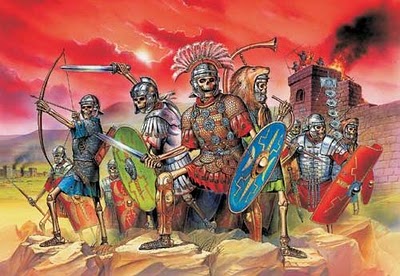
As you enter the crypt’s main chamber, the ghoul you followed stands in front of a makeshift altar. The thing turns to you, its raspy voice echoing the following command. “Kill them.” All around you, skeletons emerge from their coffins, ready to fight.
The scene above happened to all of us. An intelligent undead creature commanding a horde of mindless ones makes for a fun and typical encounter. Undead make great opponents, PCs generally don’t have to think too closely about what they do with them, and only rarely does their destruction cause consternation in the party.
Still, something gnawed at me regarding that encounter. How can a normal, basic ghast (or ghoul or wight) command skeletons/zombies that surround it? Why does the zombie obey the undead? Why would it not obey a living creature that does not control then through magic such as a necromancer would use spells like command undead or control undead ? As a computer engineer my natural instinct is to devise a finite state machine to determine the undead’s behavior. But I can see where that could confuse some people, and really… to account for everything… well that could be problematic.
How can I simplify the model to make it easy and universal? Let’s set some basis.
1. Intelligent undead should have some measure of power over the mindless ones.
2. A mindless undead’s natural instinct is to kill and destroy the living.
3. The changes must not impact the CR of the intelligent undead
4. The changes must not impact the CR of the mindless undead
5. The changes must not change existing spells or abilities (such as channel energy, the Command Undead feat, the command undead spell).
Putting a little thought into it, I would propose the following.
The necromantic energies found in all undead creatures are more powerful in intelligent undead. When a mindless undead comes into close proximity with one such creature, their necromantic energy align. This alignment makes the mindless undead extremely suggestible to the intelligent undead’s wishes.
This alignment only works on mindless undead who are not commanded or controlled through other means. Thus a skeleton commanded to attack an intelligent undead would do so without hesitation. A commanded mindless undead who orders could be open to interpretations or vague such as patrol the walls, could influenced by an intelligent undead. In the example, a zombie could be suggested by the intelligent undead to focus its patrol the west wall.
While not perfect, this mini-rule can explain and justify the scene above, without changing the creature, without changing any spells of magic usage. Thus accomplishing the 5 goals mentioned above.
JP


 Louis Porter mentions Secret Project X and shows you the outline mentioned in the
 Am I the only one who, comes Halloween finds himself staring at a blank page, or a page the fills up with material that is either bland, without relevance or just terrible? The time of year that should be most inspiring to a big horror and fear-fan like me. Yet, that is not the case. While I thoroughly enjoy the event and the celebration - I don’t consider it a holiday; I’m not druid or ancient celt-revivalist. I mean TV movies become interesting or at least worth looking over. Horror and scary things are all around us, the getting’s good.


 This Friday, Mario restarts a new Warhammer campaign. I still have not decided on a character concept I like. I thought of a few: an outlaw falsely accused of a crime, a hunter/poacher or a Kislevite bounty hunter. I’m still undecided and may just decide when I roll dice and the character starts to take shape or as we talk about what we want to do.